
Peptide Therapy Google Ads Management
Every day, people type “peptide therapy near me” into Google and click on whichever clinic shows up first. MedClicx builds and manages Google Ads campaigns that put your clinic in that spot, in front of patients who are already looking for exactly what you offer. We handle the strategy, the compliance headaches, and the day-to-day management, so your budget goes toward booked consultations instead of wasted clicks.
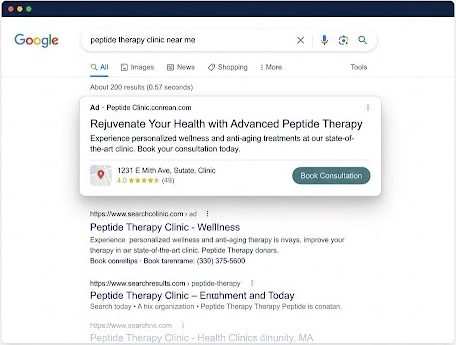





Peptide Therapy PPC Is Not Standard Medical Advertising
Most medical PPC agencies run the same playbook for every specialty. That doesn’t work for peptide therapy marketing. Google’s policies around health claims, hormone-related content, and injectable treatments are stricter here than they are for a general dermatology or dental practice, and campaigns built without accounting for this get flagged, disapproved, or throttled before they ever reach real patients.
There’s also the keyword problem. People search for peptide therapy under dozens of different names, from specific compounds like Sermorelin and BPC-157 to broader terms like “peptide injections” or “hormone optimization therapy.” A campaign that treats all of these the same way ends up spending money on searches that were never going to convert, while missing the ones that would have.
Talk to a Team That Puts Strategy First
A Look at How This Plays Out in Practice
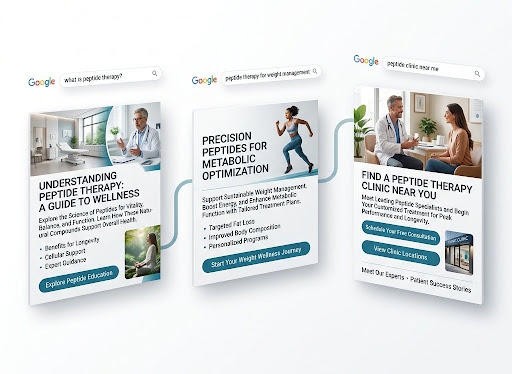
Say a patient in your area searches “peptide therapy for muscle recovery.” A well-structured campaign has an ad group built specifically around recovery-related terms, with ad copy addressing that use case directly, pointing to a landing page focused on recovery treatments rather than your full service list.
That patient sees an ad that speaks to exactly what they’re looking for, lands on a page that confirms they’re in the right place, and the path to booking is short. Compare that to an account running one broad “peptide therapy” campaign for every search term, where that same patient sees generic ad copy and lands on a homepage they have to dig through. The first version costs less per consultation and converts more often, even with the same budget.
Everything Included in Your Campaign
Account Structure and Keyword Mapping
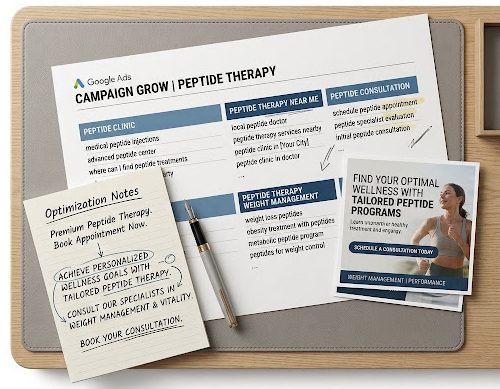
Before a single ad goes live, your account gets built around how people actually search, not a generic template. Branded searches, treatment-specific searches, and condition-based searches each get their own campaign structure, because someone searching your clinic’s name by brand is in a completely different stage than someone typing “peptide therapy for joint pain” for the first time.
Ad Copy Written to Survive Google's Review Process
Writing ads for peptide therapy means working around restrictions most clinics don’t know exist until an ad gets rejected. We avoid the specific claim language and terminology that trigger automatic disapprovals, while still writing copy that gives patients a real reason to click over a competitor. This includes testing multiple headline and description combinations so the ad that performs best keeps running while weaker versions get phased out.
Landing Pages That Match the Search
A patient who clicks an ad about peptide therapy for recovery and lands on a page listing every service your clinic offers usually leaves without booking. We either build dedicated landing pages for your top campaigns or work with your existing site to make sure the page someone lands on speaks directly to what they searched for. If your current site isn’t set up to support this kind of page structure, restructuring it around clear, treatment-specific pages is usually one of the highest impact changes a clinic can make to its ad performance.
Bid Management and Budget Allocation
Ads don’t run on autopilot. Bids get adjusted based on which keywords, locations, and times of day are actually producing consultations, not just clicks. Budget gets pulled away from underperforming ad groups and pushed toward the ones generating real patient inquiries, which is reviewed on an ongoing basis rather than set once and left alone.
Call Tracking and Lead Attribution
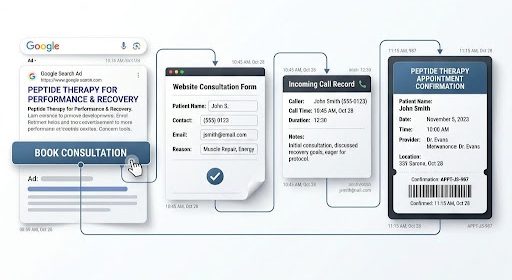
Every phone call and form submission gets tied back to the specific keyword and ad that generated it. Without this, there’s no real way to know whether your budget is working. With it, decisions about where to spend more or less are based on actual booked consultations instead of guesswork.
Local Services Ads Setup
Where your clinic qualifies, we also set up and manage Google Local Services Ads, which place your listing above standard search results with a verified badge and a direct call button. This runs alongside your main search campaigns and tends to work especially well for clinics still building up their brand recognition.

Where Your Ad Spend Actually Goes
Search campaigns for high-intent keywords.
Terms like “peptide therapy clinic,” “BPC-157 treatment,” or “peptide injections for recovery” go to people actively comparing providers. These get the largest share of budget because they convert the fastest.
Local targeting around your clinic.
Campaigns are built around your specific service area, so your budget isn’t spent showing ads to people three states away who will never book.
Remarketing for people who didn’t convert.
Most patients don’t book on their first visit to your site. Remarketing keeps your clinic visible to them across Google and YouTube until they’re ready.
Google Local Services Ads.
These place your clinic above standard search results with a verified badge, which builds instant credibility for patients who don’t recognize your name yet.
Key Metrics We Track:
Tracking That Tells You What's Actually Working
Effective Google Ads management depends on tracking the metrics that directly impact lead generation and return on investment. By monitoring campaign performance, we identify what’s working, eliminate wasted ad spend, and continuously optimize your ads for better results.
Key Metrics We Track:
- Cost per Click (CPC)
- Cost per Consultation
- Call Tracking
- Form Conversion Rate
- Quality Score
What Clinics Usually Ask Before Getting Started
Is peptide therapy harder to advertise on Google than other treatments?
In several ways, yes. Health claim restrictions and terminology around hormones and injectables mean ad copy has to be written carefully from the start, and accounts without this experience often run into repeated disapprovals.
What kind of budget is realistic to start with?
This depends on how competitive your local market is and which specific treatments you’re promoting. Actual keyword costs in your area are reviewed during the initial account audit, which is free.
How fast will I start getting calls or form submissions?
Clicks and initial inquiries can come in within the first week or two of launch. Cost per consultation typically improves over the following month as enough data builds up to guide bid adjustments.
Can this run alongside social media advertising?
Yes, and for peptide therapy specifically, running social content and paid campaigns alongside search ads often shortens the research phase, since patients arrive at your search ad already somewhat familiar with your clinic.
What if my account has already been suspended or has a history of disapprovals?
This happens more often in health-related advertising than clinic owners expect. Reviewing and rebuilding account structure is a normal part of getting a suspended or restricted account back to full performance.
Do you also handle the tracking, or just the ad management?
Conversion tracking, call tracking, and monthly reporting are all part of the service, so you always know what your ad spend is actually producing.
Your Competitors Are Already Bidding on These Keywords
Right now, someone searching for peptide therapy in your area is looking at a page of ads, and one of your competitors is probably on it. Every week that goes by without a properly structured campaign is a week of patient searches going to someone else’s clinic instead of yours. A free audit takes a look at what’s currently happening in your market, what it would cost to compete for the keywords that matter, and where the fastest wins are likely to come from.