A Complete Dermatology SEO Strategy For Sustainable Organic Growth
-
 James Walker
Table of Contents:
- What is Dermatology SEO?
- Why Do Dermatologists Need SEO?
- How Does Medical SEO for Dermatologists Help in New Patient Acquisition?
- What Does a Dermatology SEO Strategy Include?
- Dermatology SEO Best Practices
- Dermatology SEO Checklist
- Conclusion
- FAQs
Dermatology practices lose potential patients every day to competitors who simply show up first in search results.
A dermatologist can offer excellent care and still struggle to fill the schedule if the website is invisible to the people searching for treatment.
This guide breaks down what a dermatology SEO strategy actually includes, why it matters for patient acquisition, and how to build one that keeps generating appointment leads long after the initial work is done.
What is Dermatology SEO?
Dermatology SEO is a specialized branch of healthcare SEO focused on improving a dermatology practice’s visibility in organic search results, so patients searching for skin treatments, conditions, or dermatologists nearby can find the practice without relying on paid ads.
It covers keyword research, on-page SEO, local search optimization, technical SEO, content creation, and link building, all built around how dermatology patients actually search.
Dermatology SEO has to account for two things most industries do not deal with. First, medical searches fall under YMYL (Your Money or Your Life), which means Google holds healthcare content to a stricter accuracy and trust standard than most topics.
Second, dermatology covers both medical conditions (acne, eczema, skin cancer) and elective cosmetic services (Botox, fillers, laser treatments), so the keyword strategy has to serve two very different types of patients and search intent at the same time.
Why Do Dermatologists Need SEO?
Most dermatology patients start their search on Google, not through a referral. Someone notices a mole, a breakout that will not clear up, or simply wants to look into Botox, and the first move is almost always a search rather than a phone call to a friend.
SEO matters because it captures that existing demand. Patients are already searching for the exact services dermatology practices offer.
Search visibility for those queries determines whether your clinic gets the appointment or a competitor does.
Dermatology marketing services that include organic search alongside paid channels consistently outperform practices that rely on advertising alone, because organic rankings keep bringing in traffic and patient acquisition long after a PPC campaign has spent its budget.
Benefits of SEO for Dermatologists
SEO delivers a mix of short-term and long-term benefits for a dermatology practice. Here is what a properly executed strategy provides:
- Lower long-term patient acquisition cost.
- Compounding organic traffic.
- Stronger trust and credibility.
- Higher-intent traffic.
- Coverage across cosmetic and medical services.
- Support for multi-location growth.
- Better lead quality and conversion.
- Stronger online reputation.
- Readiness for AI-driven search.
How Does Medical SEO for Dermatologists Help in New Patient Acquisition?
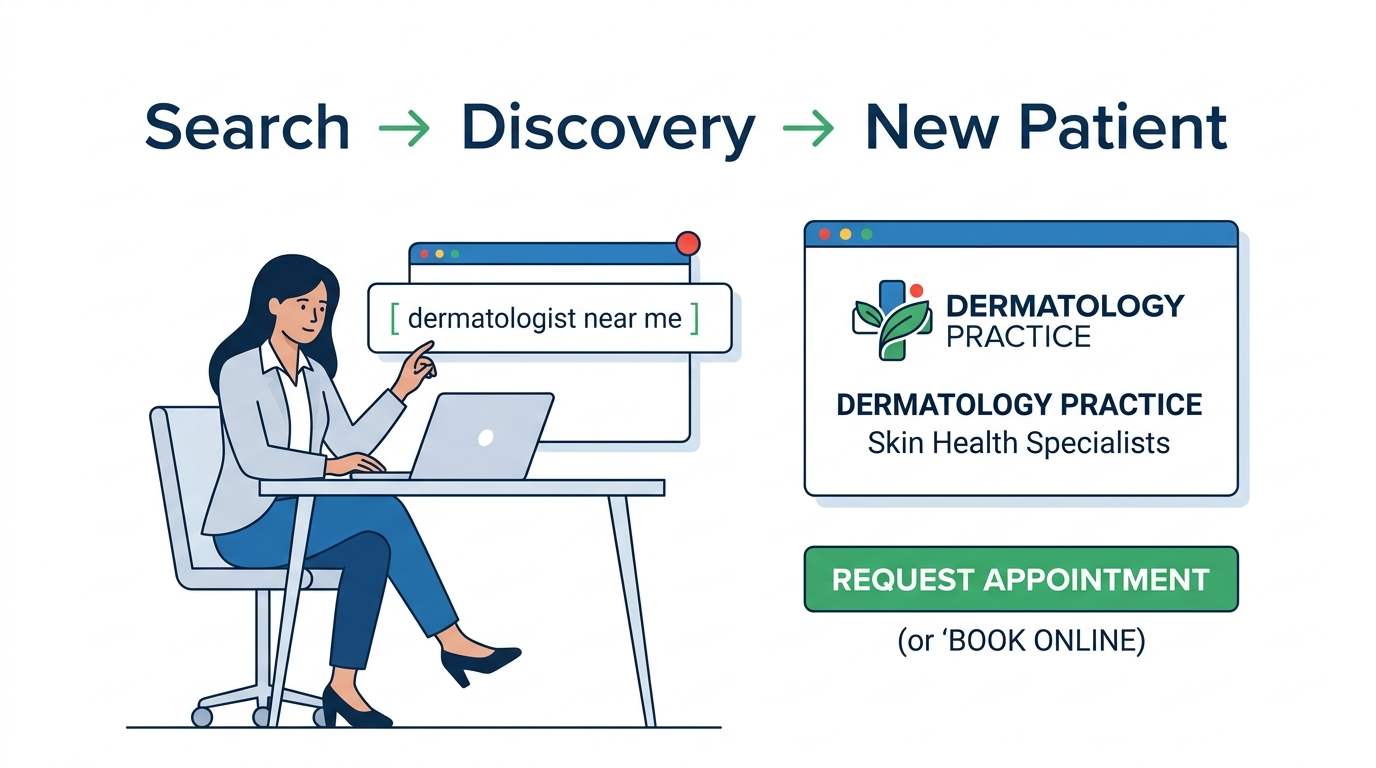
Medical SEO for dermatologists helps new patient acquisition by putting your practice in front of people at the exact moment they are deciding where to get treatment, then guiding them through a website built to convert that interest into a booked appointment.
The process works in stages:
| Patient Stage | What the Patient Is Doing | What SEO Does |
| Awareness | Searching a symptom or condition (“why is my skin breaking out”) | Ranks informational content that answers the question and introduces your practice |
| Consideration | Comparing providers and treatments (“best dermatologist for acne near me”) | Ranks service and location pages, showcases provider credentials and reviews |
| Decision | Ready to book (“dermatologist near me accepting new patients”) | Ranks Google Business Profile and service pages with clear scheduling links and calls to action |
What Does a Dermatology SEO Strategy Include?
1. Dermatology Keyword Research
Keyword research is where every dermatology keyword strategy starts, and it means mapping out every condition, treatment, and search phrase patients actually use, not just the obvious ones like “dermatologist near me.”
This includes long-tail keywords such as “how to treat cystic acne at home” or “recovery time after Mohs surgery,” which carry less volume individually but add up to significant traffic when covered well.
Target a mix of three categories: condition-based terms (acne treatment SEO, eczema, psoriasis), procedure-based terms (Botox SEO, microneedling SEO, skin cancer screening SEO), and location-based terms that combine a service with a city or neighborhood.
Search intent matters more than search volume. A keyword with lower volume but clear booking intent, like “Mohs surgery dermatologist [city],” is often more valuable than a high-volume informational term that rarely leads to an appointment.
2. Local SEO for Dermatology Practices
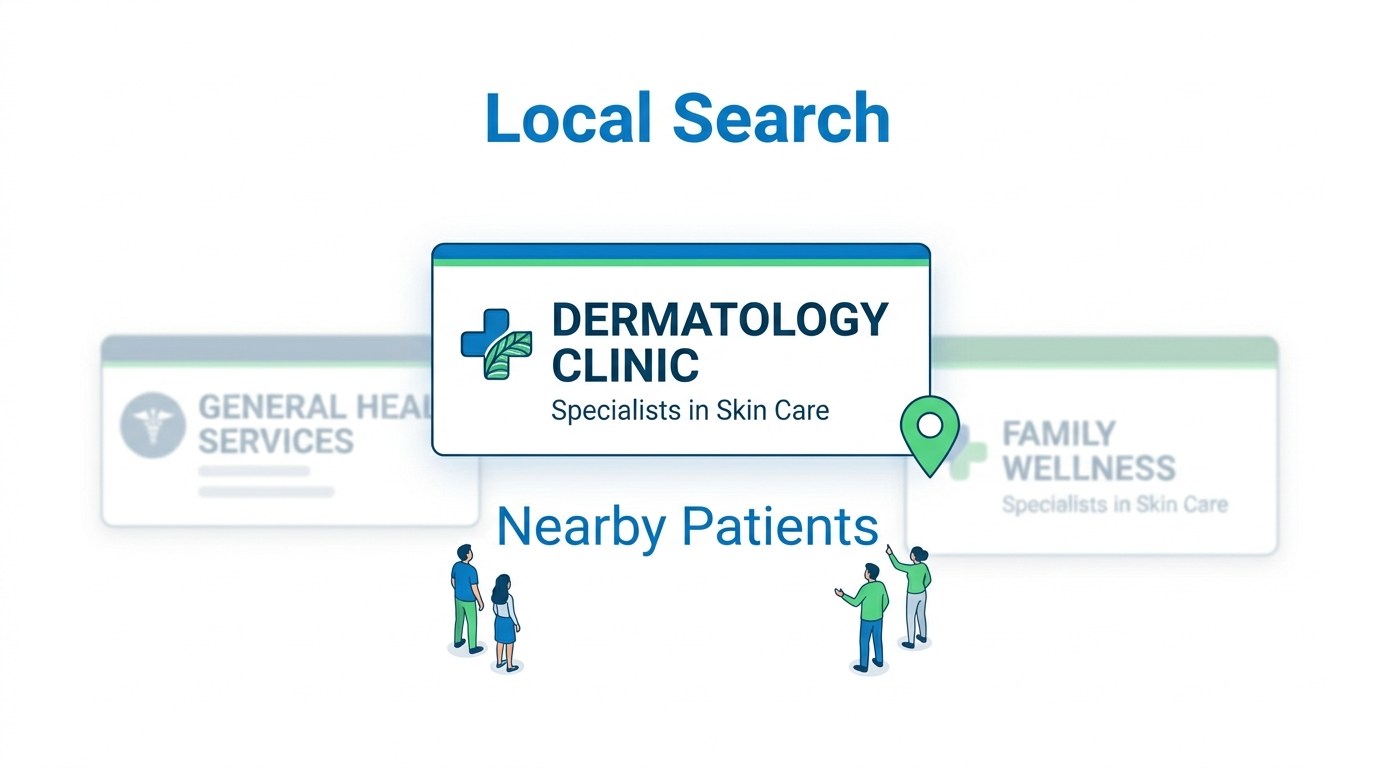
Local SEO for dermatology practices determines whether your clinic shows up in the map pack when someone searches for care nearby, which is where most dermatology-related local searches end up converting.
This includes Google Maps SEO, local map pack SEO, and building consistent local SEO signals across the web.
NAP consistency (your practice’s name, address, and phone number matching exactly across your website, directory listings, and Google Business Profile) is a foundational trust signal for local rankings.
Inconsistent listings across directory listings confuse both search engines and patients trying to find the right location.
For a deeper breakdown of local ranking factors across the healthcare space, see our full guide to local SEO for healthcare practices.
3. Dermatology Website Optimization
Website optimization for a dermatology practice covers everything patients interact with directly. Medical website optimization is not just about looking clean. It has to reduce friction between a patient landing on your site and taking action.
Provider bio pages deserve more attention than most practices give them. Patients want to know who is treating them before they book, so provider profiles with clear photos, credentials, and specialties directly influence conversion rate optimization.
Scheduling links and calls to action like “schedule a consultation” should appear above the fold and repeat throughout the page, not just get buried in the footer.
A well-optimized dermatology website design also supports SEO indirectly. Search engines track engagement signals like time on page and bounce rate, and a site that’s confusing to navigate loses both patients and rankings.
4. Technical SEO for Dermatology Websites
Technical SEO for healthcare websites makes sure search engines can actually crawl, index, and understand your site correctly.
This is foundational work that most patients never see, but it determines whether the rest of your SEO strategy has a chance to work.
Key elements include a logical site architecture for clinics (organized by service, condition, and location), clean meta titles for dermatology pages that are unique on every page, and proper H1/H2 structure for medical websites so search engines understand the hierarchy of information on each page.
Broken links, duplicate content, and slow-loading scripts all undermine technical performance even when the on-page content itself is strong.
5. Dermatology Service Page SEO
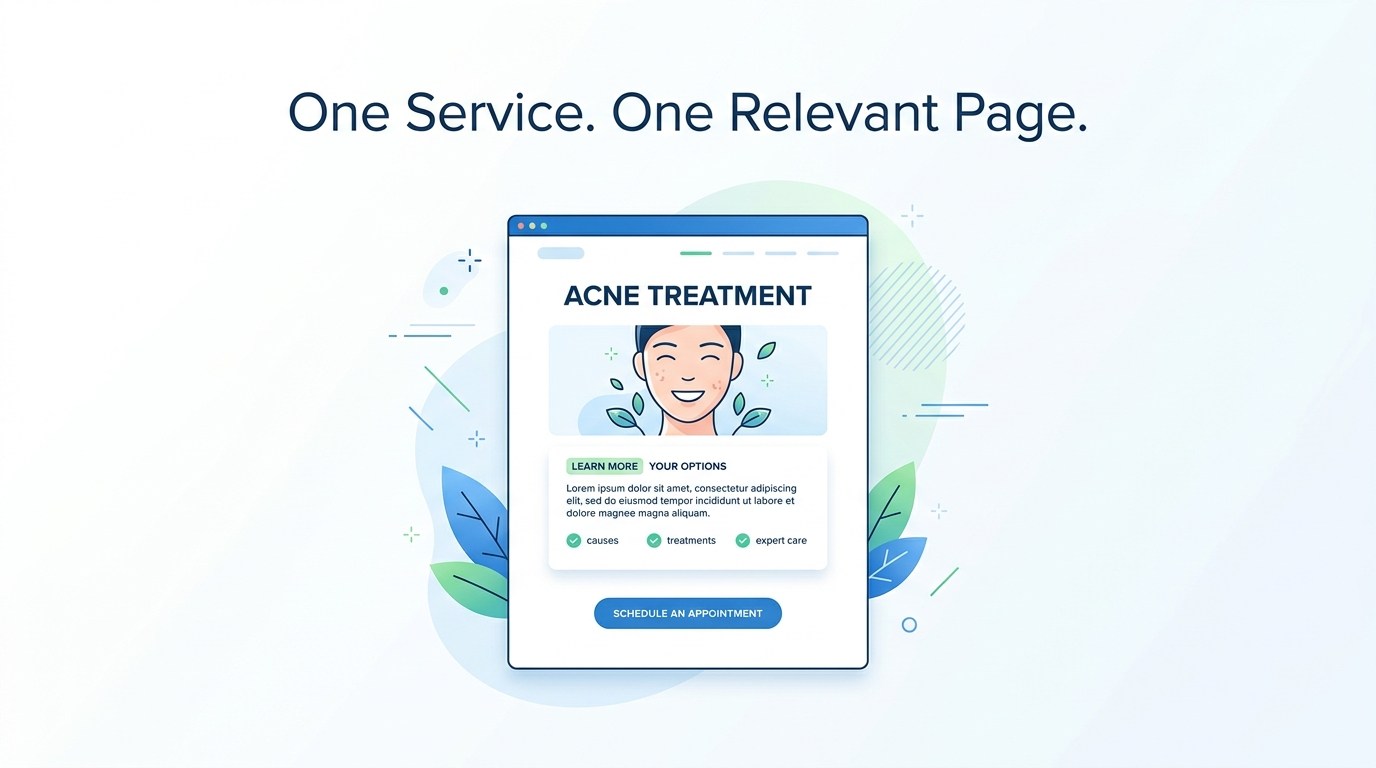
Service pages are where most dermatology SEO traffic should convert, so treatment page SEO and condition page SEO deserve dedicated attention rather than being treated as an afterthought to the homepage.
Dermatology landing page optimization means each treatment page should include clear procedure information.
Each of the service pages serves a different patient intent, and treating them as separate, fully optimized pages instead of one generic “services” page is one of the highest-impact changes a practice can make.
6. Content Strategy for Dermatologists
Medical content SEO has to balance two things: being genuinely useful and being accurate. Content optimization means every piece should answer a real patient question directly, supported by patient-focused content that reflects how people actually search rather than industry terminology.
Dermatologists often need a blog for SEO. A blog is the easiest way to build content clusters and topical authority around conditions and treatments that don’t fit naturally into a service page.
Dermatology blog SEO works best when paired with real patient testimonials and patient stories, used with proper consent, since firsthand experience adds a layer of trustworthy medical content that generic advice articles cannot match.
7. Google Business Profile Optimization
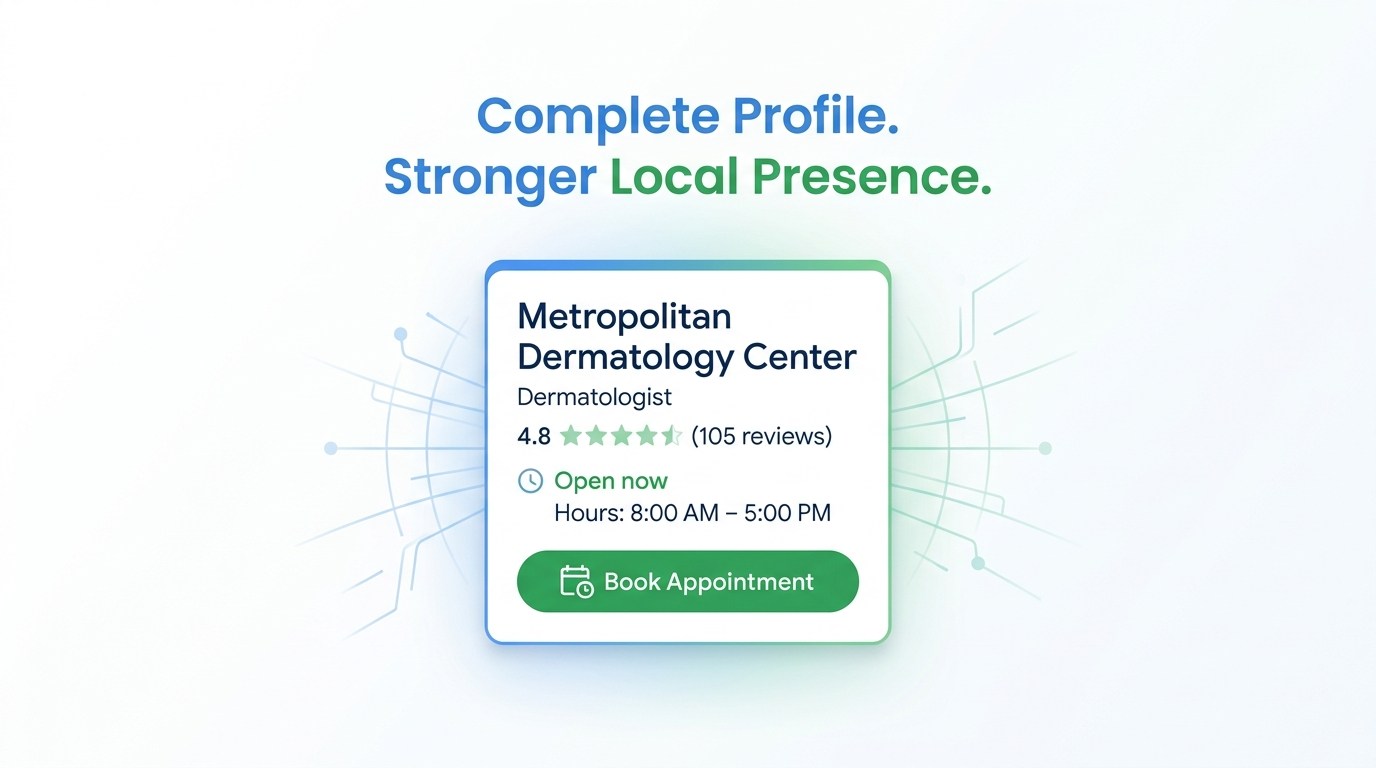
Your Google Business Profile is often the first thing a patient sees before they ever click through to your website.
A complete, active profile directly affects whether you show up in the local map pack.
Google Business Profile optimization includes accurate GBP services listed for every treatment you offer, regularly updated GBP photos showing your office and team, and consistent GBP posts announcing new services, promotions, or educational content. Profiles that sit untouched for months tend to lose visibility to competitors who post regularly.
Patient reviews SEO plays a direct role here too. Google reviews for dermatology practices influence both rankings and patient trust, and responding to reviews, positive or negative, signals that your practice is active and engaged.
A steady stream of new reviews, paired with prompt responses, does more for local visibility than almost any other single action.
8. Medical SEO and E-E-A-T
E-E-A-T stands for Experience, Expertise, Authoritativeness, and Trustworthiness, and it’s Google’s framework for evaluating YMYL SEO content, the category that all medical and dermatology content falls under. Google holds healthcare sites to a stricter trust standard than most other industries.
Building E-E-A-T for a dermatology practice means making provider credentials visible, not buried. Board certifications, professional headshots, and clearly listed specialties on every provider bio page all reinforce trust signals for medical websites.
Content should be written or reviewed by qualified providers, with author information clearly attached to blog posts and treatment pages.
9. Schema Markup for Dermatology Practices
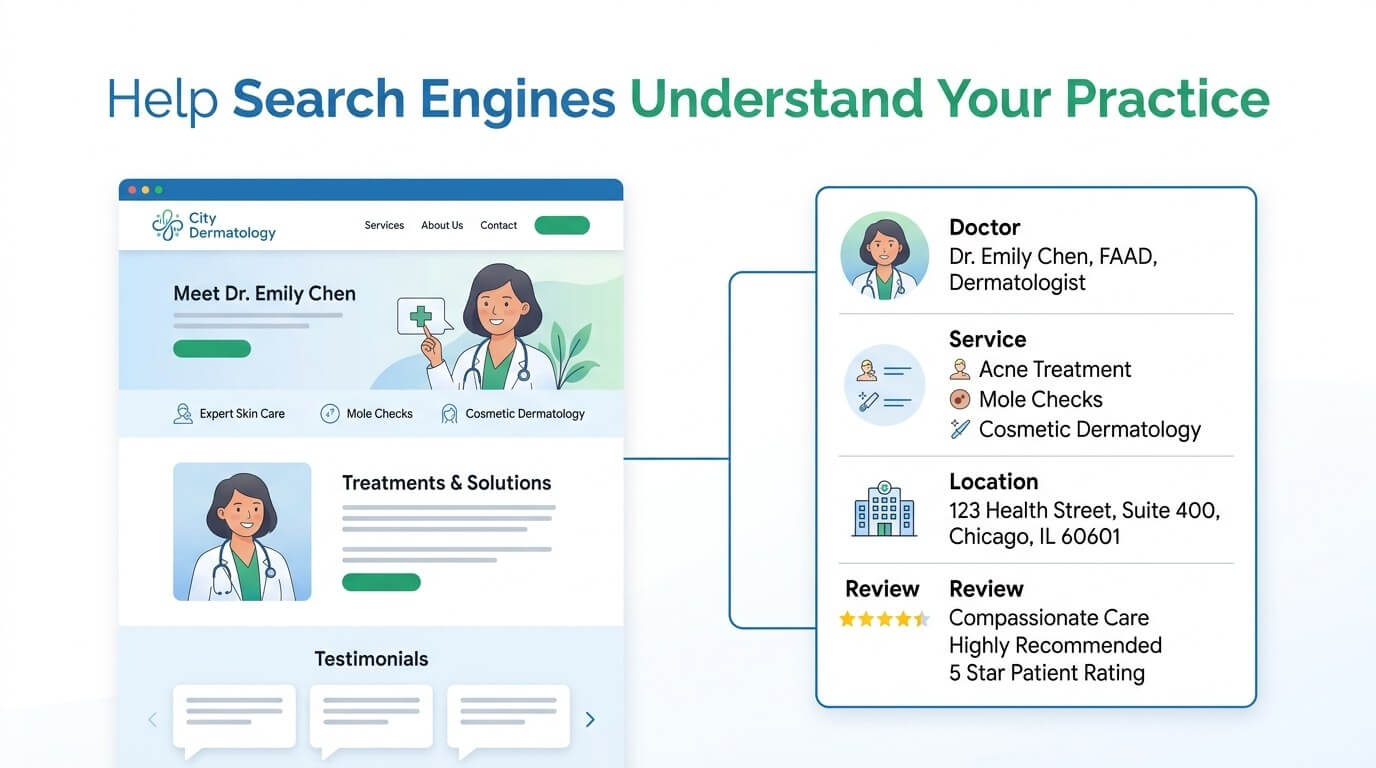
Schema markup for medical practices is structured data added to your website’s code that helps search engines understand exactly what your content represents instead of guessing.
Medical schema markup for a dermatology practice typically includes MedicalClinic and Physician schema for your provider pages, LocalBusiness schema for location and contact information, and FAQ schema for question-and-answer content.
Schema markup for services, locations, and reviews helps your review stars, service listings, and location details show up directly in search results rather than requiring a click to find them.
10. Mobile and Page Speed Optimization
Mobile optimization covers responsive design, tap-friendly buttons, readable text without zooming, and forms that are easy to fill out on a small screen.
Core Web Vitals for medical websites, which are Google’s specific metrics for loading speed, interactivity, and visual stability, directly factor into rankings, so a slow or unstable page can quietly cost a practice traffic it should otherwise be getting.
Website speed for dermatology practices matters even more on pages with before-and-after galleries or video content, since large, unoptimized media files are one of the most common causes of slow page load times.
Compressing images, lazy-loading galleries, and minimizing unnecessary scripts all contribute to a faster, more stable experience that keeps patients on the page instead of bouncing back to search results.
11. Internal Linking and Site Structure
Good internal linking reinforces the content clusters and topical authority discussed earlier, since links between related pages signal to search engines which pages belong together and which page is the primary target for a given topic.
Site structure should generally flow from broad category pages down to specific treatment and condition pages, with blog content linking upward into that structure wherever relevant.
12. Link Building and Digital PR
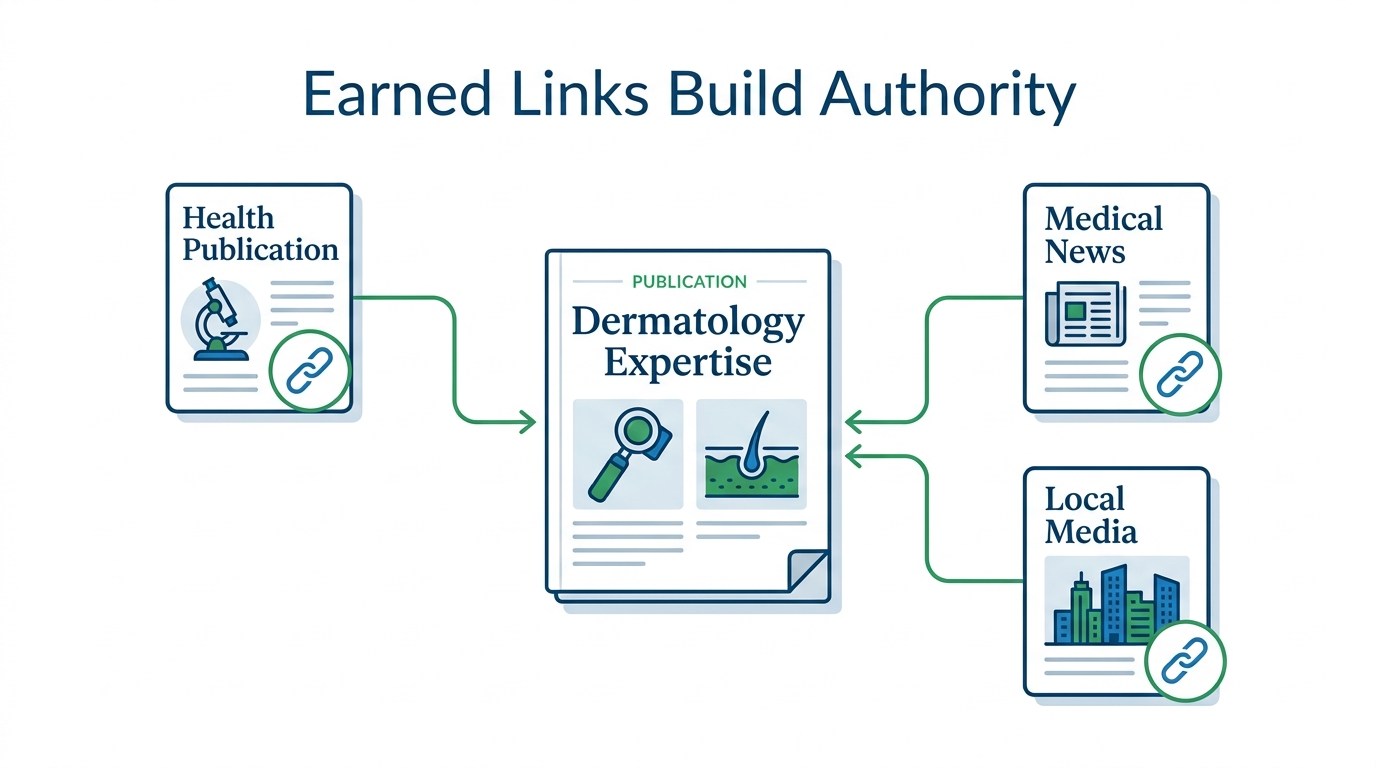
Link building remains one of the strongest ranking factors in any SEO strategy, dermatology included.
Healthcare backlinks from reputable, relevant sources signal to search engines that other trusted sites vouch for your practice’s authority.
Quality matters far more than quantity here. A handful of backlinks from relevant, authoritative medical or local sources does more for rankings than dozens of low-quality directory links.
Link building also overlaps with reputation management. Being featured or reviewed by a respected local publication builds both a backlink and public trust at the same time, which is difficult to replicate through any other single tactic.
13. SEO for AI Overviews and Search
A growing share of patients now get answers directly from AI Overviews, ChatGPT, and other AI-powered tools before they ever click a traditional search result, which makes AI search optimization a core part of any current dermatology SEO strategy rather than an optional add-on.
Answer engine optimization (AEO) focuses on structuring content so AI tools can pull it directly into their answers and, ideally, cite your practice as the source.
This means writing in a clear, direct question-and-answer format, using proper schema markup, and making sure factual claims are easy for AI systems to extract and verify.
AI search visibility and general AI visibility depend heavily on the same E-E-A-T signals that matter for traditional rankings.
Practices that show up in chatbot search visibility results tend to already have strong organic rankings, well-structured content, and solid schema markup in place.
Dermatology SEO Best Practices
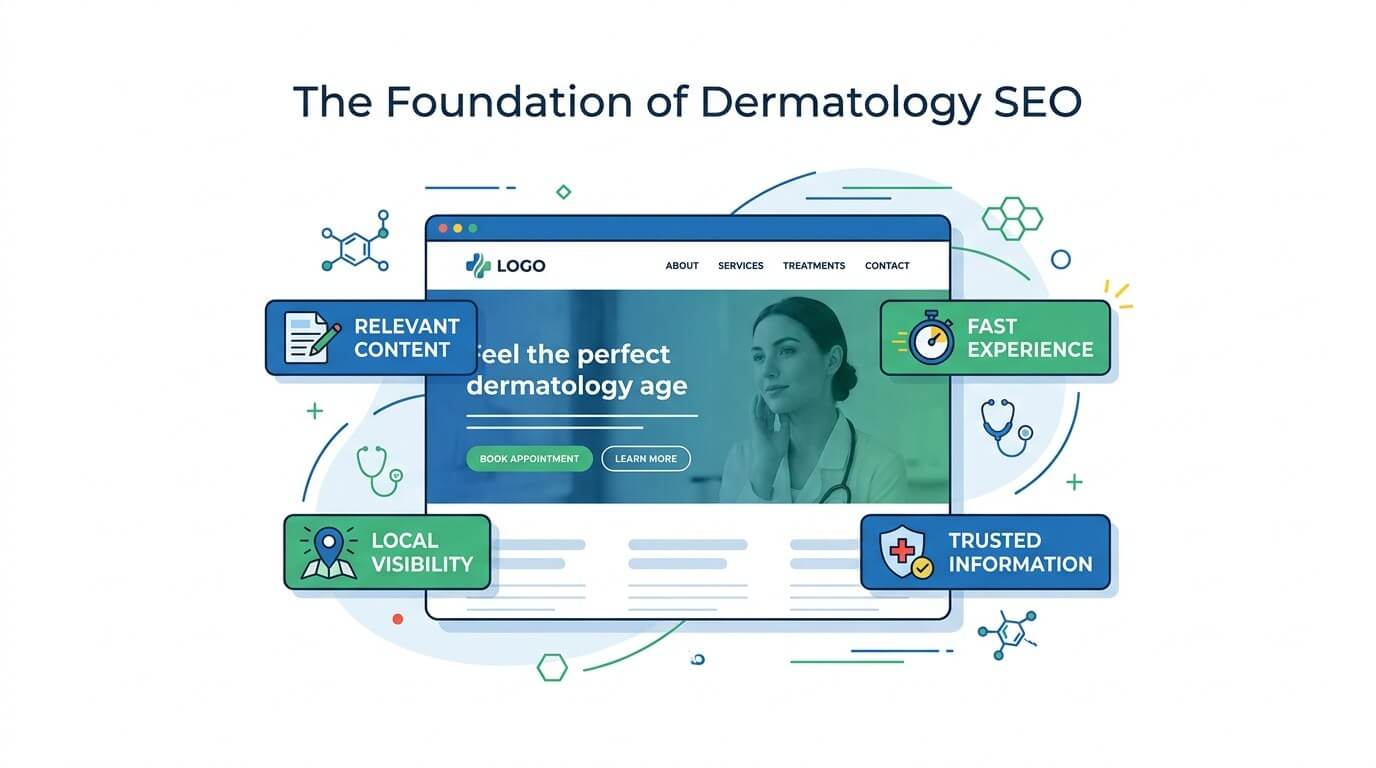
These best practices cover how to execute them well and keep them working over time.
- Track SEO analytics beyond rankings. SEO reporting should include organic traffic, appointment leads, call volume, form submission volume, and conversion rate, not just keyword positions. Rankings that don’t turn into patients aren’t delivering real SEO ROI.
- Update service and location pages regularly. Search engines favor content that stays current. Refresh treatment pages with updated information, new before-and-after photos, and current pricing guidance where relevant.
- Post to Google Business Profile weekly. Consistent GBP posts and photo updates keep your profile active and improve local map pack visibility.
- Respond to every review. Patient reviews and how you respond to them affect both reputation management and local rankings.
- Keep NAP consistent everywhere. Audit directory listings periodically to catch outdated addresses or phone numbers before they cost you rankings and patient trust.
- Prioritize page speed on media-heavy pages. Before-and-after galleries and video content should be compressed and optimized so they don’t quietly tank your Core Web Vitals.
- Build content around real patient questions. The best-performing dermatology content answers a specific question directly instead of covering a broad topic vaguely.
- Diversify keyword targeting. Balance cosmetic dermatology SEO and medical dermatology SEO so the practice isn’t overly dependent on one type of patient demand.
- Monitor cost per lead against paid channels. Comparing cost per patient acquisition across SEO and PPC helps justify ongoing investment and shows where the budget is working hardest.
- Treat schema and technical SEO as maintenance, not a one-time task. Structured data and site health should be checked regularly, especially after any website redesign or platform change.
Dermatology SEO Checklist
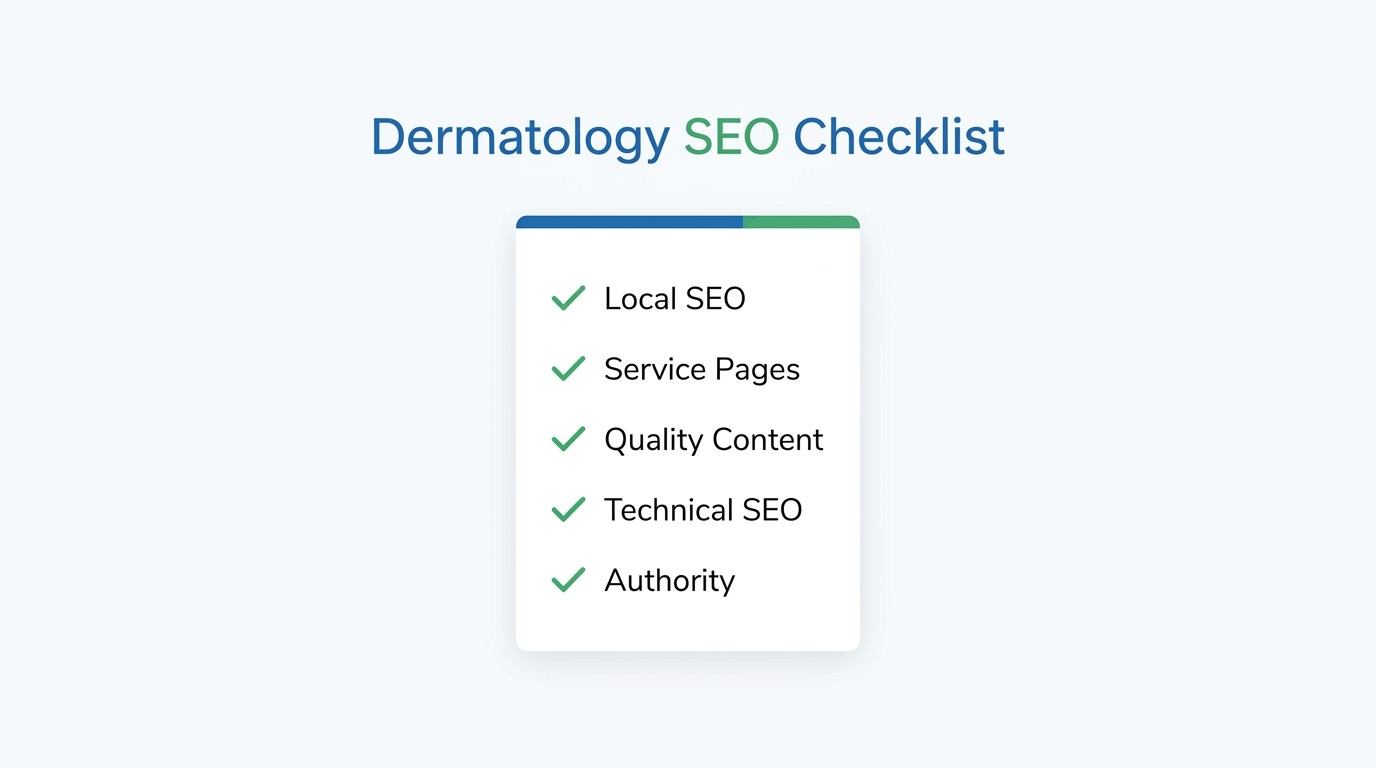
Use this checklist to audit where your current dermatology SEO strategy stands.
Keyword and content
- Condition, treatment, and location-based keyword research completed
- Content organized into topic clusters with clear topical authority
- Dedicated treatment and condition pages for core services
- Blog content targeting long-tail keywords and FAQ content
- Patient testimonials and stories included where appropriate
Local SEO
- Google Business Profile fully completed and verified
- NAP consistency confirmed across website and directory listings
- Location-specific landing pages for multi-location practices
- Consistent GBP posts and photo updates
- Active review generation and response process
Technical and on-page
- Unique meta titles and descriptions on every page
- Proper H1/H2 structure throughout the site
- Mobile-friendly, responsive design confirmed
- Core Web Vitals and page load times within a healthy range
- Clean site architecture with logical internal linking
Trust and compliance
- Provider bio pages with credentials, board certifications, and headshots
- HIPAA-compliant forms, tracking, and before-and-after photo consent
- Author and reviewer information attached to medical content
- Schema markup implemented for practice, providers, services, and reviews
Off-page and AI search
- Ongoing link building from relevant, authoritative sources
- Content structured for answer engine optimization
- SEO analytics and reporting reviewed monthly against lead and conversion data
Conclusion
A dermatology practice that isn’t visible in search is invisible to the patients actively looking for care.
Every piece of this strategy, from keyword research to AI search optimization, exists for one reason: turning search visibility into booked appointments.
MedClicx is a dermatology SEO agency built around that exact outcome. Our dermatology SEO services cover keyword research, local SEO, technical fixes, content, and AI search optimization, handled by a team that works exclusively in healthcare and already understands patient search behavior and compliance requirements.
Talk to a dermatology SEO consultant at MedClicx and find out exactly where your current strategy stands and what it would take to close the gap.
FAQs About Dermatology SEO
Is SEO worth it for dermatologists?
What is the difference between SEO and PPC for dermatologists?
How much does SEO cost for a dermatology practice?
How do I optimize my Google Business Profile as a dermatologist?
How long does dermatology SEO take for patient lead generation?
Let’s increase appointment bookings
At MedClicx, we help medical practices connect with more patients.


Senior Digital Marketing Strategist &
Healthcare SEO Consultant
James Walker is a Senior Digital Marketing Strategist and Healthcare SEO Consultant at MedClicx. He specializes in helping healthcare organizations and service-based businesses grow their online presence through SEO, content marketing, local SEO, AI search optimization, (GEO), technical SEO, website optimization, and digital marketing strategies.
Over the years, James has worked on improving organic visibility, lead generation, and brand authority by combining search engine optimization, website performance, content strategy, conversion optimization, and AI-ready content. His expertise also includes Google Business Profile optimization, schema markup, user experience (UX), analytics, and modern digital marketing best practices.
At MedClicx, James writes educational articles covering SEO, content marketing, digital marketing, AI search optimization, social media marketing, web design, advertising strategies, podcasts, and online business growth. His goal is to simplify complex marketing concepts and help businesses make data-driven decisions that generate sustainable long-term results.
- James Walker

- James Walker

- James Walker
- James Walker