Orthopedic Marketing Ideas to Attract More Patients and Grow Your Practice
-
 James Walker
Table of Contents:
- What Is Orthopedic Practice Marketing (and How It’s Changed)
- How Patients Find and Choose an Orthopedic Practice
- The Orthopedic Practice Marketing Funnel
- The Most Effective Orthopedic Marketing Ideas
- HIPAA-Compliant Marketing: What You Can and Can’t Do
- How to Measure Orthopedic Marketing ROI
- Common Orthopedic Digital Marketing Mistakes to Avoid
- How Much Does Orthopedic Marketing Cost?
- Which Orthopedic Digital Marketing Channel Should You Start With If Budget Is Limited?
- MedClicx Final Take on Orthopedic Digital Marketing
- FAQs About Orthopedic Marketing and Orthopedic Advertising
Orthopedic marketing has changed more in the last five years than it did in the previous twenty. Practices that once filled their schedules almost entirely through physician referrals are now competing for patients who start on Google, compare two or three surgeons side by side, read a stack of reviews, and increasingly ask an AI assistant to explain a treatment before they ever pick up the phone.
This guide covers what orthopedic practice marketing actually means today, how patients move from first symptom to booked appointment, and which ideas orthopedic practices, surgery centers, and multi-location groups are using to grow surgical volume in 2026.
What Is Orthopedic Practice Marketing (and How It’s Changed)
Orthopedic marketing is the set of strategies a practice uses to reach, educate, and convert patients who need musculoskeletal care. It includes:
- Orthopedic SEO
- Paid orthopedic advertising
- Orthopedic content posting
- Local search optimization
- Reputation management
- Scheduling and follow-up systems that turn an inquiry into a booked appointment.
What makes it different from general healthcare marketing is the range of patients involved. A 68 year old weighing a total hip replacement, a 24 year old athlete with a torn ACL, and a warehouse worker with a herniated disc are all “orthopedic patients,” but they search differently, decide on different timelines, and respond to completely different messaging.
Referrals from primary care physicians and word of mouth carried the bulk of new patient volume, and many practices still lean heavily on referral-based patients today.
That has shifted hard toward direct-to-patient marketing, and it’s a big part of why practices now hire a dedicated orthopedic practice marketing agency instead of handling orthopedic surgeon marketing and seo internally with whatever time is left over.
Research puts the number of patients who use a search engine before booking any kind of appointment at 77 percent, and roughly 60 percent of all healthcare-related searches now happen on a phone rather than a desktop.
How Patients Find and Choose an Orthopedic Practice
Not every orthopedic search means the same thing, and treating them all the same is one of the most common reasons orthopedic marketing underperforms. Patients move through roughly five distinct search intents, often within the same week.
| Search Stage | Example Query | What the Patient Needs | Content That Should Answer It |
| Symptom-based | “why does my knee hurt going downstairs” | Reassurance and direction | Symptom-focused blog content, “when to see a doctor” guides |
| Condition-based | “hip arthritis” or “rotator cuff tear” | Understanding of their likely diagnosis | Dedicated condition pages |
| Procedure-based | “total hip replacement” | Details on the treatment itself | Treatment-specific pages with outcomes, recovery, and risks |
| Surgeon and local | “orthopedic surgeon near me” | A specific provider they can trust | Physician profile pages, Google Business Profile |
| Referral validation | Googling a surgeon’s name after a PCP referral | Proof the surgeon is credible | Reviews, detailed bio, consistent listings |
The Orthopedic Practice Marketing Funnel
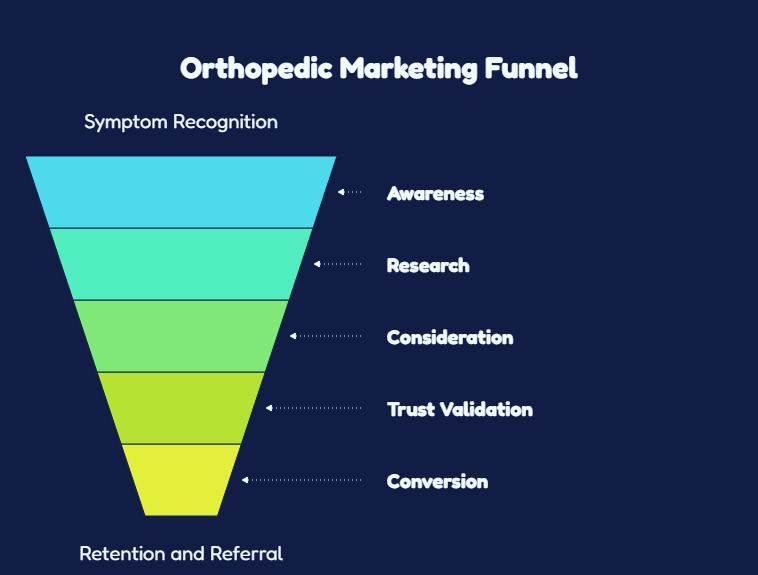
The image shows an orthopedic practicemarketing funnel that should sit behind every campaign decision. Once you separate search intent by stage, the next step is mapping what happens after the search, from first contact through to a returning, referring patient.
Most orthopedic practices market heavily at the top of this funnel and barely touch the bottom. A practice that fixes scheduling, call answering, and review response first will often see a bigger jump in booked appointments than one that just increases ad spend.
The Most Effective Orthopedic Marketing Ideas
Orthopedic Website SEO
SEO for orthopedic surgeons leads almost every effective orthopedic marketing strategy, because it’s the channel that keeps producing organic traffic long after you stop actively working on a page.
A sound orthopedic SEO strategy, whether built in-house or through outside orthopedic SEO services, comes down to three content buckets working together:
- Treatment and conditions pages. Individual, keyword-focused pages for each surgery, condition, and non-surgical treatment, including dedicated surgery pages for major procedures, not one generic “services” page trying to rank for everything.
- Location pages. A dedicated, optimized page for each practice location, built for local search rankings rather than one “locations” page listing addresses.
- Physician profile pages. A real page per surgeon covering training, subspecialty, and outcomes, not a two-line bio buried in a directory.
A practice offering hip care, for example, benefits from separate pages for hip arthritis, anterior hip replacement, total hip replacement, hip pain, and hip preservation rather than one page trying to cover all five. Done well, orthopedic SEO compounds over time in a way paid channels simply don’t.
Google Ads and Paid Search for Orthopedic Practices
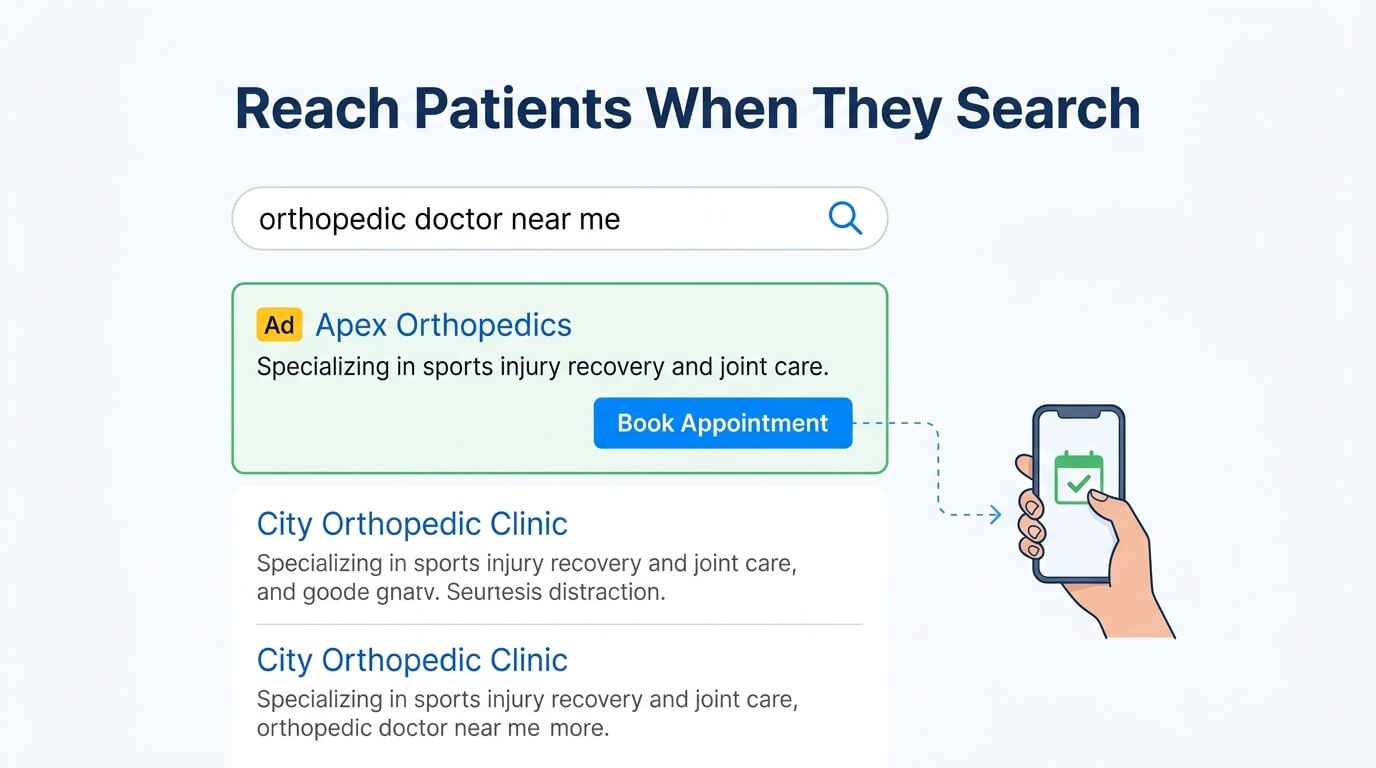
If SEO for orthopedic surgeons is the long-term layer, Google Ads is the channel for immediate demand. The advantage is appointment readiness. Someone searching “knee pain specialist near me” or “herniated disc treatment near me” is actively trying to solve a problem that’s affecting their daily life right now.
A well-structured account separates campaigns by intent level rather than lumping everything under “orthopedics”:
| Campaign Type | Intent Level | Example Keyword |
| Procedure campaigns | Very high | total knee replacement, anterior hip replacement |
| Condition campaigns | High | herniated disc treatment, rotator cuff tear |
| Urgent care and walk-in | High, time-sensitive | orthopedic urgent care near me |
| Sports medicine | Medium to high | sports medicine specialist |
| Brand and physician name | Very high (validation) | [surgeon name] orthopedic surgeon |
Landing pages matter as much as the ads themselves. A patient who clicks a total hip replacement ad and lands on a generic homepage will usually bounce.
Pairing every orthopedic Google Ads campaign with a landing page built for that exact procedure, complete with a clear call to action and minimal distractions, is what actually drives the low-cost, high-volume appointment results practices are chasing.
Google Business Profile and Local SEO
For a multi-location practice, local SEO for orthopedic practices deserves the same structured thinking a franchise brand would apply.
Individual location pages, built with real location page optimization and paired with fully optimized Google Business Profiles for each address, are what win “near me” searches and local Google searches around each of your practice locations.
This location-based marketing approach is sometimes called a franchise SEO model, and it matters because Google generally will not rank one generic location page for a dozen different local search results across different geographical locations.
Reputation is a core part of ongoing Google Business Profile optimization. A profile with strong, recent reviews and consistent posting tends to outrank a thinner, less active competitor profile even when the underlying website content is similar. If your practice hasn’t audited local SEO recently, this is usually where the fastest wins are sitting.
Patient Reviews and Reputation Management
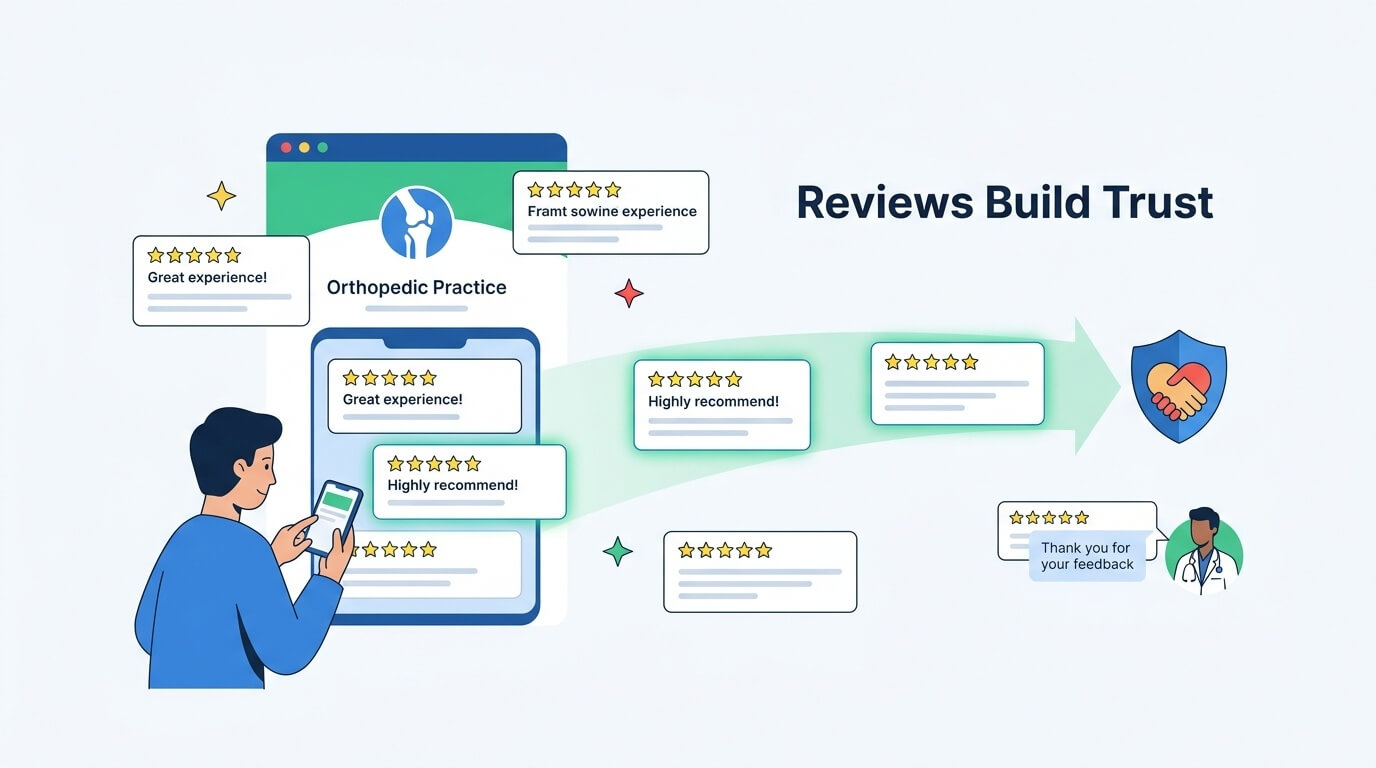
A real reputation management program has a few concrete parts.
- Automated review requests. Triggered by text or email shortly after a visit, ideally tied into your scheduling or EHR system so it happens without staff remembering to ask.
- Multi-platform monitoring. Reviews land on Google, Healthgrades, Vitals, WebMD, and Zocdoc, not just your Google Business Profile. Monitoring all of them matters because patients check more than one.
- A response standard. Every review, positive or negative, gets a response within 24 to 48 hours. Negative review responses should stay professional, never confirm or deny a patient relationship (this is a HIPAA issue, covered later), and offer to take the conversation offline.
- No review gating. Filtering patients so only happy ones get asked to leave a public review violates Google’s policies and can get a profile penalized. Ask everyone, and let the system average out.
Data from ReviewTrackers and Womply has also found that clinics rated 4.5 stars or higher tend to receive roughly three times more inquiries than lower-rated competitors.
Building reputation management for doctors into the marketing plan from day one, rather than bolting it on later, is one of the higher-leverage moves available to most practices.
Content Marketing for Orthopedic Practices
Content marketing is what feeds the top and middle of the funnel described earlier. The goal is to answer the real questions patients are typing into Google (and increasingly, into ChatGPT and other AI chatbots).
Effective orthopedic content marketing usually includes:
- Symptom and condition explainers written for a general reader, not other clinicians
- FAQ-style content structured to be easily extracted by search engines and AI tools
- Recovery timelines and what-to-expect content for major procedures
- Seasonal and injury-specific content (school sports season, winter falls, gardening injuries in spring)
Content marketing also feeds patient retention strategies, not just new patient acquisition. Orthopedic email marketing sent after a procedure, recovery tips, follow-up reminders, and physical therapy check-ins keeps a practice visible during the months a patient isn’t actively searching.
Social Media Marketing for Orthopedic Surgeons
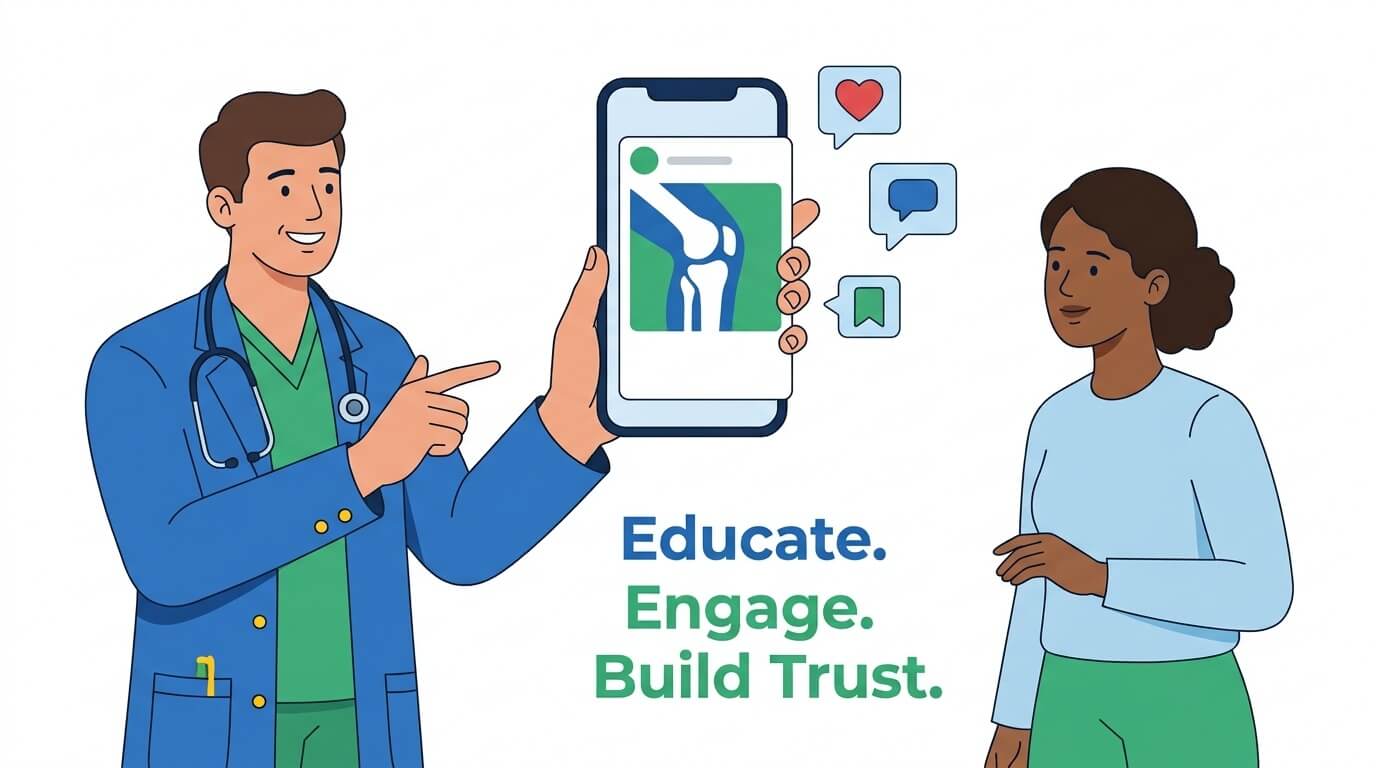
Social media works differently depending on the platform, and treating all channels the same is a common waste of budget.
Instagram and Facebook build practice-level familiarity and community trust.
YouTube supports longer educational content and doubles as a search engine in its own right, since it’s owned by Google and ranks in general search results.
LinkedIn matters more for referring physician relationships and, for private equity-backed or MSO groups, for institutional credibility with investors and partners.
Video marketing for orthopedic surgeons should be the priority format across all of them, and uploading with proper titles, descriptions, and captions supports YouTube SEO on top of the social reach itself.
Getting surgeons comfortable on camera, even briefly, does more for orthopedic social media marketing and broader healthcare social media efforts than any amount of stock photography.
Build Backlinks and Orthopedic Authority
Backlink building is simply earning links from other reputable sites pointing to yours, and it remains one of the stronger Google ranking factors.
But don’t chase backlinks before the content is actually worth linking to. Also, prioritize quality over quantity.
Keeping physician listing management consistent across directories reinforces both the backlinks and the entity signals.
NAP citations on local business directories and reputable listing platforms help build trust and gain website authority while providing users with key information about your brand along with helpful reviews.
Surgeon and Entity Authority (E-E-A-T)
Google and AI systems both lean on a concept generally known as E-E-A-T, shorthand for experience, expertise, authoritativeness, and trustworthiness.
For an orthopedic practice, building this out means treating each surgeon as a distinct, verifiable entity across the web.
Practical steps include:
- Detailed physician bios covering board certification, fellowship training, subspecialty focus, and hospital affiliations.
- Physician schema markup connecting a surgeon’s website profile to their credentials in structured data that search engines can read directly.
- Consistent listings across Healthgrades, Doximity, and hospital system directories, so the same credentials and affiliations appear everywhere.
- Getting surgeons quoted in local press, medical publications, or podcast interviews to build genuine third-party authority.
- Claiming and actively managing Google Knowledge Panels where available, both for individual surgeons and the practice as a whole.
AI systems and search engines both favor well-established entities with consistent, verifiable credentials across the web, which means this section connects directly to how well your practice shows up in AI-generated answers.
Patient Scheduling and Conversion Optimization
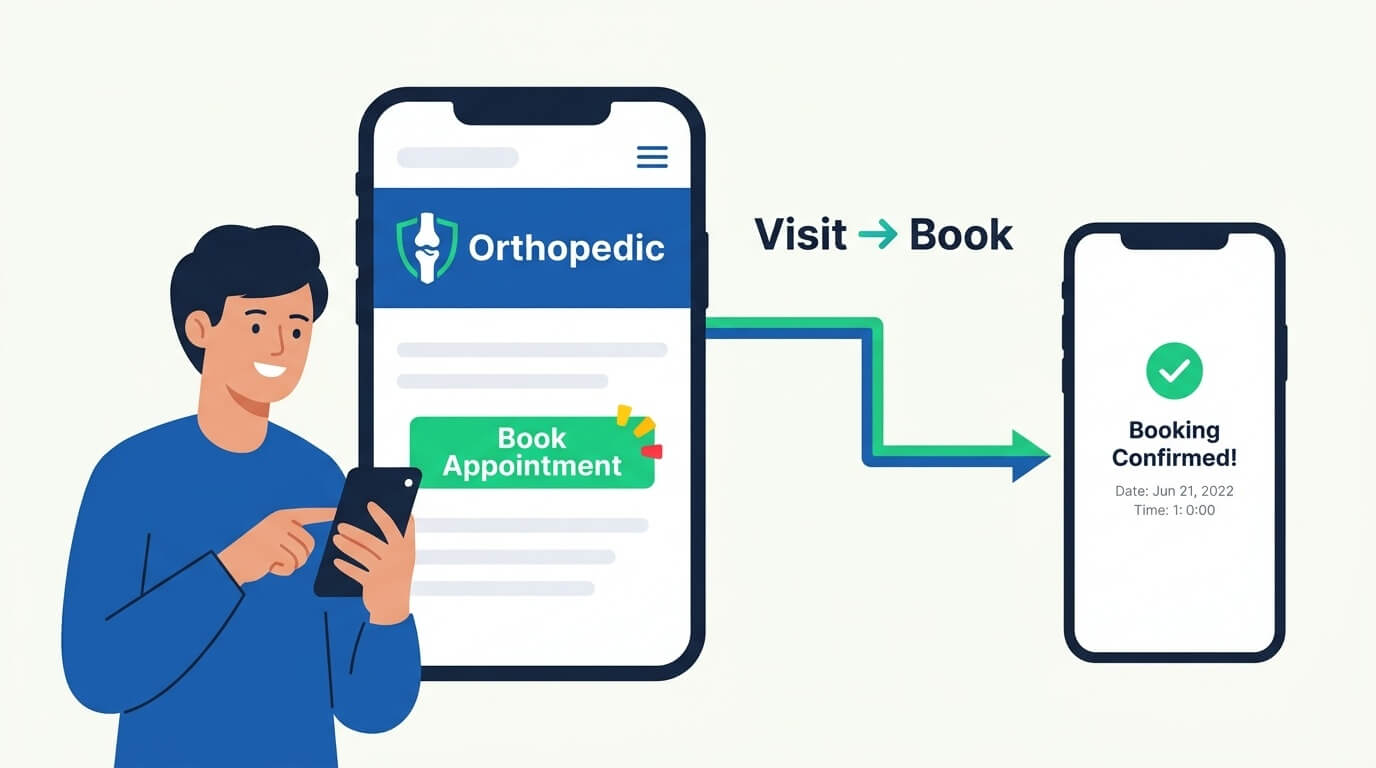
A practice can rank well, run strong ads, and still lose patients if the path from click to booked appointment has too much friction.
Self-scheduling. Self-patient scheduling built on solid self-scheduling software lets patients pick a time directly, day or night, and consistently improves patient satisfaction, increases new patient appointments, and reduces staff workload chasing down leads to try to book them manually.
Call tracking. Call tracking for medical practices, using dynamic phone numbers tied to specific campaigns, is what makes it possible to know which channel actually produced a booked appointment instead of just a click.
Intake and follow-up. Basic lead nurturing, a missed-call text-back system and a same-day follow-up standard for web form submissions will recover appointments that would otherwise be lost to whichever practice called back first.
Reducing no-shows. Booked appointments and attended appointments are not the same metric, and the gap between them matters. Automated confirmation texts and reminders close a meaningful part of that gap.
Treating patient conversion rate as seriously as ad spend, testing landing pages, simplifying forms, and making pricing or insurance information easy to find is often the single highest-leverage fix available to a practice that feels like its marketing “isn’t working.
AI Search Optimization for Orthopedic Practices
This is the newest and fastest-moving part of orthopedic practice marketing. The scale of this shift is hard to overstate. OpenAI has reported that more than 40 million people worldwide turn to ChatGPT daily for health information.
Nearly a third of ChatGPT’s weekly users reportedly ask a health-related question in a given week. Patients are asking these tools “what’s the recovery time for a total knee replacement” or “do I need surgery for a torn meniscus” well before they search for a specific practice.
A few practical steps can help you get cited in AI responses:
- Write extractable answers. Open sections with a clear, direct definition or answer, the way this article’s opening section does, rather than burying the point three paragraphs in.
- Use FAQ formatting and schema. Structured question-and-answer content, built with proper schema markup for medical websites, is easier for AI systems to lift and cite accurately, and it’s the same structure that tends to win featured snippets in healthcare searches and voice search medical practice queries on smart speakers and phones.
- Keep entity data (NAP) consistent. The same practice name, address, phone number, and physician credentials should appear identically everywhere, since this is part of what AI models use to judge reliability.
- Publish original data. Practices that share their own outcome data, average wait times, or patient volume figures give AI models something specific to cite, instead of generic industry language.
- Show up where AI models pull from. Healthgrades, hospital directory pages, YouTube video transcripts, and even relevant forum discussions all feed into what these tools surface.
AI health answers are not always reliable. A widely cited Mount Sinai study published in Nature Medicine in early 2026 found that ChatGPT Health failed to direct users to emergency care in 52 percent of gold-standard medical emergency scenarios tested.
That’s a meaningful gap. As more patients lean on AI for a first opinion, a practice’s own authoritative content becomes one of the more reliable counterweights available.
HIPAA-Compliant Marketing: What You Can and Can’t Do
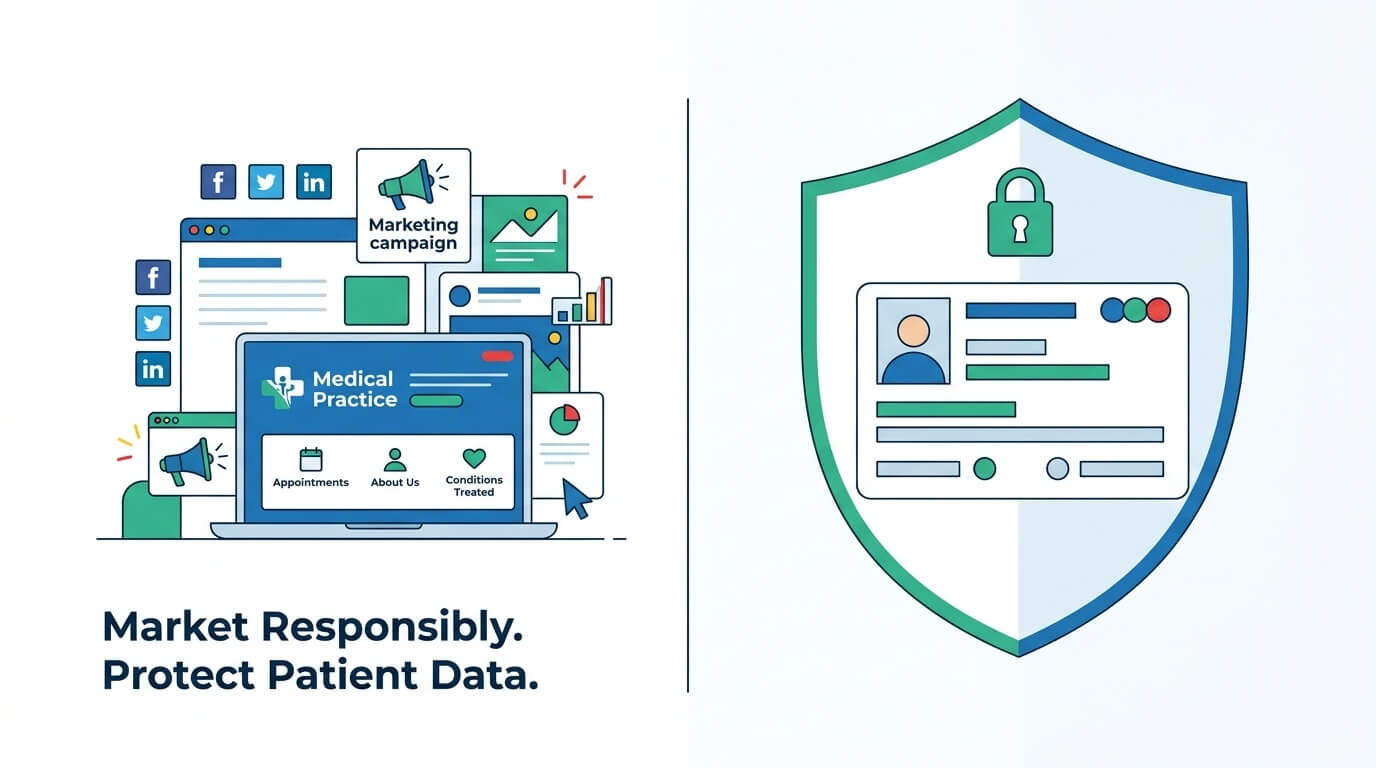
HIPAA-compliant orthopedic advertising is a legal requirement with real financial consequences for getting it wrong.
Ad pixels and tracking. Standard Meta Pixel and Google Ads conversion tracking can inadvertently transmit protected health information if a patient’s browsing behavior on condition-specific pages gets tied to identifiable data. The Office for Civil Rights has actively pursued enforcement actions related to this exact issue. Server-side or first-party tracking, and de-identified conversion events, are the safer approach.
Business Associate Agreements. Any ad platform, CRM, or marketing automation vendor that could come into contact with PHI needs a signed BAA in place before you connect them to patient data.
Forms and intake. HIPAA-compliant forms should avoid tying diagnosis-specific fields directly to identifiable contact information without proper consent and secure handling.
Testimonials. Real patient stories and photos require explicit, documented HIPAA-compliant authorization before they’re used in any marketing material, website page, or social post.
Remarketing risk. Retargeting someone who visited your “herniated disc treatment” page with a follow-up ad can inadvertently reveal a health condition to anyone else who shares that device. Segmenting and aggregating remarketing audiences carefully avoids this.
Reviews. As mentioned earlier, review responses should never confirm or deny that someone is a patient. Even a well-intentioned “we’re sorry your knee surgery didn’t go as expected” response can constitute a HIPAA disclosure.
Getting healthcare marketing compliance right isn’t just about avoiding penalties. It’s also a trust signal. A practice that’s visibly careful with patient information is a practice patients feel safer choosing.
How to Measure Orthopedic Marketing ROI
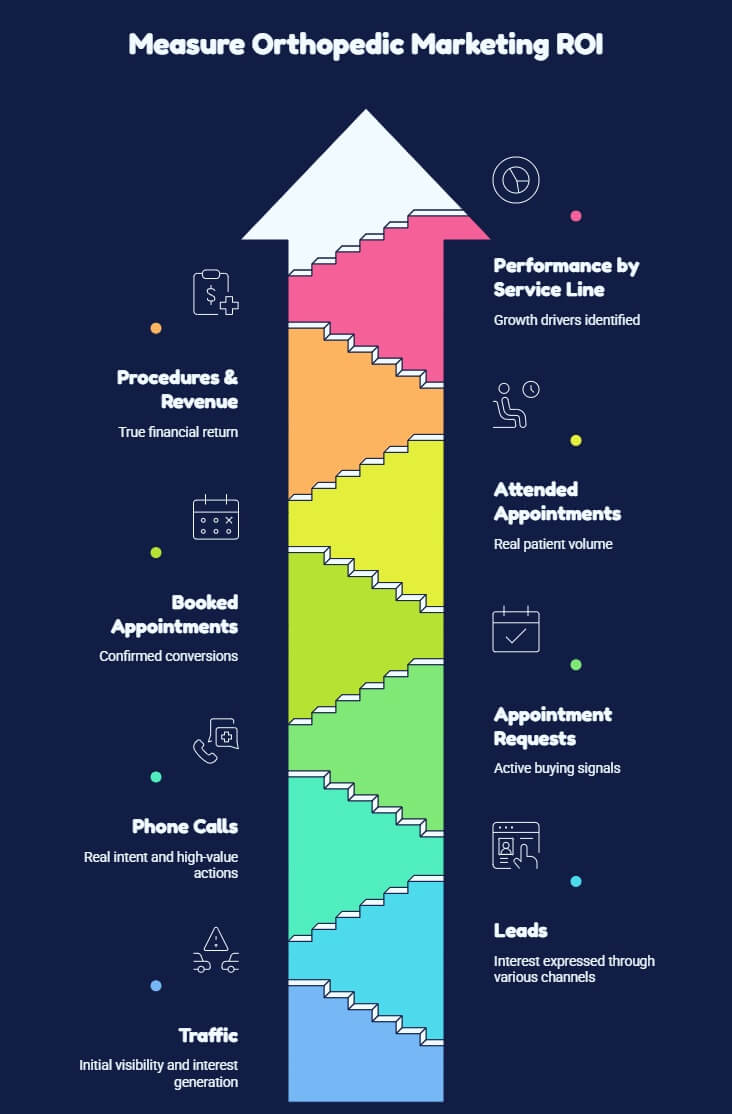
Traffic isn’t the primary KPI, and treating it like one is how practices end up with a marketing report that looks great and a schedule that isn’t any fuller. A proper measurement framework follows the funnel all the way through.
| Metric | What It Tells You | How to Track It |
| Traffic | Visibility, but not demand on its own | Analytics dashboard |
| Leads | Interest generated across channels | Form fills, chat, call volume |
| Phone calls | Real intent, often the highest-value action | Call tracking for medical practices |
| Appointment requests | Active buying signal | Scheduling tool, form submissions |
| Booked appointments | Confirmed conversion | CRM or scheduling software |
| Attended appointments | Real patient volume, accounts for no-shows | EHR integration with marketing data |
| Procedures and revenue | True financial return, where attribution allows | CRM marketing automation tied to billing |
| Performance by service line | Which treatments are actually driving growth dashboard results | Segmented reporting by procedure type |
The gap between booked appointments and attended appointments is worth watching closely, since a high no-show rate can make a campaign look far less effective than it actually is. Tying marketing data back to the EHR gives a far more accurate picture of digital marketing ROI than top-line traffic ever will.
Common Orthopedic Digital Marketing Mistakes to Avoid
When doing digital marketing for orthopedic surgeons, you must avoid these mistakes:
- Building one generic services page instead of individual treatment and condition pages that actually match how patients search.
- Ignoring mobile page speed, even though the majority of healthcare searches now happen on a phone.
- Running ads without call tracking, which makes it impossible to know which campaign actually produced a patient.
- Unclear physician bio or ignoring E.E.A.T signals, which weakens both patient trust and the entity authority search engines and AI tools look for.
- Treating reviews as set-and-forget instead of an ongoing system with response standards.
- No follow-up process for web leads, letting fast-moving competitors win patients who inquired first.
- Spending on awareness channels before fixing conversion basics like scheduling friction and call answering speed.
- Ignoring website accessibility until a demand letter arrives.
- Having no AI search or answer-engine strategy despite rapidly growing AI-driven patient research.
- Reporting on traffic and leads only, without tracking cost per booked appointment by service line.
How Much Does Orthopedic Marketing Cost?
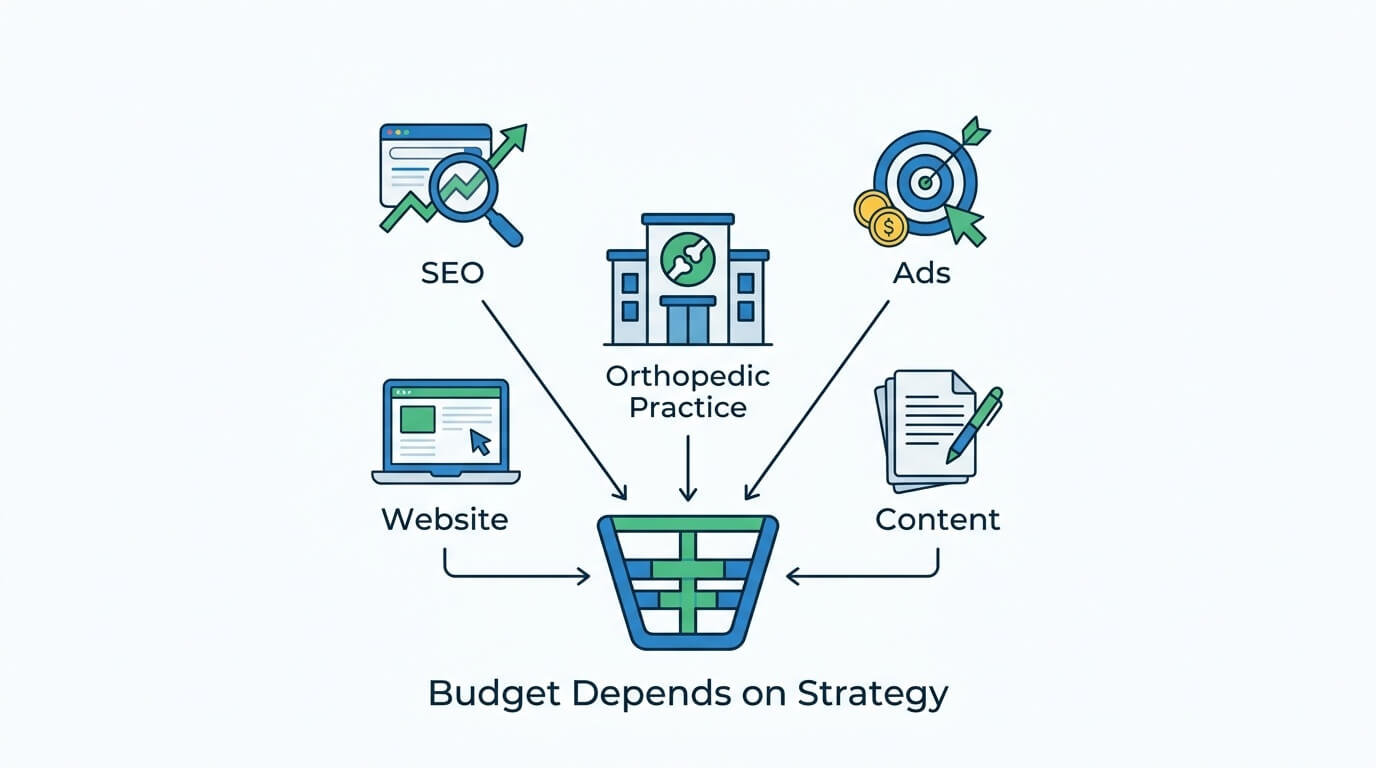
Orthopedic digital marketing typically costs $3,000 to $20,000+ per month, depending on practice size, location, competition, and services promoted.
A single-location practice may spend $2,000 to $6,000 monthly on SEO and content, while Google Ads can require $3,000 to $15,000+ in monthly ad spend, excluding management fees.
A new or redesigned orthopedic website can cost $5,500 to $25,000+, while reputation management and social media typically range from $500 to $3,500 per month.
For growth-focused practices, a marketing budget of roughly 5% to 10% of annual revenue can be a useful benchmark.
The right investment ultimately depends on patient acquisition costs, local search competition, and the revenue potential of services such as joint replacement, spine care, sports medicine, and orthopedic surgery.
Which Orthopedic Digital Marketing Channel Should You Start With If Budget Is Limited?
This is the question most orthopedic marketing content never actually answers. If you can’t fund every channel at once, sequencing matters more than trying to do everything at 20 percent effort.
For a practice starting from a limited budget, Google Ads combined with a fully optimized Google Business Profile tends to produce the fastest visible results, since both target people actively searching right now.
SEO for orthopedic surgeons should start in parallel even though it takes longer to pay off, because it’s the layer that eventually reduces dependence on paid spend.
Reputation management should never be paused, regardless of budget, since it affects the performance of every other channel running at the same time.
Social media and video are the easiest to trim temporarily without immediate damage, though they matter more as competition increases in a given market.
MedClicx Final Take on Orthopedic Digital Marketing
Orthopedic digital marketing in 2026 is about building a system where SEO, paid search, local visibility, reputation, and AI search readiness all reinforce each other, backed by scheduling and follow-up processes that actually convert the demand you’re generating.
Most orthopedic practices we talk to have pieces of this in place: a decent website, some ad spend, a handful of reviews, but not the connected system that turns visibility into a full surgical schedule. That gap is usually where the real growth is sitting.
If your practice is ready to build a real orthopedic marketing services strategy rather than another disconnected tactic, MedClicx works exclusively with healthcare practices and understands the specific complexity orthopedics brings, from subspecialty architecture to HIPAA-compliant orthopedic advertising to AI search visibility. Get in touch for a free growth strategy session, and we’ll show you exactly where your current marketing is leaving patients and revenue on the table.
FAQs About Orthopedic Marketing and Orthopedic Advertising
What are the most effective orthopedic marketing strategies?
Is Google Ads effective for orthopedic surgeons?
How long does orthopedic marketing take to work?
How do you measure orthopedic marketing ROI?
How do you choose an orthopedic surgery marketing agency?
Let’s increase appointment bookings
At MedClicx, we help medical practices connect with more patients.


Senior Digital Marketing Strategist &
Healthcare SEO Consultant
James Walker is a Senior Digital Marketing Strategist and Healthcare SEO Consultant at MedClicx. He specializes in helping healthcare organizations and service-based businesses grow their online presence through SEO, content marketing, local SEO, AI search optimization, (GEO), technical SEO, website optimization, and digital marketing strategies.
Over the years, James has worked on improving organic visibility, lead generation, and brand authority by combining search engine optimization, website performance, content strategy, conversion optimization, and AI-ready content. His expertise also includes Google Business Profile optimization, schema markup, user experience (UX), analytics, and modern digital marketing best practices.
At MedClicx, James writes educational articles covering SEO, content marketing, digital marketing, AI search optimization, social media marketing, web design, advertising strategies, podcasts, and online business growth. His goal is to simplify complex marketing concepts and help businesses make data-driven decisions that generate sustainable long-term results.
- James Walker

- James Walker
- James Walker
- James Walker