A Step-by-Step Guide to SEO for Medical Practices That Want to Grow
-
 James Walker
Table of Contents:
- What Is SEO for Medical Practices?
- Why SEO Is Important for Medical Practices
- How to Build an Effective Medical SEO Strategy
- Optimizing a Medical Practice Website
- Local SEO for Doctors
- Creating Trustworthy Medical Content
- Building Authority With Links and Digital PR
- Measuring Medical SEO Performance
- Medical AI Search Optimization
- Building Authority for Generative Search Results
- Medical Practice SEO Checklist
- Conclusion
- FAQs
People rarely choose a medical practice without doing some research first. They search for a doctor, look up a condition or treatment, compare nearby clinics, read reviews, check a practice website, and often use Google Maps before deciding who to contact.
If your practice isn’t showing up in that search, it doesn’t matter how good the care is once they walk through the door.
This guide walks through exactly what SEO for medical practices involves, why it matters more than most practices realize, and how to build a strategy that keeps working long after it’s set up.
What Is SEO for Medical Practices?
SEO for medical practices is the process of helping a medical practice become easier to discover in search engines when potential patients are looking for relevant healthcare services, doctors, treatments, or information.
It combines several areas of optimization, including website SEO, local search, content, technical performance, reputation, and authority.
For example, a family medicine practice may want to appear for searches such as:
- family doctor near me
- primary care physician in [city]
- annual physical exam
- diabetes management
- same-day primary care
Health-related searches fall under what Google calls YMYL, short for Your Money or Your Life, meaning inaccurate information can cause real harm.
That is why medical SEO is not simply about adding the word “doctor” to a few pages. It starts with understanding what patients actually search for and then building a website and online presence that clearly answer those needs.
Why SEO Is Important for Medical Practices
SEO for medical practices builds credibility, since patients tend to trust practices that show up consistently in search over ones they’ve never heard of.
It’s also more cost-efficient over time than constantly paying for ads, because a ranking page keeps working without a fee every time someone clicks it.
For a broader look at how digital channels work together to support that growth, see our guide on digital marketing for doctors.
How SEO Helps Attract New Patients
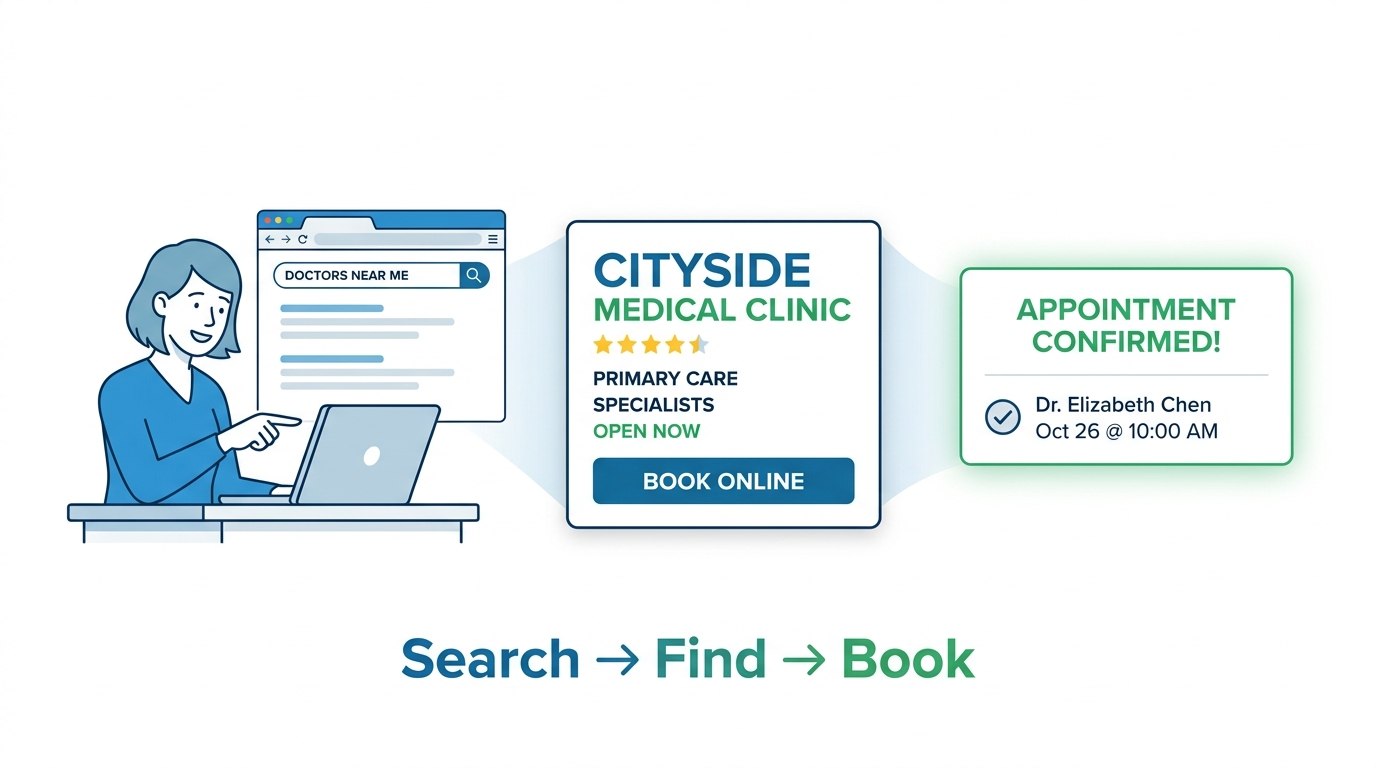
SEO attracts new patients by meeting them exactly where they already are: typing a question, a symptom, or a service into a search bar. Here’s roughly how that plays out:
| Where the Patient Is | What They’re Searching | What SEO Delivers |
| Just noticing a problem | “why does my knee hurt when I climb stairs” | An informative page that answers the question and introduces your practice as a credible source |
| Comparing providers | “best orthopedic doctor near me” | A location and service page that ranks locally and shows your credentials |
| Ready to book | “orthopedic clinic accepting new patients [city]” | A Google Business Profile and landing page with a clear way to schedule |
Building Long-Term Search Visibility
Paid advertising can put a practice in front of people immediately, but those visits generally depend on an ongoing advertising budget.
SEO works differently. Improvements to pages, content, technical performance, local visibility, and authority can continue supporting organic traffic over time.
The real objective is sustainable medical practice online visibility that compounds as the website develops stronger content, better service pages, more trusted references, and clearer signals about what the practice offers.
How to Build an Effective Medical SEO Strategy
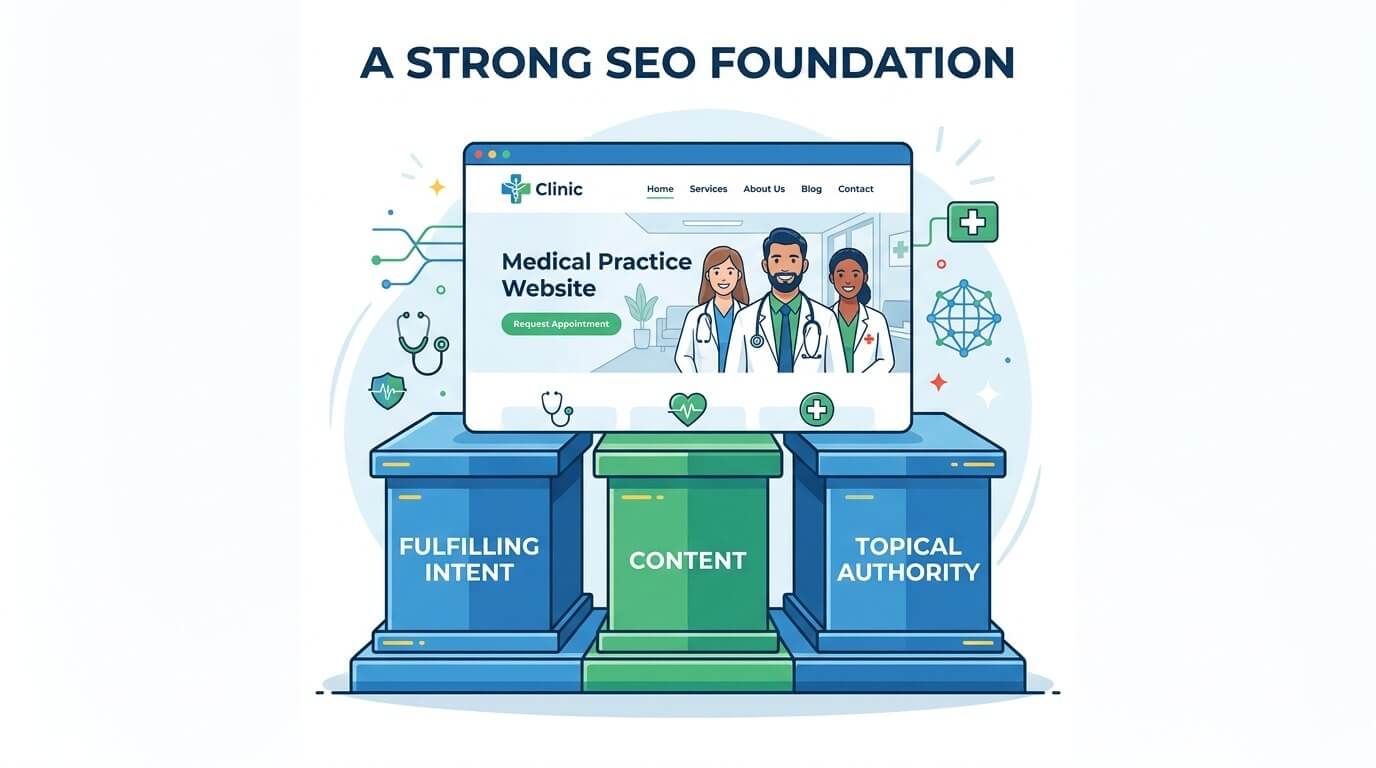
A useful medical practice SEO strategy starts by understanding the practice, its specialties, geographic market, competitors, and the questions patients ask throughout the decision process.
Researching Medical and Local Search Intent
Medical practice keyword research should identify what people are trying to accomplish when they search.
For example, these searches have very different intent:
- “what is an MRI”
- “MRI for lower back pain”
- “MRI center near me”
- “MRI clinic in Chicago”
- “MRI appointment”
Medical SEO keyword research should therefore consider:
- treatment and service terms
- condition-related searches
- symptom and question-based searches
- specialist searches
- local and city-based searches
- “near me” searches
- insurance and appointment-related searches
- branded searches
- competitor and comparison searches
Instead of asking only, “What keyword should this page rank for?” ask, “What does the person searching this actually need?”
That question usually leads to better content and better conversions.
Creating Service and Location-Based Content
Medical service page seo means every core service gets its own dedicated page. Healthcare service page seo works best when each page answers what the treatment is, what to expect, and how to book, in that order.
If your practice serves multiple areas, medical practice location pages should be built for each one with unique content. Multi-location medical practice seo depends on this.
Duplicate or near-duplicate location pages tend to compete with each other in search results instead of each one ranking on its own.
If you’re running more than one clinic, our complete guide to multi-location healthcare marketing breaks down how to structure this without the locations undermining each other.
Building Topical Authority Through Helpful Content
A medical practice can strengthen its visibility by consistently covering the topics its patients care about.
Rather than publishing unrelated medical articles, a practice could build a connected group of useful resources covering diabetes symptoms, diagnosis, lifestyle management, blood sugar monitoring, medication questions, and when to seek care.
These connected resources form medical content clusters and can help establish healthcare topical authority around an area the practice genuinely serves.
Google emphasizes helpful, reliable, people-first content and specifically notes that stronger E-E-A-T matters more for topics that can affect people’s health and well-being. That means the goal is to publish information patients can actually use.
1. Optimizing a Medical Practice Website
On-Page SEO and Internal Linking
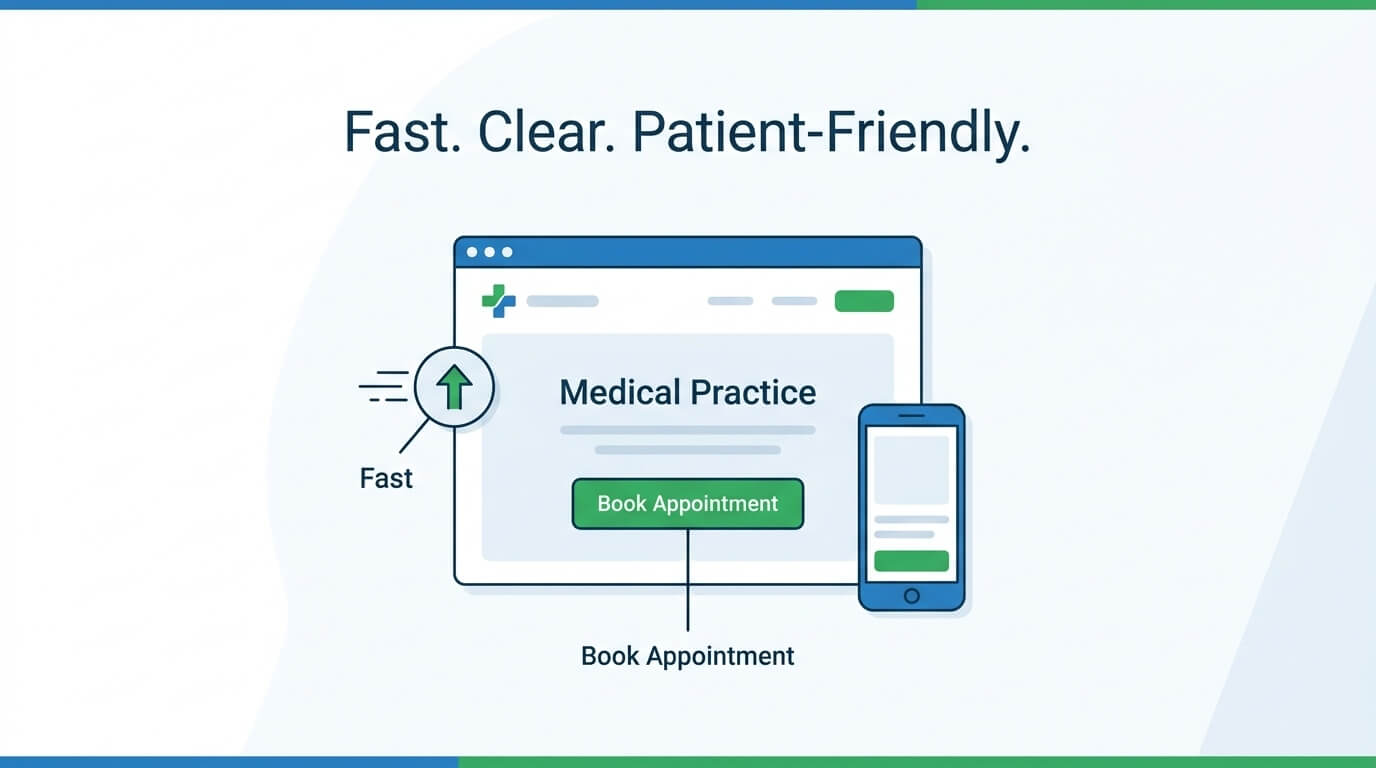
Medical practice on-page SEO begins with making every important page clearly communicate its purpose.
Each page should have a descriptive title, a logical heading structure, useful copy, and content that matches the query it is targeting. Meta titles and meta descriptions should describe the page accurately.
For example, a page about pediatric allergy treatment should immediately communicate what the page offers rather than using a vague title such as “Our Services.”
Internal linking connects related services, conditions, physician pages, location pages, and educational resources.
Technical SEO, Mobile Experience, and Page Speed
Medical technical SEO focuses on making sure search engines can crawl, understand, and index the website properly.
A medical SEO technical audit should look for issues such as:
- blocked or poorly accessible pages
- incorrect canonical tags
- broken links
- duplicate URLs
- indexing problems
- missing or incorrect metadata
- poor mobile usability
- slow-loading pages
- rendering problems
- weak internal linking
- unnecessary URL complexity
Indexing and crawlability are especially important because even excellent content cannot perform well if search engines cannot properly access or index it.
Medical website page speed and Core Web Vitals should be reviewed as part of broader technical quality rather than treated as isolated SEO tasks.
Structured data deserves a specific mention here too. Med schema markup and healthcare schema markup, including medical organization schema and medical service schema, help search engines understand exactly what your practice offers.
Medical Website Structure and User Experience
Medical website architecture should follow a logical hierarchy:
- Broad categories at the top
- Specific services and conditions underneath
- Blog content linking back up into that structure
A confusing site, where patients can’t find the one page they actually need, loses both rankings and trust. User experience and SEO are more connected than most people realize.
Search engines track how people interact with a page, and a frustrating experience, whether that’s a hidden phone number, a booking form buried three clicks deep, or text that’s hard to read on a phone, quietly works against your rankings even if the content itself is solid.
A well-built medical website design makes this far easier to get right from the start rather than patching it later.
2. Local SEO for Doctors
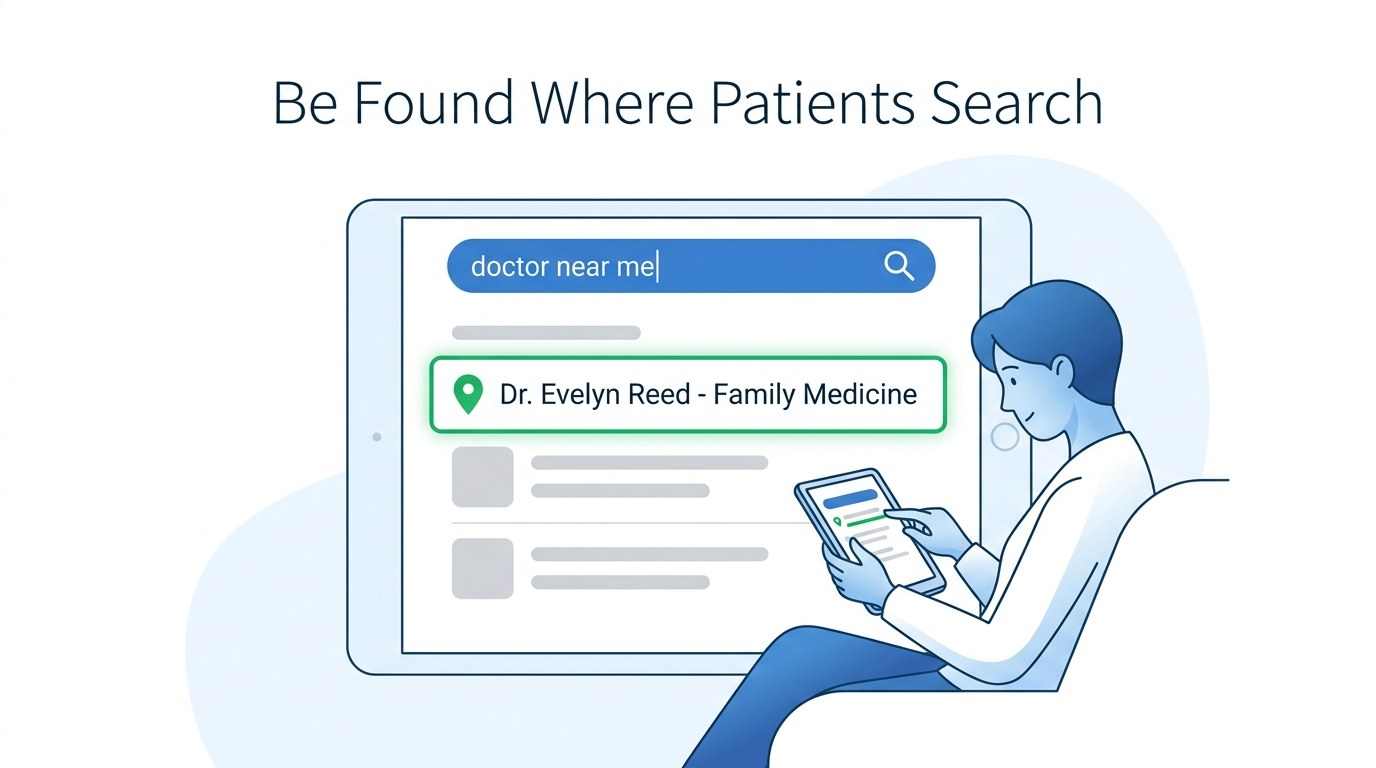
For a deeper dive into ranking factors and citation building across healthcare, see our full guide to local SEO for healthcare practices.
Google Business Profile for Doctors
Google uses information from Business Profiles and other sources to understand businesses and surface relevant local results.
It states that local results are primarily influenced by relevance, distance, and prominence. Complete and accurate business information helps Google better understand the business and match it with relevant searches.
For practices, that means keeping details such as the following accurate:
- practice name
- address
- phone number
- website
- business category
- hours
- services
- locations
Google Business Profile for doctors should represent the actual practice accurately rather than being treated as a place to insert extra keywords.
Google Maps SEO for medical practices also depends on broader local authority. Your website, reviews, citations, links, and business information across the web all contribute to the picture search engines can build around the practice.
Local Citations and Medical Directories
Medical practice citations are online references to the practice’s name, address, phone number, and related business information.
These references can exist across healthcare directories, local business platforms, professional associations, insurance-related listings, and other relevant sources.
Medical directory listings can be useful when they are legitimate, relevant, and accurate. The goal is to establish a consistent footprint across trustworthy and relevant sources.
This becomes especially important for practices with multiple offices, where location information needs to remain consistent across the website and major platforms.
Reviews and Local Reputation
Reviews influence both how patients choose a provider and how search engines evaluate local trust.
That makes patient reviews SEO and medical practice reputation management worth treating as ongoing processes rather than occasional cleanup tasks.
Practices should encourage genuine feedback, respond professionally where appropriate, and monitor their reputation across important platforms.
The objective should never be to manufacture reviews. Trust is far more valuable than a larger number of questionable ratings.
This is close enough to a full-time job that many practices hand it off to a dedicated reputation management service rather than trying to keep up with it internally.
3. Creating Trustworthy Medical Content
E-E-A-T Healthcare SEO and YMYL Considerations
E-E-A-T stands for experience, expertise, authoritativeness, and trustworthiness.
Google explains that E-E-A-T itself is not a single ranking factor, but its systems use a range of signals that help identify content demonstrating these qualities.
It also says its systems place more weight on strong E-E-A-T for topics that can significantly affect people’s health, safety, or well-being.
That is particularly relevant to YMYL medical SEO.
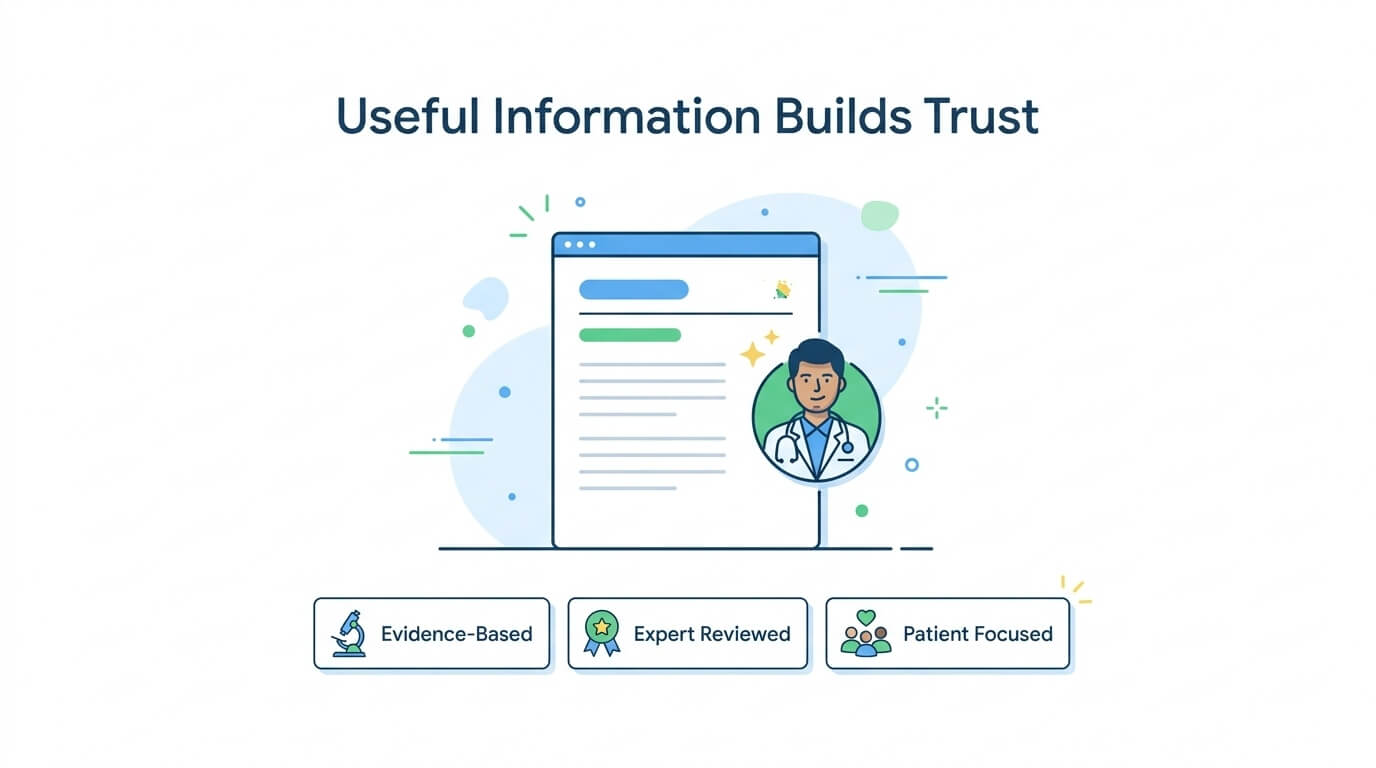
For healthcare websites, practical trust signals can include:
- clear author information
- physician or specialist review where appropriate
- accurate references and sources
- transparent medical credentials
- updated information
- clear practice information
- accessible contact details
- a strong About page
- consistent professional identity
These signals do not replace strong content. They support it.
Physician Expertise and Content Credibility
A generic article written as though it could belong to any medical practice is unlikely to differentiate the website.
That first-hand perspective can make content more useful and more trustworthy. Medical website credibility also improves when readers can understand who created or reviewed the content.
Google’s people-first guidance specifically encourages clear authorship and information that helps visitors understand the expertise behind content.
4. Building Authority With Links and Digital PR
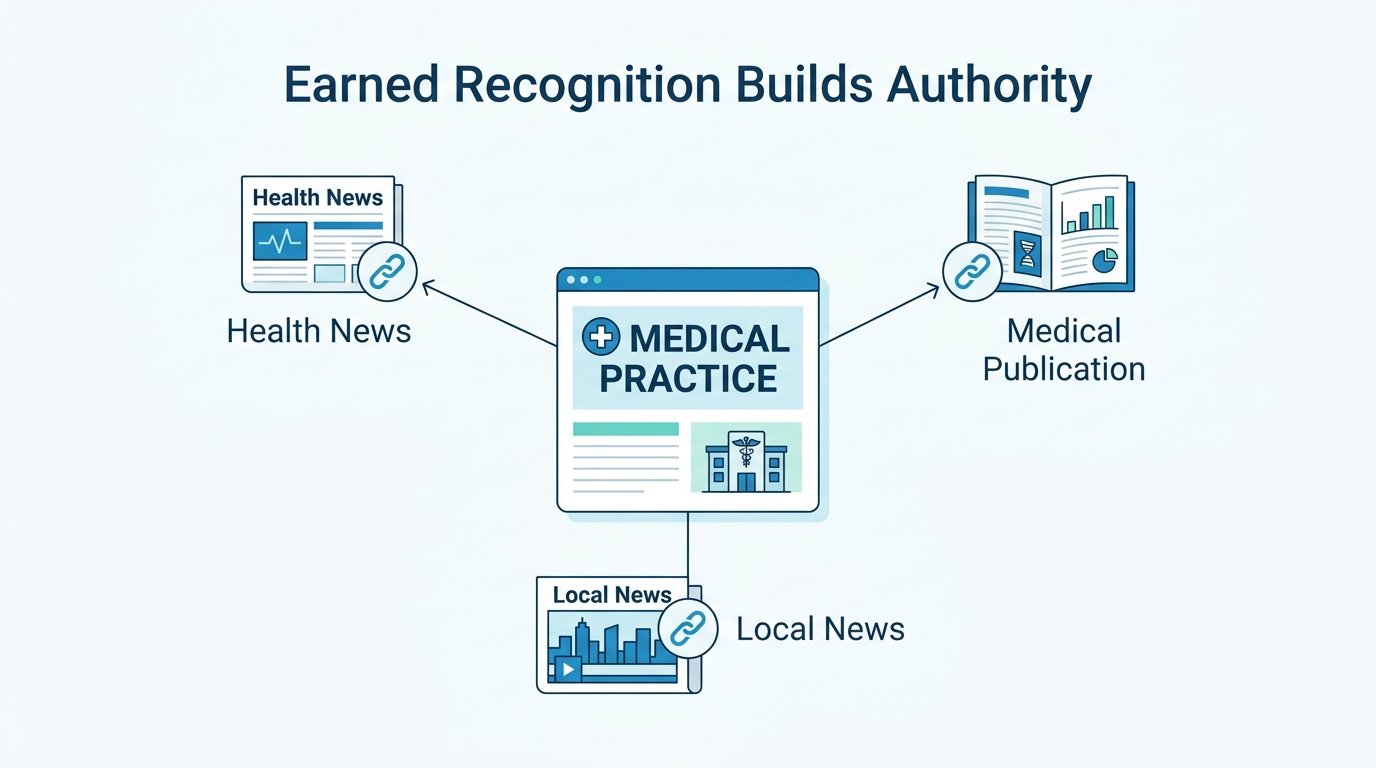
Medical off-page seo, meaning everything that happens outside your own website, still plays a major role in rankings.
Medical practice link building from relevant, reputable sources tells search engines that other trusted sites vouch for your practice.
A medical practice backlink strategy should focus on quality over quantity. A single link from a respected local news outlet, a medical association, or a well-known health publication does more for your rankings and reputation than dozens of low-quality directory links ever could.
Healthcare digital PR, things like expert commentary for local journalists, community health events, or sponsorships, often earns these kinds of links naturally, alongside real visibility in your community.
5. Measuring Medical SEO Performance
Rankings, Organic Traffic, and Visibility
Medical practice SEO metrics should reflect both visibility and business value.
Useful indicators include:
- Organic clicks
- Impressions
- Non-branded traffic
- Rankings for priority services
- Rankings for local searches
- Google Business Profile visibility
- Traffic to service pages
- Traffic to location pages
- Calls and appointment requests
- Conversion rates
Medical practice organic traffic should also be analyzed by landing page.
If a blog receives thousands of visits but generates little interest in the practice, while a service page receives fewer visits but drives appointment requests, the second page may be more valuable.
Medical SEO reporting should therefore connect search data with actual business objectives.
Medical practice lead generation can be tracked through appointment forms, phone calls, booking systems, contact forms, and other measurable actions.
6. Medical AI Search Optimization

Search itself is changing quickly, and medical practices that ignore it are going to feel that shift the hardest, given how often people research health topics before making a decision.
AI seo for medical practices is no longer something to think about later. It’s already shaping how patients find care right now.
AI systems need reliable information they can understand and use in context.
That makes several established SEO principles even more important:
- clear page structure
- direct answers to real questions
- trustworthy medical information
- strong topical coverage
- crawlable content
- clear business information
- distinct service and location pages
- authoritative references
- useful, original insights
A useful way to approach medical practice optimization for AI search is to ask whether your page can independently answer a patient’s question without forcing them to search again.
Google’s generative AI guidance specifically emphasizes unique, valuable, non-commodity content and warns against producing large quantities of pages simply to target every possible query variation.
Building Authority for Generative Search Results
Generative engine optimization for healthcare is increasingly discussed as though it were an entirely separate discipline.
In practice, much of the foundation is still traditional SEO, content quality, technical accessibility, and real-world authority.
Google specifically states that there is no special markup, AI text file, or “chunking” requirement that guarantees inclusion in its generative search features.
It also says structured data is not required specifically for generative AI search, although structured data remains useful as part of an overall SEO strategy.
For a medical practice, that means the best preparation is not a collection of AI tricks.
It is a website with:
- accurate provider information
- clear services
- strong local signals
- expert-led content
- useful answers
- consistent business information
- trustworthy references
- strong technical foundations
Google also provides a Generative AI performance report in Search Console for measuring visibility in its generative AI features.
Medical Practice SEO Checklist
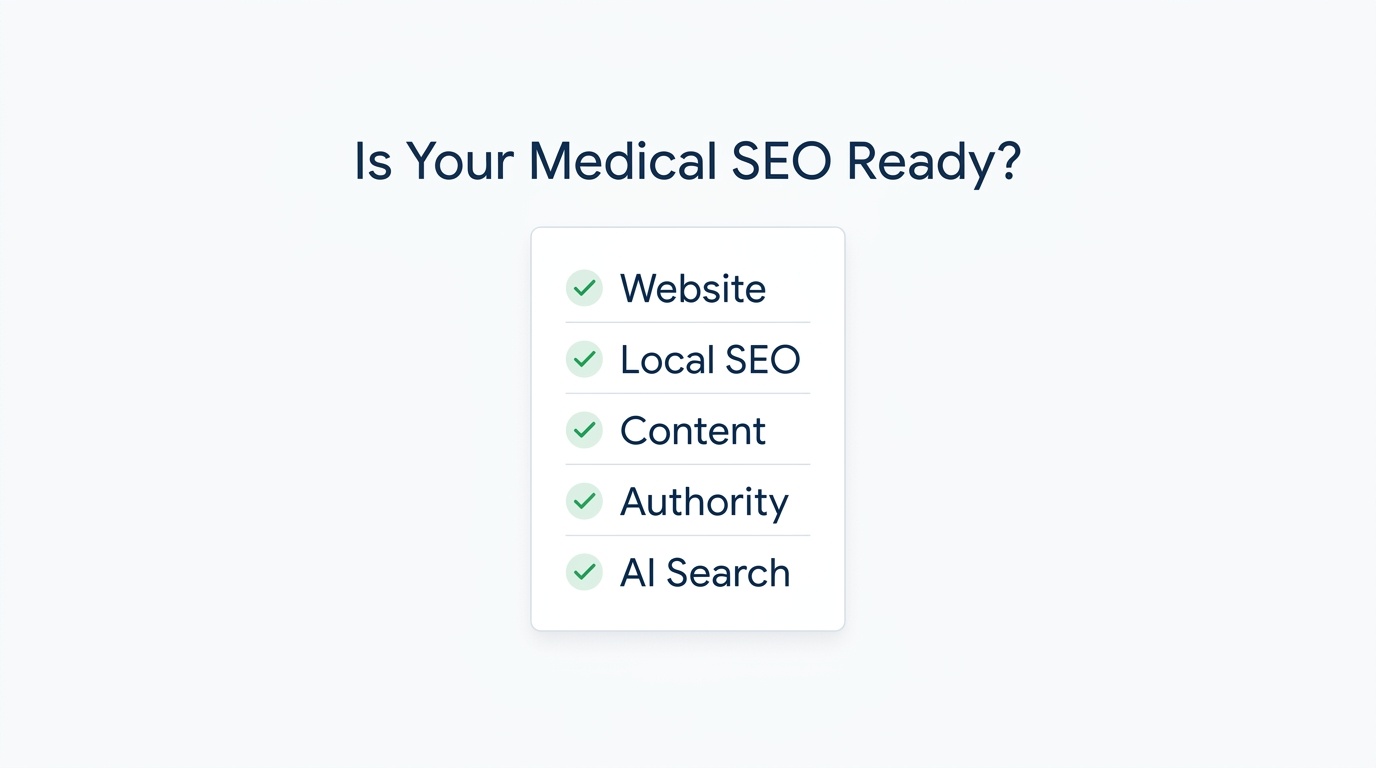
A practical medical SEO checklist should cover the entire search experience rather than just keywords.
Website
- Clear website architecture
- Dedicated pages for important medical services
- Useful physician and provider pages
- Mobile-friendly design
- Fast page experience
- Crawlable and indexable pages
- Accurate title tags and meta descriptions
- Strong internal linking
- Descriptive image alt text
- Clean URLs and canonicalization
Local SEO
- Verified Google Business Profile
- Accurate practice name, address, phone, and hours
- Correct primary and secondary categories where applicable
- Complete service information
- Consistent medical practice citations
- Relevant medical directory listings
- Ongoing review management
- Unique location pages for genuine locations
- Local authority and community mentions
Content
- Search intent-based keyword research
- Service-focused content
- Patient-focused educational resources
- Medical content clusters
- Clear physician authorship or review
- Accurate and up-to-date information
- Evidence and reputable references where appropriate
- Strong E-E-A-T signals
- Content written for patients first
Authority
- Relevant medical SEO backlinks
- Professional and industry mentions
- Legitimate medical guest posting
- Healthcare digital PR
- Community and local media opportunities
- Competitor backlink analysis
- Ongoing medical practice competitor analysis
Measurement
- Organic search traffic
- Search impressions and clicks
- Priority keyword rankings
- Local search visibility
- Service-page performance
- Leads and appointment actions
- Conversion rates
- Medical SEO reporting
- Medical SEO ROI
Conclusion
MedClicx works as a dedicated medical SEO agency and healthcare marketing agency for doctors across specialties.
Our medical practice SEO services bring keyword research, technical audits, Google Business Profile management, and content strategy together under one plan, so nothing gets built in isolation.
Get a free SEO assessment from MedClicx and find out exactly where your practice stands and what it would take to start ranking for the searches that matter most.
FAQs About Medical SEO
How does SEO help a medical practice get more patients?
How long does medical SEO take to produce results?
Does medical SEO work for private practices?
How can doctors improve their Google Business Profile ranking?
How can medical practices appear in AI search results?
Let’s increase appointment bookings
At MedClicx, we help medical practices connect with more patients.


Senior Digital Marketing Strategist &
Healthcare SEO Consultant
James Walker is a Senior Digital Marketing Strategist and Healthcare SEO Consultant at MedClicx. He specializes in helping healthcare organizations and service-based businesses grow their online presence through SEO, content marketing, local SEO, AI search optimization, (GEO), technical SEO, website optimization, and digital marketing strategies.
Over the years, James has worked on improving organic visibility, lead generation, and brand authority by combining search engine optimization, website performance, content strategy, conversion optimization, and AI-ready content. His expertise also includes Google Business Profile optimization, schema markup, user experience (UX), analytics, and modern digital marketing best practices.
At MedClicx, James writes educational articles covering SEO, content marketing, digital marketing, AI search optimization, social media marketing, web design, advertising strategies, podcasts, and online business growth. His goal is to simplify complex marketing concepts and help businesses make data-driven decisions that generate sustainable long-term results.
- James Walker

- James Walker

- James Walker
- James Walker