Healthcare Marketing in 2026: Marketing Strategies for Clinics and Hospitals
-
 James Walker
Table of Contents:
- What Is Healthcare Medical Marketing?
- Modern Healthcare Marketing vs Traditional Healthcare Marketing
- Healthcare Marketing Strategies for Clinics and Hospitals
- Benefits of Healthcare Marketing
- Modern Medical Marketing Strategy (2026 Framework)
- Conclusion
- FAQs
Healthcare marketing in 2026 has evolved into a highly competitive and AI-driven ecosystem where visibility, trust, and digital authority determine patient acquisition success.
Modern healthcare medical marketing is no longer limited to traditional advertising or word-of-mouth referrals; instead, it is shaped by search engines, AI-powered discovery tools, and patient-first digital experiences.
The shift has made marketing in the healthcare industry a critical growth factor for clinics, hospitals, and multi-location medical practices.
Healthcare providers must adopt structured digital strategies that improve visibility across search engines, local listings, and AI-driven platforms to remain competitive.
In this blog, you will discover how healthcare marketing works in 2026 and the key strategies clinics and hospitals can use to attract more patients and grow their practice.
What Is Healthcare Medical Marketing?
Healthcare marketing refers to the strategic use of digital channels, branding, and patient-focused communication to attract, engage, and convert patients for medical services.
It includes everything from search engine optimization and paid advertising to content marketing, local SEO, and online reputation management.
Some key components in healthcare marketing include:
- Medical SEO
- for ranking in search engines
- Google Business Profile optimization for local visibility
- Paid advertising for targeted patient acquisition
- Content marketing to educate and inform patients
- Online reviews and reputation management
Effective healthcare marketing strategies ensure that when patients search for medical services, they consistently find credible and trustworthy providers.
Modern Healthcare Marketing vs Traditional Healthcare Marketing
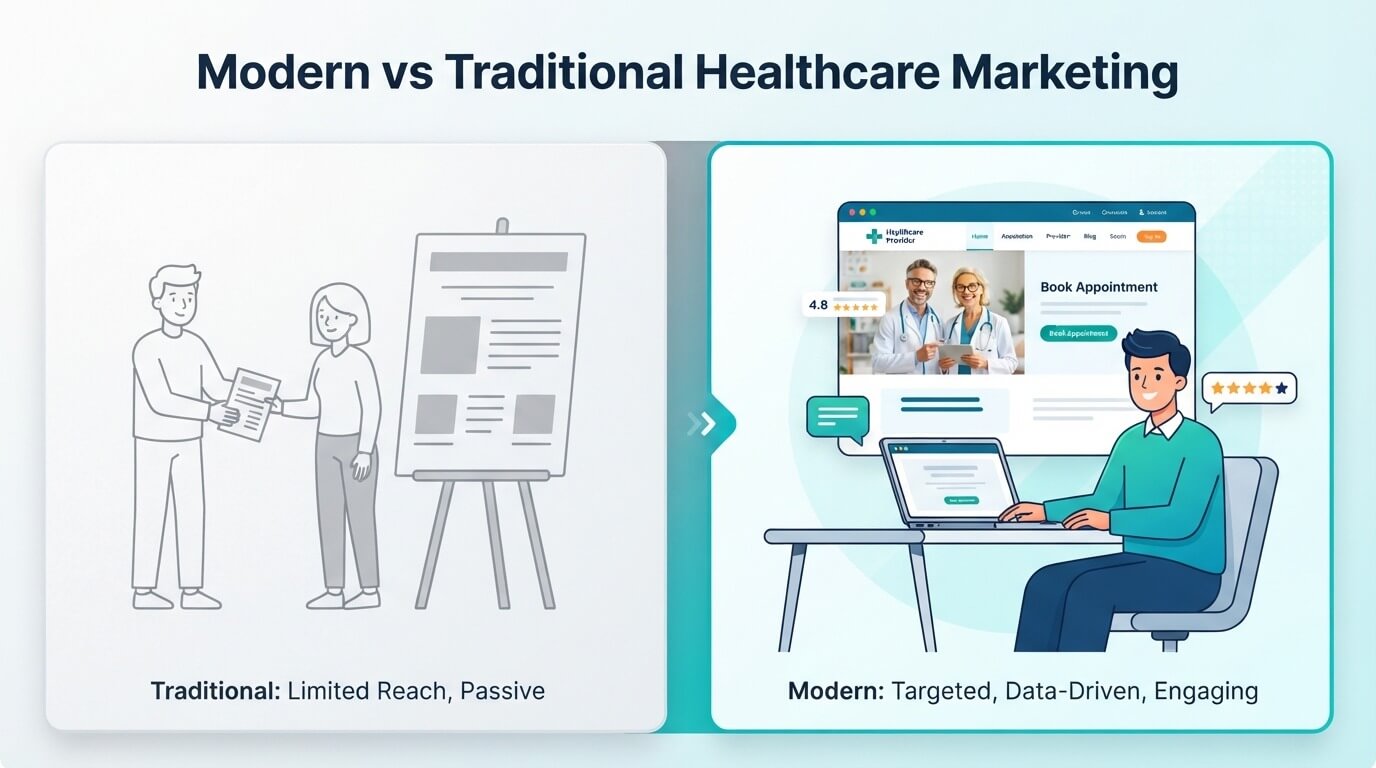
Modern healthcare marketing is fundamentally different from traditional marketing in how patients are reached, engaged, and converted.
Traditional healthcare marketing relied heavily on offline channels such as referrals, print advertising, radio, and word-of-mouth.
While these methods still play a role, they offer limited control over visibility and cannot be scaled effectively in today’s digital-first environment.
In contrast, modern healthcare marketing is driven by digital ecosystems where patients actively search for providers, compare services online, and rely on reviews, search rankings, and AI-generated recommendations before making decisions.
| Aspect | Traditional Healthcare Marketing | Modern Healthcare Marketing |
| Visibility | Relies on offline exposure like referrals, print ads, and local reputation | Driven by search engines, Google Maps, AI results, and online presence |
| Patient Reach | Limited to local or referral-based audiences | Reaches high-intent patients actively searching online |
| Trust Building | Built through word-of-mouth and long-term reputation | Built through online reviews, ratings, and digital credibility signals |
| Patient Behavior | Patients depend on referrals or offline recommendations | Patients research, compare, and evaluate providers online before booking |
| Marketing Approach | Passive (waits for patients to come through referrals) | Proactive (targets patients actively searching for care) |
| Measurement | Difficult to track ROI and performance | Fully data-driven with measurable results (traffic, leads, conversions) |
| Scalability | Limited scalability beyond local area | Highly scalable across locations and regions |
| Channels Used | Print media, radio, TV, offline networking | SEO, Google Ads, social media, content marketing, AI-driven search |
Healthcare Marketing Strategies for Clinics and Hospitals
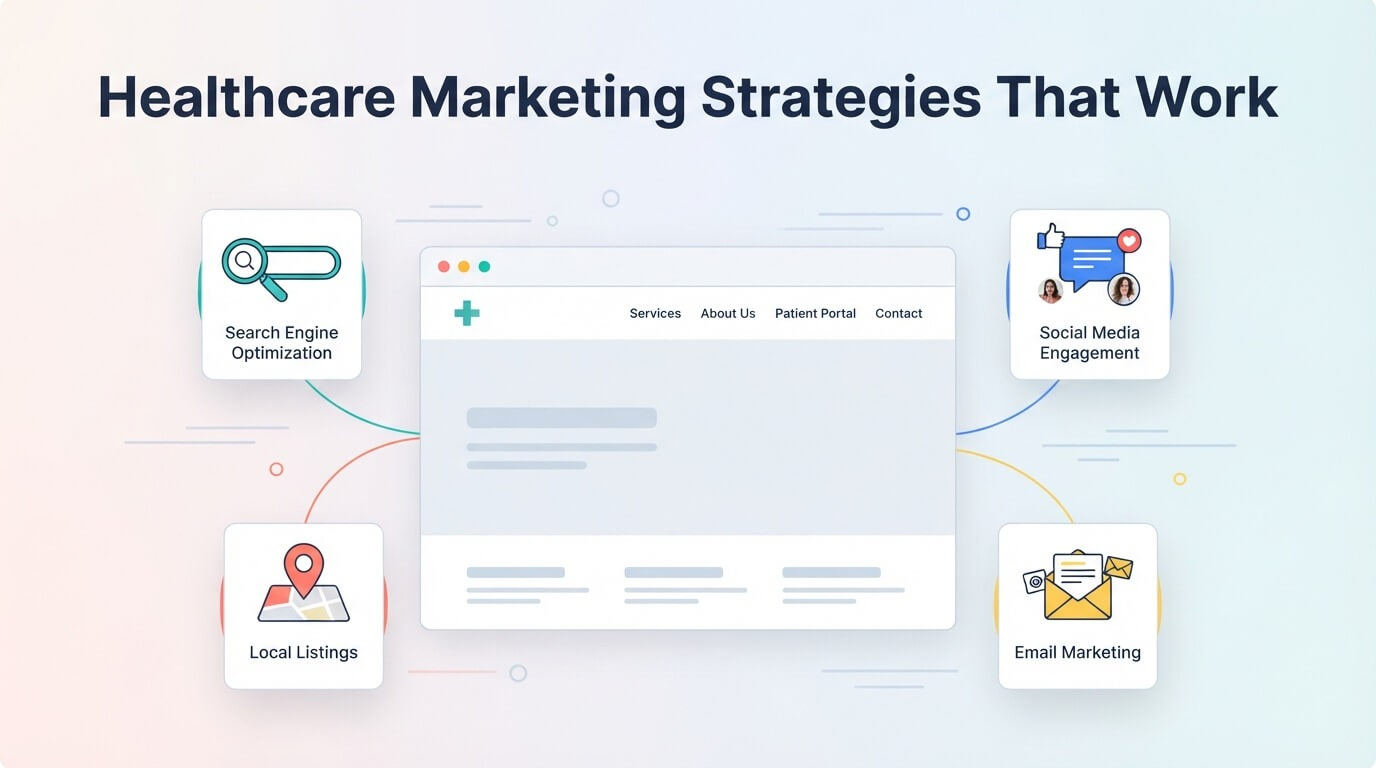
Effective healthcare marketing strategies for clinics and hospitals focus on attracting the right patients, building trust, and ensuring strong digital visibility across search engines and local platforms.
1. Search Engine Optimization (SEO)
SEO helps healthcare providers appear in Google search results when patients look for treatments, symptoms, or medical services. Optimizing service pages, blog content, and location-based keywords improves visibility and drives consistent patient inquiries.
2. Local SEO and Google Maps Optimization
For clinics and hospitals, local visibility is critical. Optimizing Google Business Profiles, managing reviews, and targeting “near me” searches helps improve rankings in map results where most high-intent patients convert.
3. Content Marketing for Patient Education
Educational content builds trust and authority. Blogs, FAQs, and treatment guides help patients understand their conditions and position healthcare providers as credible sources of information.
4. Paid Advertising (Google Ads & Social Media)
Paid campaigns allow clinics to reach patients instantly. Targeted ads based on location, intent, and services help generate quick appointments for high-demand treatments.
5. Online Reputation Management
Reviews and ratings play a major role in patient decision-making. Actively managing feedback and encouraging satisfied patients to leave reviews strengthens credibility and conversion rates.
6. Conversion-Focused Website Optimization
A healthcare website should be designed to convert visitors into patients. Clear calls-to-action, easy appointment booking, mobile optimization, and trust signals improve conversion performance.
Benefits of Healthcare Marketing
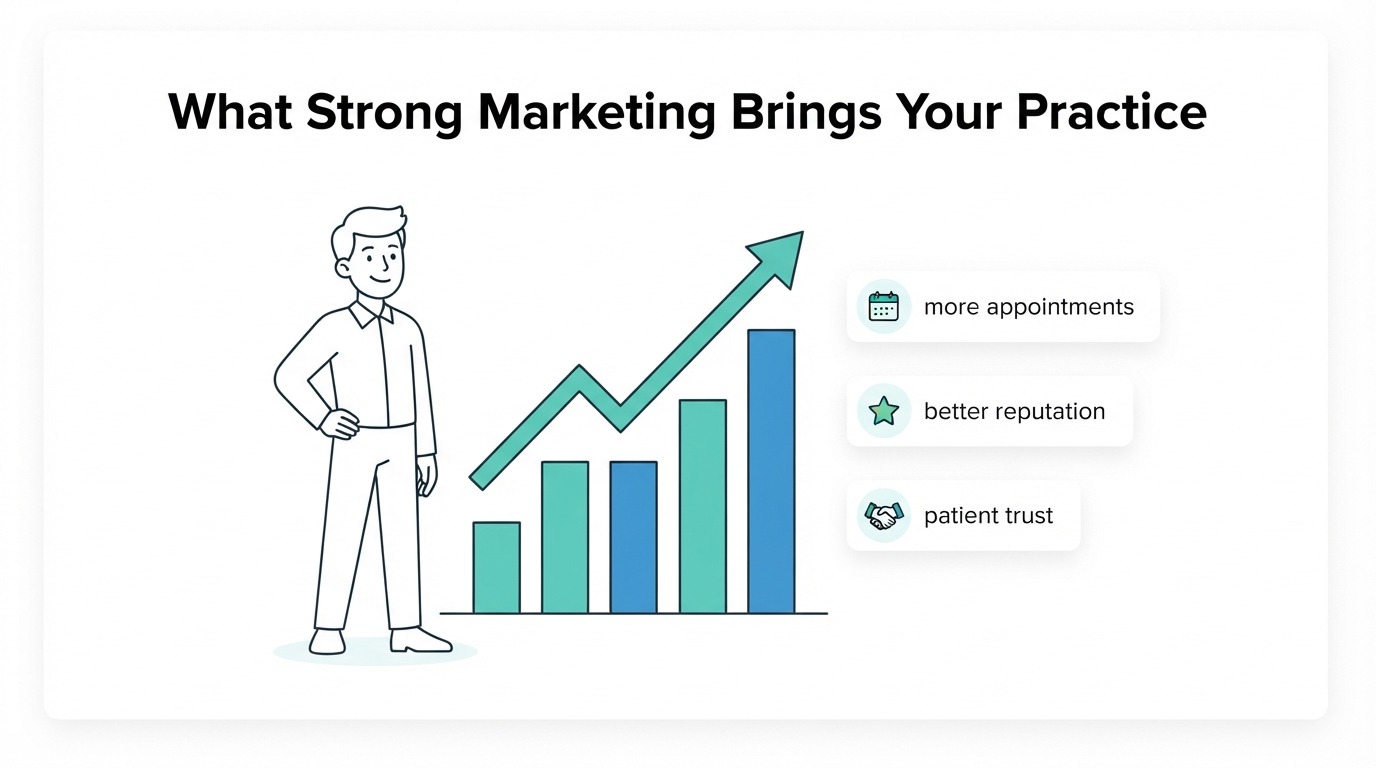
Healthcare marketing provides measurable advantages for clinics, hospitals, and medical practices by improving visibility, patient acquisition, and long-term growth.
Increased Patient Acquisition
A strong digital presence helps healthcare providers attract more patients actively searching for medical services online.
Improved Online Visibility
Healthcare marketing ensures that clinics appear across search engines, local maps, and AI-driven platforms where patients make decisions.
Stronger Trust and Credibility
Consistent reviews, educational content, and professional branding build patient trust and increase the likelihood of bookings.
Higher Conversion Rates
Optimized websites and targeted messaging help convert more website visitors into actual patients.
Competitive Advantage
Effective marketing allows clinics and hospitals to stand out in a highly competitive healthcare environment.
Long-Term Growth
Unlike short-term advertising, healthcare marketing builds sustainable visibility and continuous patient flow over time.
Modern Medical Marketing Strategy (2026 Framework)
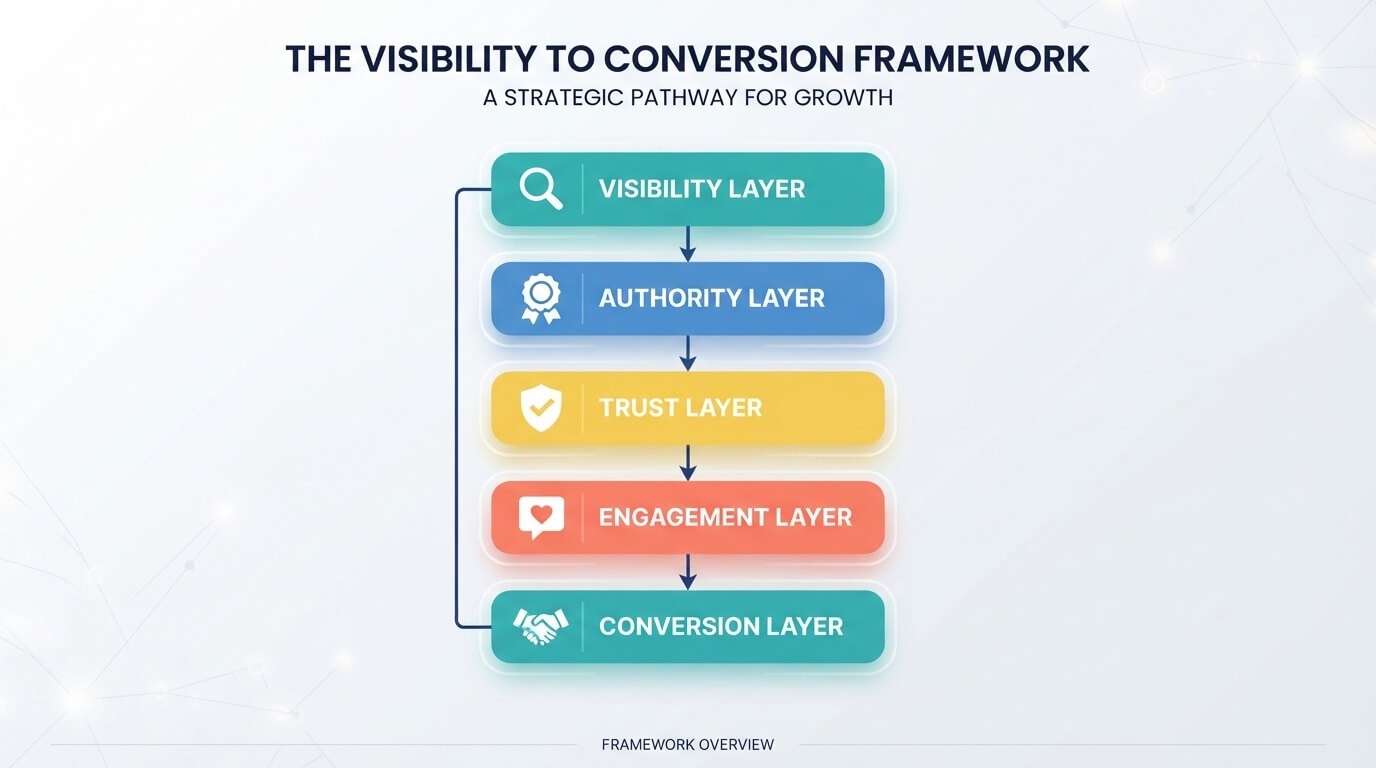
The 2026 medical marketing framework is built as a structured, end-to-end patient acquisition system. Instead of using isolated tactics, this framework connects visibility, trust, and conversion into a continuous growth cycle for clinics and hospitals.
1. Visibility Layer (AI + Search Discovery)
This layer focuses on ensuring healthcare providers are discoverable across modern search ecosystems.
It includes:
- AI-driven search optimization (Google AI Overviews, conversational search)
- SEO for treatment, symptom, and service-based queries
- Local SEO for “near me” and map-based searches
The goal is simple: be present wherever patients are searching.
2. Authority Layer (Content + Expertise Building)
This layer establishes medical credibility and topical authority in the healthcare space.
It includes:
- Educational blog content targeting patient concerns
- Condition and treatment guides
- FAQ-based structured content
- Topic clustering around medical specialties
The goal is: be seen as a trusted medical authority, not just a service provider.
3. Trust Layer (Reputation + Social Proof)
This layer focuses on building patient confidence before they make contact.
It includes:
- Google reviews and ratings management
- Patient testimonials and success stories
- Consistent online reputation monitoring
- Strengthening brand credibility across platforms
The goal is: build trust before the patient ever visits your website.
4. Engagement Layer (Website + Experience)
This layer ensures that visitors stay, explore, and take action.
It includes:
- Fast, mobile-optimized healthcare websites
- Clear service pages and treatment explanations
- Strong call-to-action placement (appointments, calls, inquiries)
- Patient-friendly UX design
The goal is: turn traffic into meaningful engagement.
5. Conversion Layer (Patient Acquisition System)
This is the final layer where attention is turned into booked appointments.
It includes:
- Appointment booking systems
- Landing pages optimized for specific treatments
- Click-to-call and instant contact options
- Retargeting and follow-up systems
The goal is: convert intent into actual patients.
Conclusion
Healthcare marketing in 2026 is no longer optional, it is essential for growth in an increasingly digital and competitive healthcare environment.
As patient behavior continues to shift toward online research and AI-assisted decision-making, clinics and hospitals must focus on visibility, trust, and conversion-driven strategies.
Modern healthcare marketing combines SEO, local search optimization, content marketing, and reputation management into a unified system that ensures consistent patient acquisition and long-term growth.
Organizations that adapt to these changes will remain competitive, while those relying on outdated methods risk losing visibility in the digital landscape.
FAQs
Why is healthcare marketing important?
How does digital marketing help hospitals?
What is included in a modern medical marketing strategy?
Let’s increase appointment bookings
At MedClicx, we help medical practices connect with more patients.

Senior Digital Marketing Strategist &
Healthcare SEO Consultant
James Walker is a Senior Digital Marketing Strategist and Healthcare SEO Consultant at MedClicx. He specializes in helping healthcare organizations and service-based businesses grow their online presence through SEO, content marketing, local SEO, AI search optimization, (GEO), technical SEO, website optimization, and digital marketing strategies.
Over the years, James has worked on improving organic visibility, lead generation, and brand authority by combining search engine optimization, website performance, content strategy, conversion optimization, and AI-ready content. His expertise also includes Google Business Profile optimization, schema markup, user experience (UX), analytics, and modern digital marketing best practices.
At MedClicx, James writes educational articles covering SEO, content marketing, digital marketing, AI search optimization, social media marketing, web design, advertising strategies, podcasts, and online business growth. His goal is to simplify complex marketing concepts and help businesses make data-driven decisions that generate sustainable long-term results.
- James Walker
- James Walker
- James Walker
- James Walker