
Digital Marketing for Doctors: How to Get More Patients Online in 2026
-
 James Walker
Table of Contents:
- What Is Digital Marketing for Doctors?
- The 5 Pillars of Digital Marketing for Doctors
- A Successful Digital Marketing Strategy Checklist
- Conclusion
- FAQs
In today’s highly competitive healthcare landscape, digital marketing for doctors has become essential for attracting new patients and growing a sustainable medical practice.
Patients no longer rely solely on referrals or walk-ins. They actively search online, compare providers, read reviews, and make decisions based on digital presence.
Whether it’s a Google search for “best doctor near me” or checking reviews before booking an appointment, your online visibility directly influences patient acquisition.
Doctors who fail to invest in digital marketing risk losing patients to competitors who are more visible and trusted online.
In this blog, you’ll discover what digital marketing for doctors is and the proven strategies healthcare providers can use to attract more patients, strengthen their online presence, and grow their practice.
What Is Digital Marketing for Doctors?
Digital marketing for doctors refers to the use of online channels and strategies to attract, engage, and convert patients searching for healthcare services.
It involves promoting a medical practice through platforms such as Google, social media, websites, and online directories to increase visibility and patient appointments.
Unlike traditional marketing, which relies on offline methods like print ads or referrals, digital marketing focuses on reaching patients where they spend most of their time (online).
This includes search engines, social media platforms, and healthcare listing websites.
A strong digital marketing strategy for doctors typically includes:
- Search Engine Optimization (SEO) to rank higher on Google
- Local SEO to appear in “near me” searches
- Paid advertising (Google Ads) to generate immediate patient leads
- Content marketing to educate and build authority
- Reputation management to build trust through patient reviews
- Website optimization to convert visitors into booked appointments
In simple terms, digital marketing for doctors ensures that when patients search for medical services online, your practice appears, builds trust, and makes it easy for them to book an appointment.
The 5 Pillars of Digital Marketing for Doctors
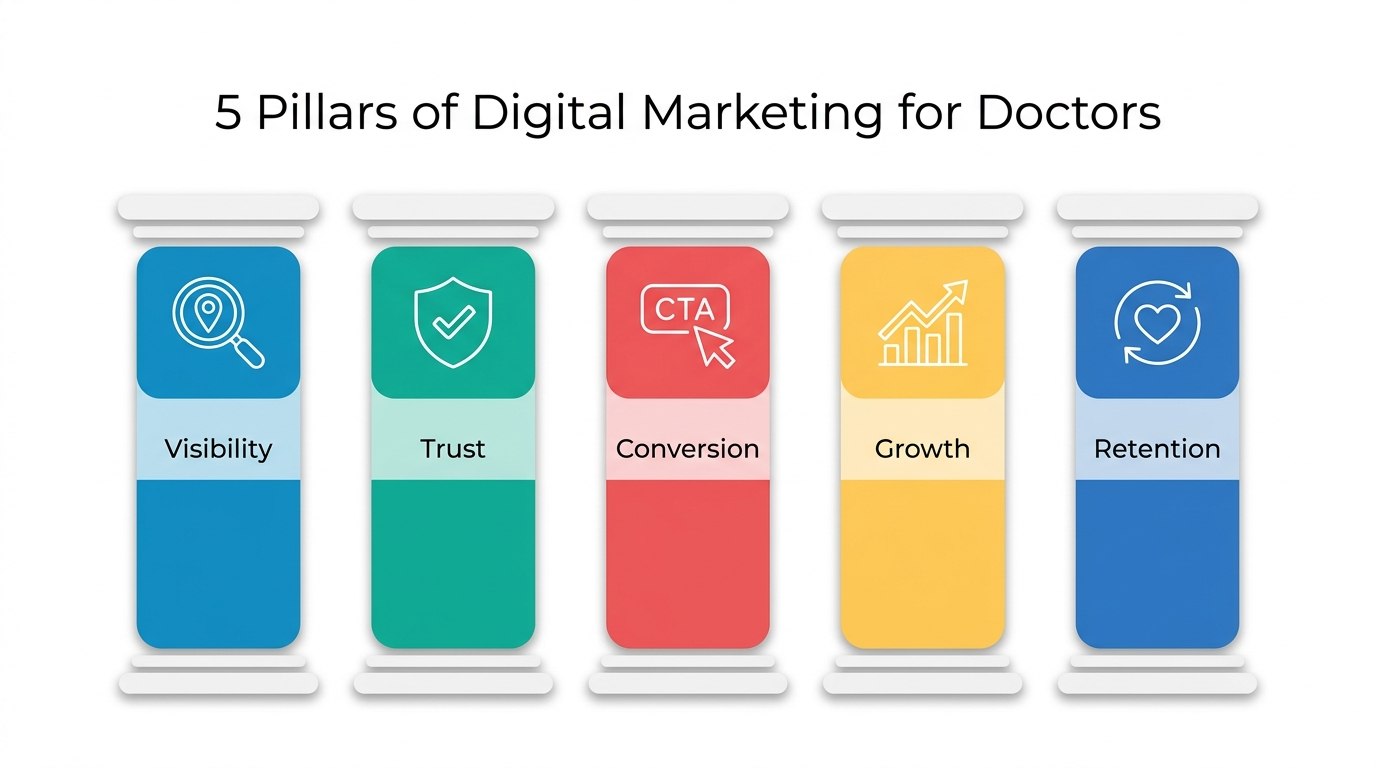
A successful digital marketing strategy for doctors is built on five core pillars. Each pillar represents a critical stage in attracting, converting, and retaining patients online. When combined, they create a complete system for consistent patient growth.
Pillar 1: Visibility (SEO & Local SEO)
Visibility is the foundation of digital marketing for doctors. If patients cannot find your practice online, no other marketing efforts will be effective.
This pillar focuses on ensuring your clinic appears in search results when potential patients are actively looking for medical services.
Optimize Your Google Business Profile
Your Google Business Profile is often the first impression patients have of your practice. Optimizing it helps your clinic appear in Google Maps, local search results, and “near me” searches.
To improve visibility,
- Claim and verify your profile
- Ensure your practice name, address, and phone number (NAP) are accurate
- Select the most relevant business categories.
- Add high-quality photos of your office, providers, and services
- Regularly post updates about new treatments, office announcements, or healthcare tips.
Encouraging patients to leave reviews on your profile can also improve local rankings and build trust with prospective patients.
Invest in Medical SEO
Medical SEO helps your website rank for healthcare-related searches that potential patients are actively making.
To improve rankings, start by identifying keywords patients use when searching for your services, such as specific treatments, conditions, or specialties.
Optimize your website’s title tags, meta descriptions, headings, and content around these keywords. Additionally, improve site speed, mobile usability, and internal linking to create a better user experience.
Regularly updating your website with fresh, relevant content can further strengthen your search visibility and attract qualified patient traffic.
Strengthen Local SEO
Local SEO focuses on helping your practice appear in location-based searches such as “doctor near me” or “best physician in [city].”
To strengthen your local presence, create dedicated location pages for each office location, maintain consistent business information across online directories, and claim listings on healthcare platforms such as Healthgrades, Zocdoc, and Vitals.
Building local backlinks through partnerships with community organizations, hospitals, and local publications can also improve your authority and visibility in local search results.
Create High-Quality Healthcare Content
Content is a powerful tool for improving search visibility and building patient trust. Publishing informative blogs, treatment guides, FAQs, and educational resources helps answer patient questions, demonstrates expertise, and increases your chances of ranking for relevant healthcare searches.
Focus on addressing common patient concerns, explaining procedures, discussing symptoms and treatment options, and providing preventive care advice.
Well-researched content not only supports SEO but also helps patients feel more confident when choosing your practice.
Pillar 2: Trust (Online Reputation & Authority)
Once patients find your practice, they evaluate trust before booking an appointment. This pillar focuses on building credibility through reviews, reputation management, and authoritative content.
Generate More Patient Reviews
Online reviews are one of the most influential factors in a patient’s decision-making process. Encouraging satisfied patients to leave reviews on Google and healthcare platforms helps strengthen your reputation, improve local search rankings, and increase appointment conversions.
You can generate more reviews by sending follow-up emails or text messages after appointments, providing direct review links, and training staff to politely request feedback from happy patients. The easier you make the process, the more likely patients are to leave a review.
Manage Your Online Reputation
Reputation management involves actively monitoring, responding to, and maintaining patient feedback across review sites, social media, and healthcare directories. Regularly check platforms where patients may leave reviews and respond professionally to both positive and negative feedback.
Thank patients for positive comments and address concerns raised in negative reviews while maintaining HIPAA compliance.
Consistent engagement demonstrates that your practice values patient experiences and is committed to delivering quality care.
Establish Medical Authority Through Content
Doctors who consistently share valuable and accurate healthcare information position themselves as trusted experts in their field.
Publishing blogs, videos, FAQs, patient success stories, and condition-specific resources helps build authority, improve patient confidence, and support long-term practice growth.
Focus on creating content that answers common patient questions and reflects your expertise.
Sharing this content through your website, email newsletters, and social media channels can further expand your reach and reinforce your credibility within your specialty.
Pillar 3: Conversion (Website & Patient Experience)
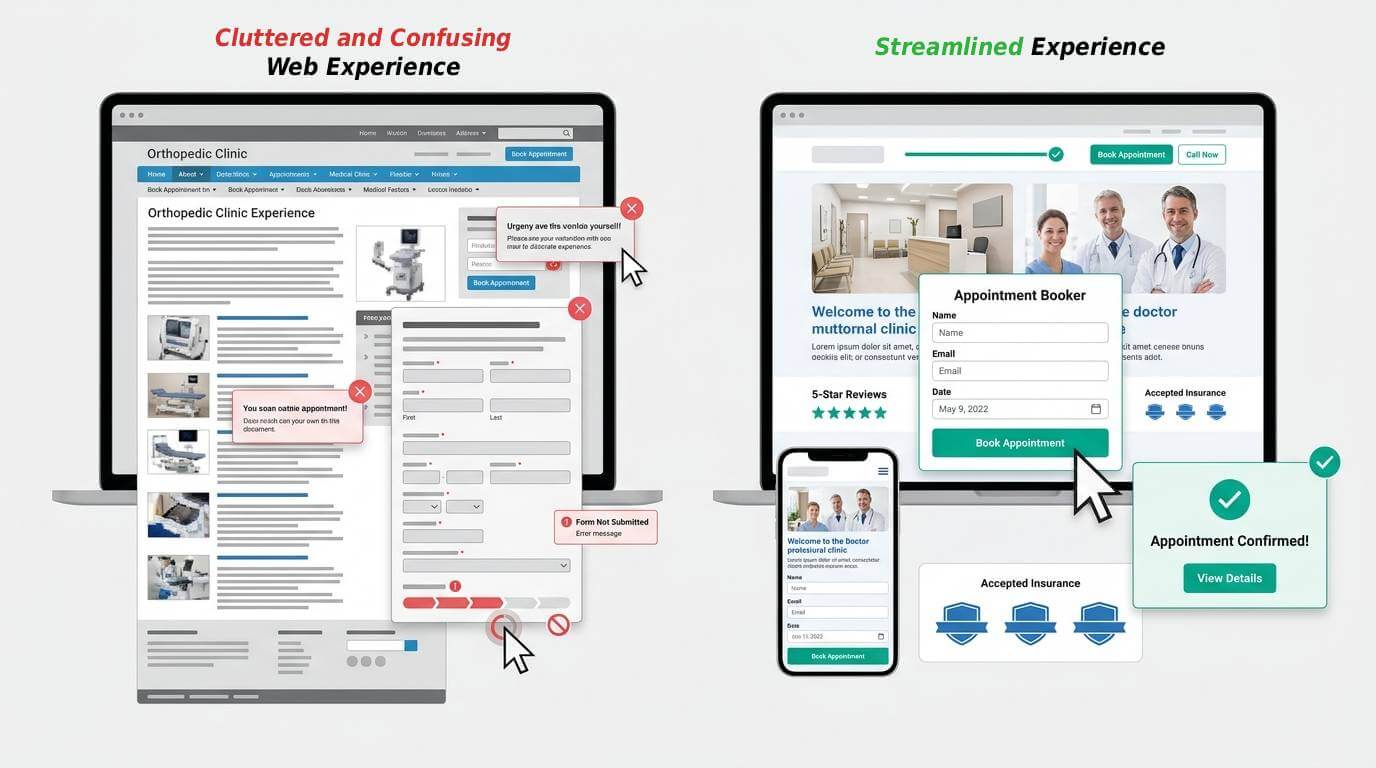
Conversion is the stage where website visitors turn into actual patients. Even if your practice has strong visibility and trust, a poorly optimized website or booking experience can result in lost opportunities. This pillar focuses on improving the patient journey from interest to appointment.
Build a High-Converting Medical Website
A high-converting medical website is designed to guide visitors toward booking an appointment. It should clearly communicate your services, specialties, and value proposition within seconds of landing on the page.
Essential elements include
- Clear calls-to-action
- Provider information
- Patient testimonials
- Service pages
- Easy navigation
The goal is to reduce confusion and make it simple for patients to take the next step.
Improve Mobile User Experience
Most patients search for doctors on mobile devices, making mobile optimization critical. A mobile-friendly website should load quickly, display properly on all screen sizes, and offer easy navigation.
Buttons should be large enough to tap easily, text should be readable without zooming, and important information like contact details and location should be instantly accessible.
Optimize Appointment Booking and Contact Forms
The booking process should be as simple as possible. Long or complicated forms can discourage patients from completing appointments. Instead, use short, clear forms that only ask for essential information. Integrating online scheduling tools or “click-to-call” options can further improve conversions and reduce friction in the patient journey.
Pillar 4: Growth (Advertising & Patient Acquisition)
Growth focuses on actively attracting new patients through paid and organic channels. While SEO builds long-term visibility, this pillar ensures consistent patient flow through targeted marketing campaigns.
Run Targeted Google Ads Campaigns
Google Ads allows doctors to appear at the top of search results instantly for high-intent keywords. By targeting condition-based and service-based searches, you can reach patients who are actively looking for treatment.
Well-structured campaigns, location targeting, and optimized landing pages are key to maximizing return on ad spend.
Leverage Healthcare Social Media Marketing
Social media platforms help doctors connect with patients, share educational content, and build brand awareness.
Platforms like Facebook, Instagram, and TikTok can be used to post health tips, clinic updates, patient education content, and behind-the-scenes insights.
Consistent posting helps humanize your practice and strengthen patient relationships.
Use Video Marketing to Build Patient Confidence
Video content is one of the most effective ways to build trust with potential patients. Videos can explain procedures, introduce doctors, showcase patient experiences, and answer common healthcare questions.
This format helps reduce patient anxiety and increases confidence in choosing your practice.
Pillar 5: Retention (Patient Engagement & Loyalty)
Retention focuses on keeping existing patients engaged and encouraging repeat visits. Acquiring new patients is important, but long-term practice growth depends heavily on patient loyalty and referrals.
Implement Email Marketing Campaigns
Email marketing helps maintain communication with patients after their visit. Regular newsletters can include health tips, clinic updates, seasonal reminders, and preventive care advice.
This keeps your practice top-of-mind and encourages patients to return when needed.
Use Patient Retention Strategies
Retention strategies include follow-up reminders, post-visit care instructions, annual check-up reminders, and personalized communication.
These touchpoints help improve patient satisfaction and ensure continuity of care, which strengthens long-term relationships.
Encourage Referrals and Repeat Visits
Satisfied patients are one of the most powerful sources of new business. Encouraging referrals through excellent patient experiences, friendly communication, and subtle referral reminders can significantly increase patient volume. A strong referral system turns existing patients into advocates for your practice.
A Successful Digital Marketing Strategy Checklist

A successful digital marketing strategy for doctors requires consistency across visibility, trust, conversion, growth, and retention. Use this checklist to evaluate whether your practice is fully optimized for patient acquisition:
- Google Business Profile is fully optimized and regularly updated
- Website is fast, mobile-friendly, and easy to navigate
- Website ranks for relevant medical and location-based keywords
- Patient reviews are consistently generated and managed
- Practice appears in local directories and healthcare listings
- High-quality, patient-focused content is published regularly
- Appointment booking process is simple and friction-free
- Targeted Google Ads campaigns are running for high-intent searches
- Social media channels are active and provide educational value
- Video marketing is being used to build trust and engagement
- Email marketing system is in place to engage existing patients
- Patient referrals and repeat visits are actively encouraged
- Key performance metrics such as traffic, leads, and conversions are tracked
If most of these boxes are checked, your practice is well-positioned for sustainable online growth and increased patient acquisition.
Conclusion
Digital marketing for doctors is no longer an optional growth tactic. It is a core requirement for attracting and retaining patients in today’s healthcare landscape.
Patients are actively searching online, comparing providers, reading reviews, and making decisions based on digital presence.
By focusing on the five pillars (visibility, trust, conversion, growth, and retention), doctors can build a complete patient acquisition system that consistently generates appointments and strengthens long-term practice growth.
A well-executed strategy ensures that your practice is not only visible online but also trusted, chosen, and recommended by patients.
In 2026 and beyond, the doctors who invest in structured digital marketing will continue to outperform those relying solely on traditional referral-based growth.
FAQs
How can doctors attract more patients online?
What is the best digital marketing strategy for doctors?
How important is SEO for doctors?
Does Google Business Profile help doctors get more patients?
How many patient reviews should a doctor have?
Are Google Ads worth it for doctors?
What type of content should doctors publish?
Do doctors need social media marketing?
Let’s increase appointment bookings
At MedClicx, we help medical practices connect with more patients.



Senior Digital Marketing Strategist &
Healthcare SEO Consultant
James Walker is a Senior Digital Marketing Strategist and Healthcare SEO Consultant at MedClicx. He specializes in helping healthcare organizations and service-based businesses grow their online presence through SEO, content marketing, local SEO, AI search optimization, (GEO), technical SEO, website optimization, and digital marketing strategies.
Over the years, James has worked on improving organic visibility, lead generation, and brand authority by combining search engine optimization, website performance, content strategy, conversion optimization, and AI-ready content. His expertise also includes Google Business Profile optimization, schema markup, user experience (UX), analytics, and modern digital marketing best practices.
At MedClicx, James writes educational articles covering SEO, content marketing, digital marketing, AI search optimization, social media marketing, web design, advertising strategies, podcasts, and online business growth. His goal is to simplify complex marketing concepts and help businesses make data-driven decisions that generate sustainable long-term results.
- James Walker

- James Walker

- James Walker
- James Walker