Key Takeaways
- A fake review is not the same as a negative review. Google removes policy violations. Google does not remove a harsh opinion from a real patient.
- Never confirm that a reviewer was your patient in a public reply. That confirmation can itself breach HIPAA.
- Flag the review under the exact policy it breaks. Then appeal once if Google says no violation. Keep evidence in a private file.
- A court order is the strongest removal route. A cease and desist letter alone is rarely enough for Google.
- Do not buy reviews. Do not gate reviews. Do not sue a patient over an opinion.
- The durable fix is volume. Ask every patient the same way. Fresh genuine reviews push one fake review down the page.
A single fake review can cost a doctor real appointments.
Patients read reviews before they book. A one-star review from a person who was never a patient still looks real to a stranger.
It still drops the average star rating. It still shows on Google, Healthgrades, and Yelp. Medical reputation management is the work that protects that first impression.
This guide covers the full process in plain terms.
What Is Medical Reputation Management?
Medical reputation management, aka physician online reputation, is the system a practice uses to monitor, protect, and improve how it appears in online reviews and search results. Healthcare reputation management helps patients trust the practice before they book.
A strong program has five parts.
- Monitoring. Track new reviews on Google, Healthgrades, Yelp, Vitals, WebMD, Zocdoc, and Facebook.
- Removal. Flag reviews that break platform policy.
- Response. Reply in a prompt, professional, HIPAA-safe way.
- Generation. Ask every patient for a review in the same way.
- Repair. Fix listings, profiles, and old content that misleads patients.
Physician review management is not a one-time cleanup. It is an ongoing process.
New reviews arrive every week. A practice that stops monitoring will miss a fake review for weeks.
A healthcare reputation management agency does this work for a practice. It monitors platforms. It drafts HIPAA-safe replies. It files removal requests. It runs review generation.
Google Business Profile optimization keeps hours, services, and booking links accurate. A practice can also do it in-house. The choice depends on time, volume, and risk.
A solo practice with ten reviews a month can manage it with a simple system. A multi-location group usually needs help.
Why Fake Reviews Hurt Doctors
Patients rely on reviews more than most customers do. A patient cannot test a doctor before booking.
A review is often the only social proof available.
- In a Rater8 survey of 1,008 patients in December 2024, 84 percent checked online reviews before booking care.
- In the same Rater8 2026 report, 75 percent of patients said they would not book a provider rated below 4.0 stars.
- In that report, 55 percent said they had canceled or avoided a booking because of reviews. That figure was 40 percent in 2025.
A fake review can move a practice below the 4.0-star line that many patients use as a cutoff. It can also change a local ranking.
Google rewards profiles with recent reviews and prompt responses. A strong local profile helps too. Our guide to local SEO for healthcare practices explains the full system.
Doctors also face a limit that other businesses do not face. A restaurant can reply with facts. A doctor cannot. HIPAA stops a doctor from confirming a patient relationship in public.
A doctor cannot correct a false clinical claim with the real clinical facts.
Fake Review or Negative Review?
The first step is to separate two different problems. A fake review can often be removed. A negative review from a real patient usually cannot be removed.
A fake review is not based on a real patient experience. It may come from a person who was never a patient.
It may come from a competitor, a former employee, or a family member. It may be paid, bot-generated, or copied across platforms.
It may describe the wrong doctor, the wrong service, or the wrong location. It may demand money to be removed.
That is extortion.
A negative review is from a real patient who did not like the experience. The patient may say the wait was long.
The patient may say the doctor seemed rushed. The patient may say the front desk was rude.
That review is an opinion.
Google, Yelp, and Healthgrades protect opinion. They do not mediate a factual dispute between a practice and a real patient.
They do not remove a review because a practice disagrees with it.
| Review type | Example | Removable? |
| Fake, non-patient | A reviewer with no visit record posts about a procedure the practice does not offer | Yes, if policy is broken and evidence is filed |
| Fake, conflict of interest | A competitor or former employee posts as a patient | Yes, under conflict of interest policy |
| Fake, paid or bot | The same text appears on several profiles in one day | Yes, under fake engagement policy |
| Fake, extortion | A reviewer demands payment to remove a one-star review | Yes, use the extortion route |
| Negative opinion | A real patient says the wait was terrible | No, reply instead |
| Negative fact dispute | A real patient says the doctor was late, and the practice says otherwise | No, reply instead |
Ask one question before filing. Can you prove the reviewer was never a patient? Can you prove the review breaks a written policy?
If the answer is no, do not file as fake. Reply instead.
How to Remove a Fake Google Review?
Google is the most important platform for doctor review management. Most patients start on Google.
Google also has the clearest removal process. Use it in order.
Do not skip a step.
Step 1. Save evidence
Save a screenshot of the review with the reviewer’s name, the date, the star rating, and the full text. Save the reviewer profile link.
Save the same review if it appears on other platforms. Note the date you first saw it.
Check your own records in private. Search the appointment book and the patient list for the reviewer’s name.
Note the result in a private file. Do not post that result in public. Do not include protected health information in any filing to Google.
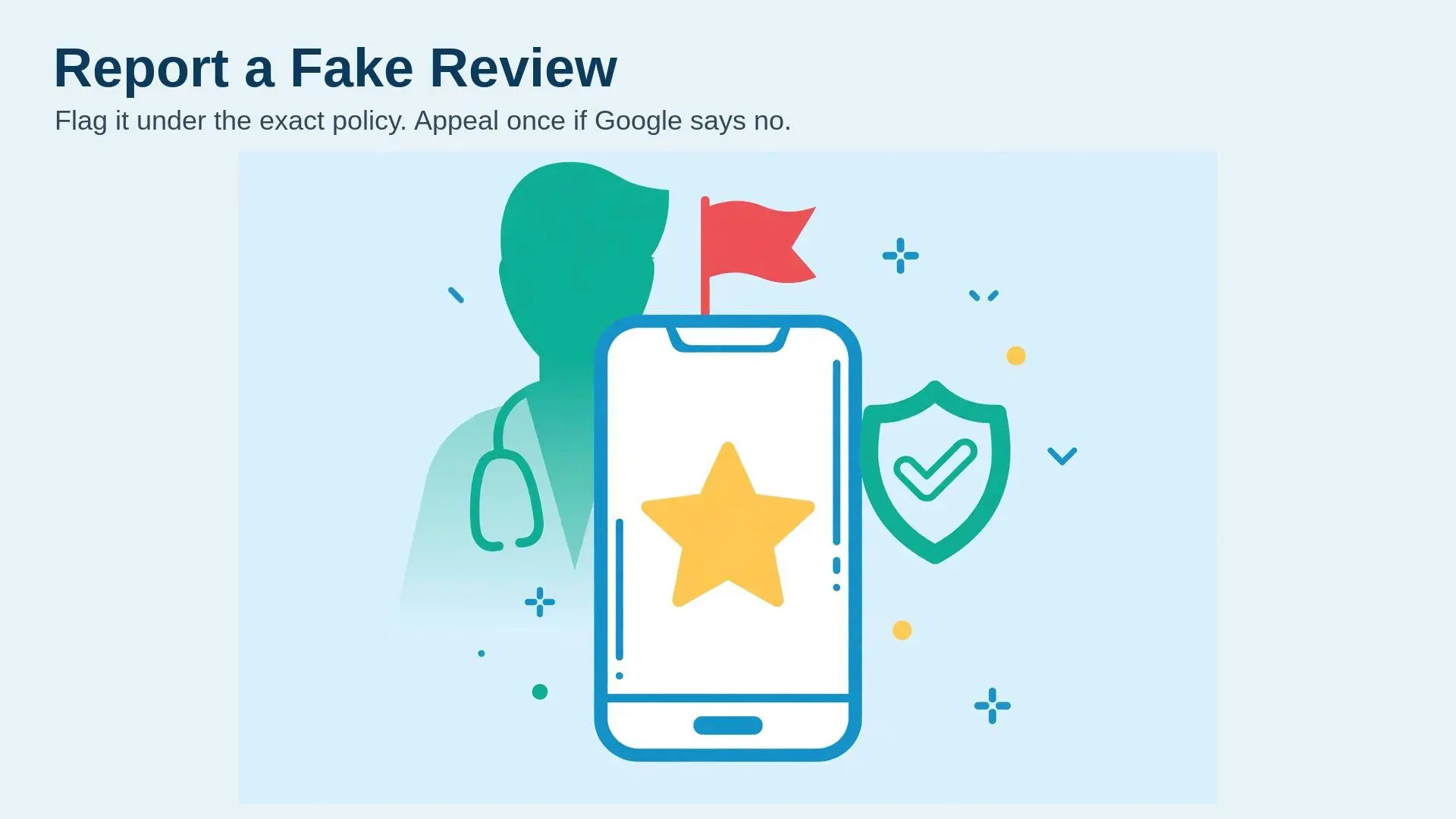
Step 2. Flag the review under the exact policy
- Open Google Maps or your Google Business Profile. Find the review.
- Select Report. Choose the reason that matches the specific policy.
- Use fake engagement for a non-patient, paid, or bot review. Use conflict of interest for a competitor or former employee.
- Use off-topic for a review about a different business or location. Use the extortion route when money was demanded.
- Do not choose a vague reason. Do not report a review just because you dislike it.
Google states this plainly. Google does not get involved in a conflict between a business and a customer.
If the review complies with policy, it will stay live.
Step 3. Appeal once if Google says no
Go to the Google Reviews Management Tool. This tool is best for more than one review. It also tracks status.
Google says a first decision typically takes several days. Vendor reports put it at about three business days for an initial decision.
If the first decision is no policy violation, you get one appeal.
Use the Reviews Management Tool. You can appeal up to ten reviews in one batch.
Attach evidence. Include screenshots with timestamps. Include the reviewer profile. Include proof of no visit, without protected health information.
Include wrong service or wrong location facts. Include pattern evidence, such as the same text on several profiles.
Step 4. Use the legal route only for a legal reason
Google has a separate legal removal request form. Use it for defamation, private personal information, or a court order.
This is the slowest channel. It also has the highest bar.
A cease and desist letter alone is rarely enough. A court order that names the specific URL is the route that works.
The legal section below gives the full details. Reply while you wait. Do not wait in silence.
A calm, generic, HIPAA-safe public reply is what future patients see. The reply section below gives a template.
Google removes a large volume of reviews each year. Google blocked or removed more than 240 million policy-violating reviews in 2024.
That figure rose to more than 292 million in 2025. Those figures show the scale. They do not guarantee that your review will be removed.
How to Remove Fake Reviews on Other Platforms
A fake review rarely stays on one platform. A copied one-star review on Google, Yelp, and Healthgrades reads to a stranger as three unhappy patients.
File on each platform. A Google removal does not remove the same text elsewhere.
| Platform | Who can review | How to report |
| Google Business Profile | Anyone, no patient verification | Flag in Maps or the Reviews Management Tool, one appeal |
| Yelp | Anyone, with an algorithm filter | Report Review under the review, then contact Support |
| Healthgrades | Patient submitted surveys and reviews | Flag on the listing or contact support for an Editorial Policy review |
| Zocdoc | Only patients who booked through Zocdoc, after the appointment | Dispute to Zocdoc Trust and Safety, within one year of approval |
| Vitals | Patient submitted reviews | Flag on the listing or contact support |
| Anyone can post a Recommendation | Report the Recommendation, or turn Recommendations off |
Reviews also spread across locations. Our multi-location healthcare marketing guide covers how to manage online reviews across every location.
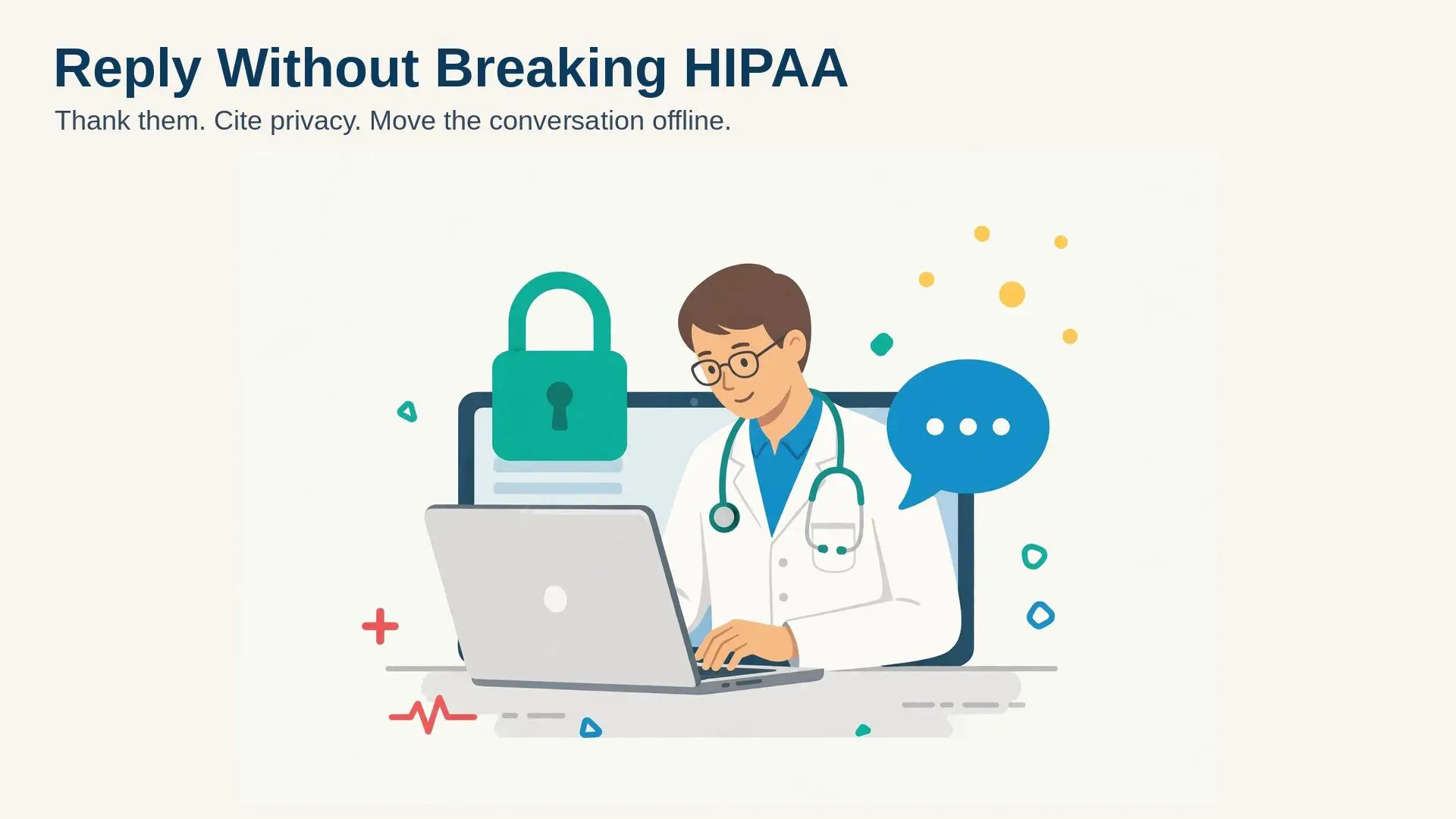
How to Respond Without Breaking HIPAA
A future patient reads the reply before they read the review.
A calm reply can neutralize a fake review even while a removal request is pending. A careless reply can create a HIPAA breach that costs far more than the review.
HIPAA does not stop a practice from responding to reviews. HIPAA stops disclosure of protected health information without the patient’s written authorization.
Protected health information is any information that identifies a patient and relates to their health, care, or payment for care.
Confirming that someone was your patient is itself a disclosure. It links an identifiable person to the fact that they received care.
You do not need to mention a diagnosis to cross the line. The patient posting their own story does not give the practice permission to add to it. Defending your reputation in public is not a permitted disclosure purpose under HIPAA.
Never say in a public reply that the reviewer is or was a patient. Never say thank you for visiting our clinic.
Never say when you came in last Tuesday. Never say we have no record of you as a patient. That line is risky.
Never share a clinical detail. Never name a visit type, a treatment, a procedure, a diagnosis, an outcome, or a medication.
Never name the clinician who treated the reviewer. Never share a date, an appointment, or a wait time for their visit.
Never share billing, balances, or insurance details.
Use the same generic reply for a positive review and a negative review where possible. That consistency protects the practice.
How to Get More Real Reviews
One fake review hurts less when a practice has 200 genuine reviews. It hurts more when a practice has 12 reviews.
Ask every patient the same way. Send a review request by text or email shortly after a visit.
Use the same public link for every patient. Do not route happy patients to Google and unhappy patients to a private form. That is review gating.
Do not pay for reviews. Do not buy fake reviews. Do not use AI-generated fake testimonials.
Each review can be a separate 53,088 dollar penalty.
Respond to every review. A steady stream of new reviews, paired with prompt responses, does more for local visibility than almost any other single action.
MedClicx runs online reputation management for doctors as a done-for-you service. It covers monitoring, HIPAA-compliant replies, removal requests, and automated review generation.
Automated requests, alerts, and reply drafts can run through AI agents and automation, with a human approving what goes out.
MedClicx Final Take on Medical Reputation Management
A fake review is a test of a system, not a test of a single reply. A practice with a monitoring system will see it in a day.
A practice with an evidence file will file a clean removal request. A practice with a HIPAA-safe template will reply without creating a new problem.
Start with the basics. Monitor Google, Healthgrades, Yelp, and Zocdoc every week.
Flag a fake review under the exact policy it breaks. Appeal once if the first decision is no.
Reply with a generic, HIPAA-safe template while you wait. Ask every patient the same way for a review.
If the review contains a provably false fact and the harm is measurable, talk to a lawyer. A court order is the strongest removal route.
Start with a free audit. It compares your rating and review count with three local competitors and gives you a three-point action plan.
Keep in mind, this is general information. It is not legal advice.

James Walker is a Senior Digital Marketing Strategist and Healthcare SEO Consultant at MedClicx. He specializes in helping healthcare organizations and service-based businesses grow their online presence through SEO, content marketing, local SEO, AI search optimization, (GEO), technical SEO, website optimization, and digital marketing strategies.
Over the years, James has worked on improving organic visibility, lead generation, and brand authority by combining search engine optimization, website performance, content strategy, conversion optimization, and AI-ready content. His expertise also includes Google Business Profile optimization, schema markup, user experience (UX), analytics, and modern digital marketing best practices.
At MedClicx, James writes educational articles covering SEO, content marketing, digital marketing, AI search optimization, social media marketing, web design, advertising strategies, podcasts, and online business growth. His goal is to simplify complex marketing concepts and help businesses make data-driven decisions that generate sustainable long-term results.
- James Walker

- James Walker
- James Walker
- James Walker