AI SEO for Doctors: A Practical Guide to Getting Found by Google AI, ChatGPT, and Other Chatbots
-
 James Walker
Table of Contents:
- What AI SEO for Doctors Actually Means
- Why SEO for Doctors Looks Different Now
- How AI Engines Actually Decide Which Doctors to Mention
- Building an SEO Strategy for Doctors That Covers Both Google and AI
- Where AI Tools Actually Pull From?
- Advanced SEO for Doctors
- SEO for Private Doctors vs SEO for Medical Practice Groups
- Some Important Things to Consider in Medical AI SEO
- How to Actually Measure If Any of This Is Working
- MedClicx Final Take on Medical AI Optimization
Quick answer: AI SEO for doctors means structuring a practice’s website, content, and online listings so tools like ChatGPT, Google AI Overviews, Gemini, and Perplexity pull it into their answers, not just regular Google rankings.
- It builds on standard SEO for doctors (technical health, local listings, content quality) rather than replacing it
- AI tools favor sites with clean structured data, consistent credential information, and content written in direct question-and-answer format
- Local SEO and reputation signals carry just as much weight as before, since most AI answers lean on the same local data Google already trusts
- Results build over months, and no tool today can guarantee a specific mention inside an AI answer, whatever an agency pitch deck claims
What AI SEO for Doctors Actually Means
AI SEO for doctors is the work of optimizing a medical website, its content, and its presence across the web so AI search tools surface and cite that practice when patients ask health-related questions. It sits on top of regular seo for doctors rather than replacing it.
If the underlying site is weak, no amount of AI-specific tweaking fixes that, the same way a badly built house doesn’t get saved by a nice paint job.
Nobody, including the AI companies themselves, has published a reliable playbook for guaranteeing a mention inside a ChatGPT or Gemini answer.
What exists is a growing, testable pattern instead. Right now, AI SEO for doctors is mostly about doing traditional SEO and digital presence work properly, then adding a handful of AI-specific technical adjustments on top of that foundation.
Why SEO for Doctors Looks Different Now
Patient search behavior has shifted in a way that’s easy to miss if you’re only watching Google Search Console.
A growing share of health questions now start in ChatGPT, Perplexity, or a Google AI Overview box instead of a traditional page of blue links.
Someone with a new symptom, a medication question, or a “do I need to see a specialist for this” question increasingly asks an AI assistant first, sometimes before they’ve even decided what type of doctor to look for. This overlaps with the same shift that’s been building with voice search for years, just accelerated and made more conversational.
Traditional SEO is optimized for a click. AI search often skips the click entirely. The tool reads the page, extracts an answer, and hands it to the patient directly, sometimes naming a practice as the source and sometimes not.
A practice can be the actual source behind an AI’s answer and never see a single visit in its analytics for it. That’s a real, unresolved tension in this whole space right now.
This kind of zero-click outcome goes a step further than the old zero-click search problem search marketers have complained about for years.
A medical seo strategy that chases AI-specific hacks while ignoring classic ranking factors is building on sand. This shift is also part of a broader set of healthcare marketing trends reshaping how practices get found online, not an isolated AI fad that will fade on its own.
How AI Engines Actually Decide Which Doctors to Mention
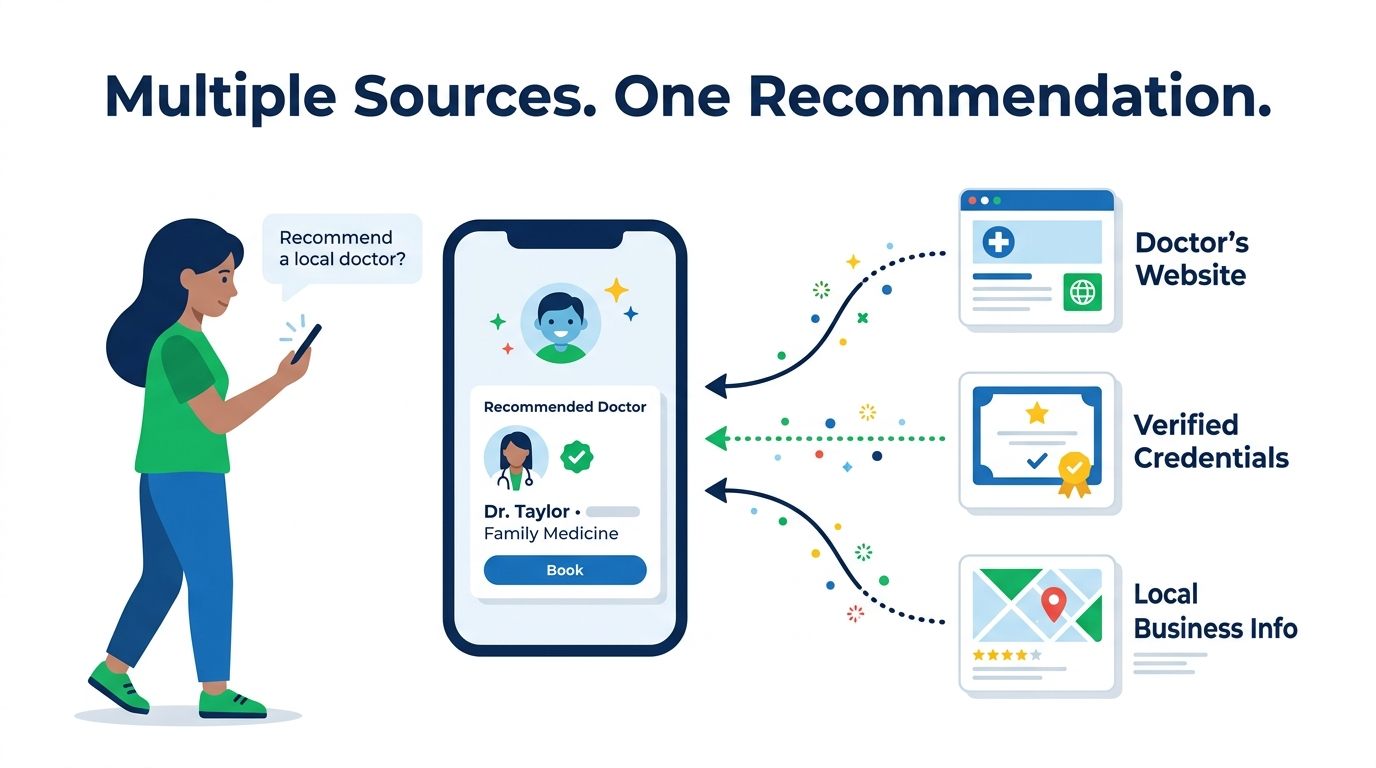
AI tools generally pull information two ways.
Some answers come straight from the model’s training data.
Others come from a live retrieval step, where the tool runs a search and reads a handful of top results in real time before answering.
For anything local or current, like “who’s a good dermatologist near me,” it’s almost always the second kind.
What that means practically is “the pages an AI tool reads during retrieval are usually the same pages already ranking well in regular search for that query”.
There isn’t a separate “AI index” a practice needs to get into. There’s the same index, read differently, and a page’s traditional Google authority still does most of the heavy lifting.
AI retrieval diverges from a human scanning search results in what it extracts and trusts. A model skimming several pages in a couple of seconds favors content that:
- States facts plainly
- Uses clear headings
- Doesn’t bury the actual answer under three paragraphs of marketing copy.
It also weighs trust signals heavily, things like consistent author credentials, matching information across multiple sources, and structured data that removes ambiguity about what a page is actually saying.
Building an SEO Strategy for Doctors That Covers Both Google and AI
A real seo strategy for doctors in this environment can’t treat “rank on Google” and “get cited by AI” as two separate projects. They share most of the same foundation. Here’s what that shared work actually looks like, layer by layer.
Doctors Website SEO
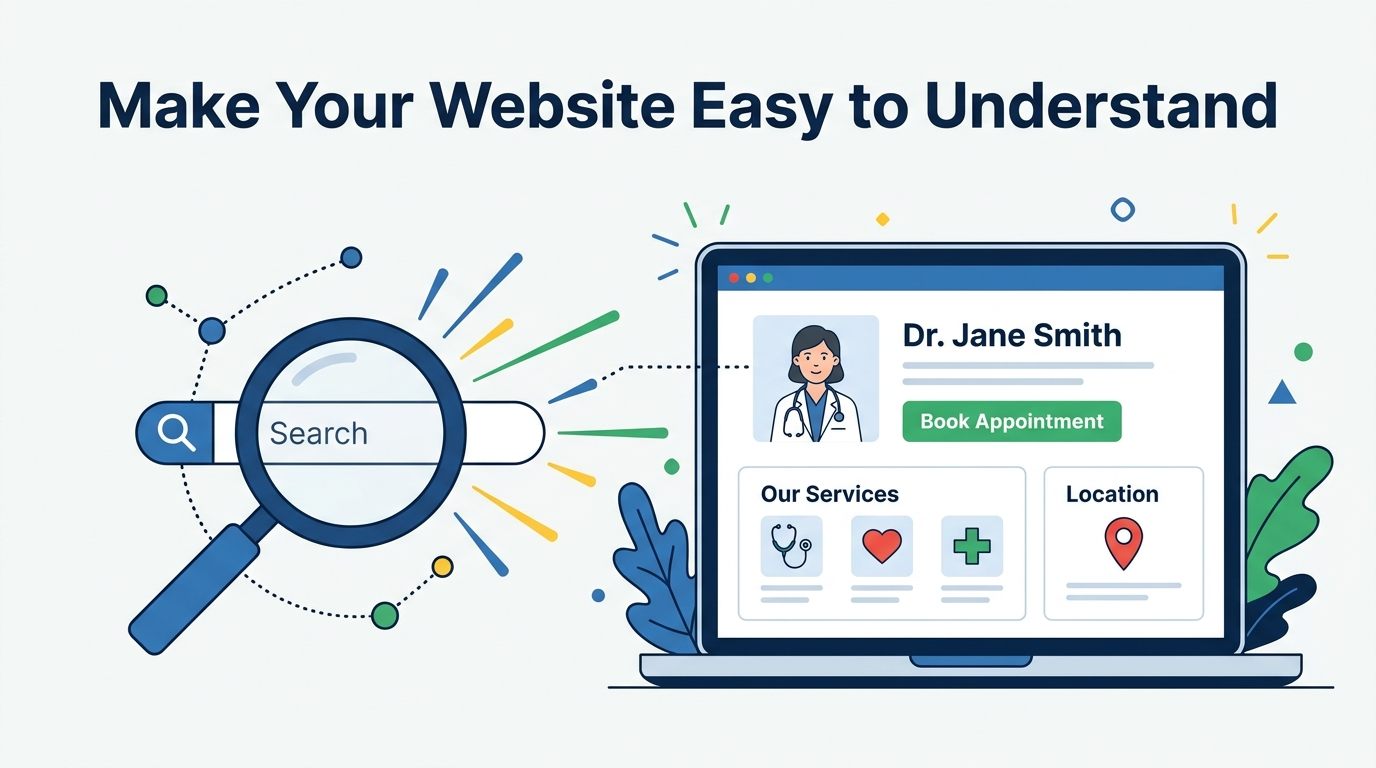
Doctors website SEO starts with making sure the site can actually be read by both search crawlers and AI crawlers. GPTBot and Google-Extended are training crawlers.
Blocking them keeps your content out of future model training data, but it has no effect on regular Google rankings or Google’s own AI Overviews, which still run through standard Googlebot.
A surprising number of practices have years-old robots.txt file that blocks all of this indiscriminately, often without anyone on the team realizing it.
For a practice that wants AI visibility, the practical move is usually to keep the retrieval bots open while making a deliberate, informed choice about the training bots. Treat it as a signal, not a guarantee.
Core technical basics still apply and still get skipped constantly:
- Clean HTML structure with one clear H1 per page
- A logical heading hierarchy underneath it
- Fast load times
- Smooth mobile experience
None of this is new. What’s changed is that these basics now affect two different systems instead of one.
Structured data deserves more attention than most practices give it. Physician schema, MedicalOrganization schema, and FAQ schema, properly implemented, give search engines and language models an unambiguous, machine-readable version of what a page is saying. A team handling medical website design from the ground up tends to get this implemented from day one instead of adding it later.
Content Structured to Get Extracted
This is probably the single biggest practical shift for medical seo strategy right now.
Write the direct answer first, then explain. If a page is about what causes plantar fasciitis, the first two or three sentences should actually answer that, in plain language, before getting into causes, risk factors, or treatment options.
Use real questions as subheadings where it makes sense, not just keyword phrases. A heading like “How long does recovery take after a knee replacement” is more likely to get pulled into an AI answer than “Knee Replacement Recovery Timeline,” even though both target similar search intent.
E-E-A-T and Credential Signals
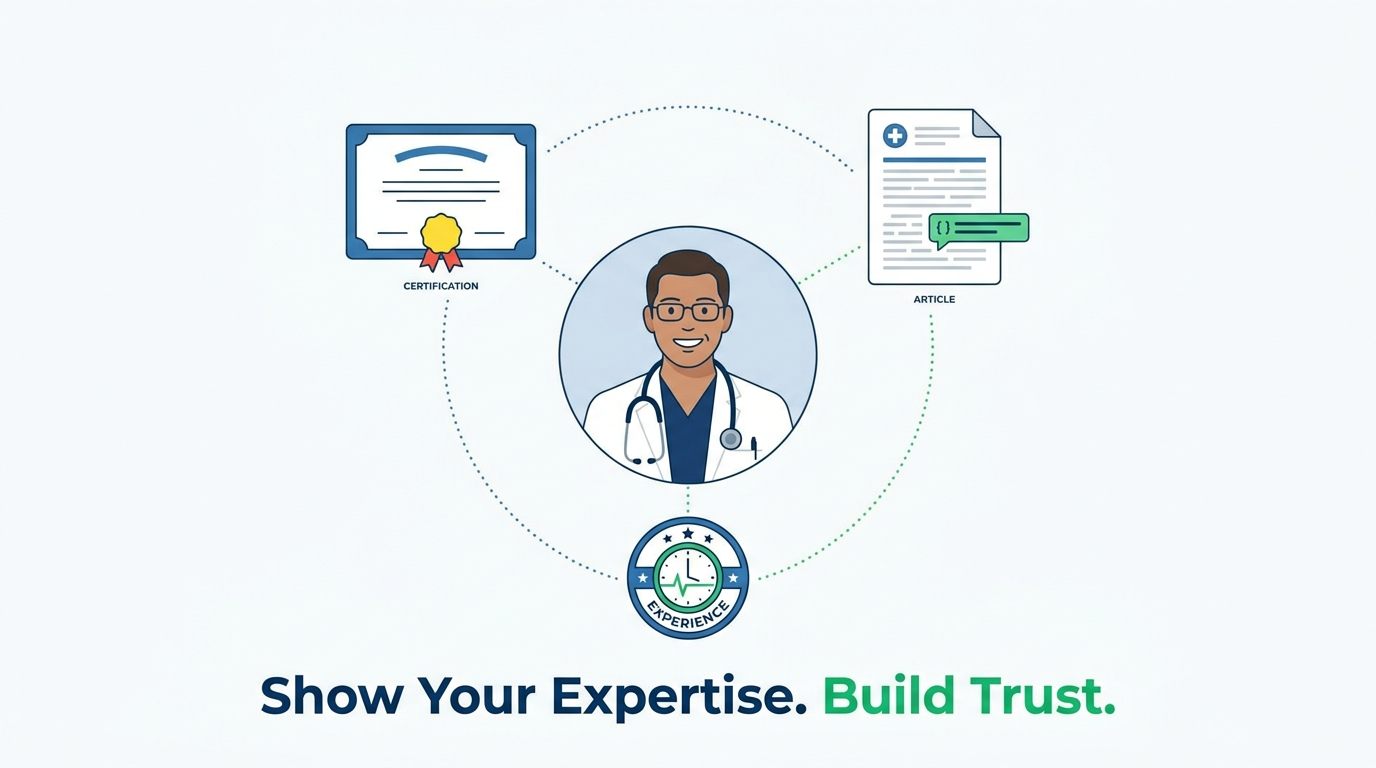
Medical content falls under what Google calls YMYL, short for Your Money or Your Life. AI tools seem even more cautious about citing health content without visible credentials behind it.
Author bios need to be real and specific. A “medically reviewed by” line attached to a real physician, consistently formatted across every relevant page, does more trust-building work than most practices realize.
The inconsistency problem shows up constantly here. A doctor’s name spelled one way on the website, a slightly different way on Healthgrades, and missing a credential entirely on a third directory creates exactly the kind of ambiguity that makes an AI system less confident about citing that source.
SEO for physicians specifically benefits from treating the individual doctor as an entity worth building consistent authority around. A physician with a complete, consistent professional footprint, bio, credentials, published content, professional association listings, tends to get treated as a more trustworthy source than an anonymous “our team” page ever will.
Local SEO Plan for Doctors
Google Business Profile accuracy matters as much as it ever did, maybe more. Services listed individually rather than lumped together, current hours, real photos, and a steady stream of recent reviews all contribute to the local data layer that both Google and AI tools draw from when answering a “near me” or “[specialty] in [city]” style question. Reviews do double duty here. They influence local ranking directly, and the actual text of reviews often gets scanned by AI tools.
NAP (name, address, and phone number) consistency matching exactly across the website, the Google Business Profile, and every directory listing sounds like a boring detail, but it’s one of the most common reasons a practice’s local presence looks fragmented to both search engines and AI systems.
If a practice moved locations two years ago and half the directories still show the old address, that’s not a small issue. It’s actively confusing the trust signals a local seo plan for doctors depends on.
Practices that struggle to keep review generation and response consistent often hand it off to a dedicated reputation management agency for doctors rather than letting it slide between other priorities.
Where AI Tools Actually Pull From?
AI tools draw from a much wider set of sources than that, and ignoring those sources leaves real visibility unclaimed.
Press mentions, local news coverage, and even a practice’s presence in community health initiatives feed into the same trust graph. Reddit and forum mentions have become a surprisingly significant source for some AI tools too.
A local news feature, a guest contribution to a health publication, or a mention from a relevant medical association doesn’t just build a backlink in the old SEO sense.
It builds the kind of cross-referenced, third-party-confirmed presence that AI systems lean on heavily when deciding whether a source is trustworthy enough to cite by name.
Advanced SEO for Doctors
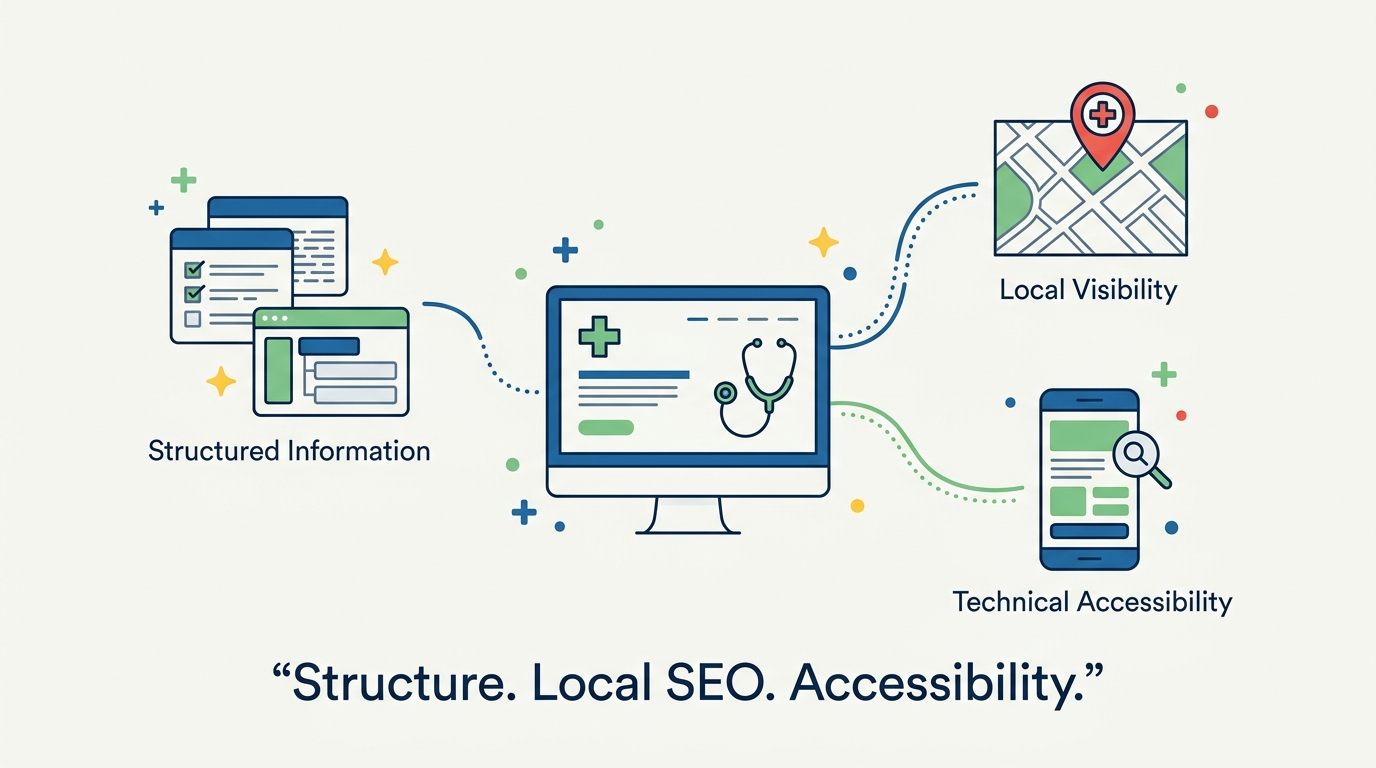
Everything covered so far is foundational. Advanced seo for doctors is what separates practices that occasionally show up in an AI answer from ones that show up consistently, across multiple tools, for multiple related queries.
Topical depth is the clearest differentiator. A practice with one decent page about a condition competes with every other practice that also has one decent page about that condition. A practice with a genuinely thorough content cluster builds something AI models can draw from repeatedly and confidently, because the depth itself signals real expertise rather than a single page built to rank for one keyword.
Internal linking at an advanced level means connecting that content cluster together deliberately. Loose, disconnected pages that happen to cover related topics do far less for entity understanding than a cluster that’s explicitly linked and structured.
Medical Schema markup goes beyond the basics. Layering Physician schema with MedicalProcedure, MedicalCondition, and Review schema gives AI systems a much richer, more specific picture of what a practice actually does and treats rather than a generic signal that it’s simply “a medical website.”
Using AI to mass-produce content as a shortcut through all of this is a real risk. Search engines and AI systems are increasingly good at spotting unreviewed, generic AI content. And in a YMYL category like healthcare, that kind of content tends to hurt trust signals rather than build them.
AI-assisted content that’s actually reviewed, fact-checked, and credited to a real clinician is a different thing entirely from AI content published on autopilot, and the difference shows up in results.
SEO for Private Doctors vs SEO for Medical Practice Groups
The core principles don’t change between a solo practitioner and a twelve-location medical group, but the practical reality of executing them does, quite a bit.
A single-location practice competing in a defined local market can build a tight, well-connected content cluster and a clean local presence much faster than a large organization juggling dozens of providers and locations.
The trade-off is resources. A solo practice usually doesn’t have a marketing team, which means this work either gets outsourced or gets squeezed into whatever time is left after seeing patients, which realistically isn’t much.
Medical practice groups with multiple providers and locations run into a different problem, which is scale without duplication. Each location needs its own genuinely localized page, each provider ideally needs their own credentialed bio page, and none of it can be templated so heavily that it starts reading as duplicate or near-duplicate content across the site.
This is also where internal structure gets genuinely complicated, and where the kind of structural planning covered in multi-location healthcare marketing matters even more, since a poorly planned content hierarchy can quietly work against every individual location instead of supporting it.
Multi-provider groups also have an advantage solo practices don’t, which is more entities to build authority around. A group with eight board-certified physicians has eight separate trust-building opportunities feeding into the same practice brand, as long as that structure is set up intentionally rather than left as an afterthought.
Some Important Things to Consider in Medical AI SEO
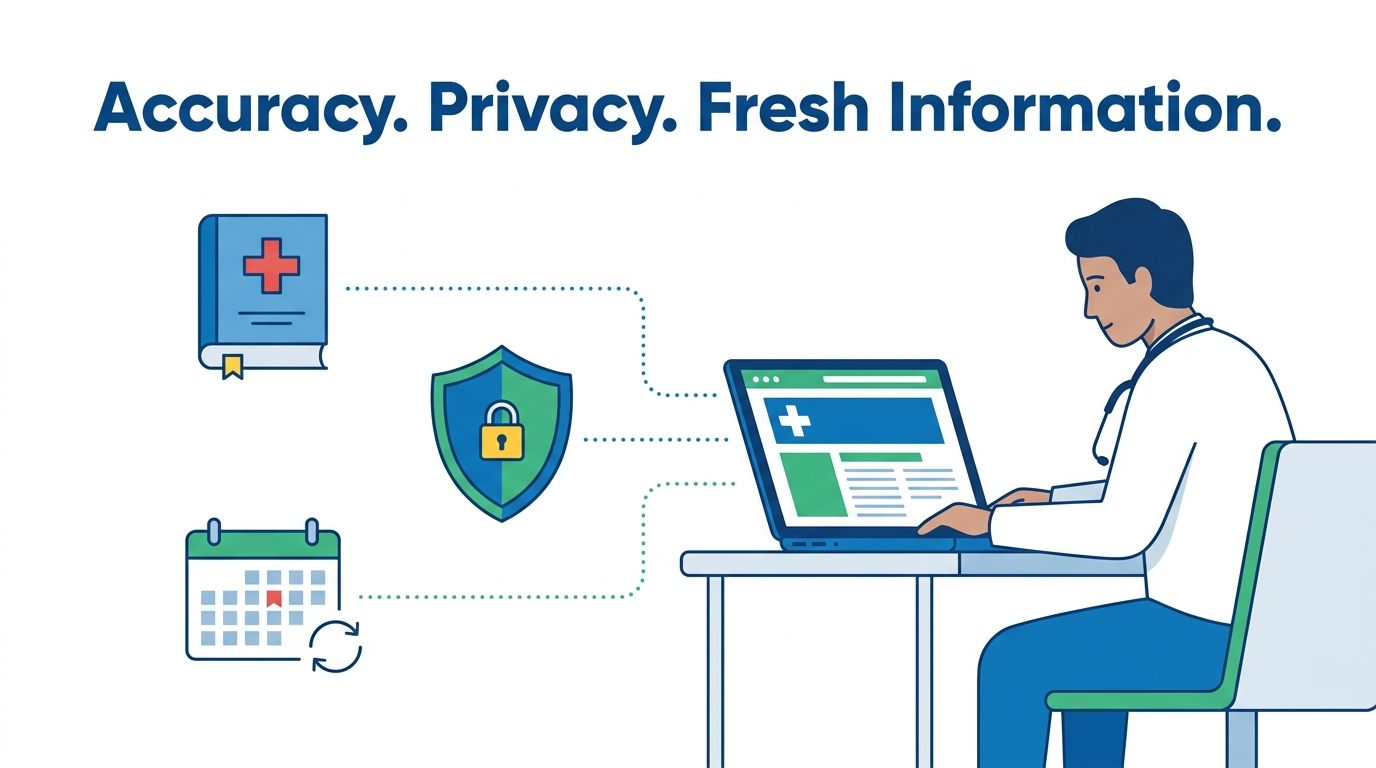
No tool currently guarantees a ranking or a citation inside a ChatGPT, Gemini, or Perplexity answer, and any agency or consultant claiming otherwise is selling something they can’t actually deliver.
These systems change constantly, aren’t transparent about their exact retrieval logic, and differ enough from each other that optimizing narrowly for one can mean nothing for another.
Llms.txt is a good example of something worth watching critically rather than rushing to implement. It’s a proposed file, similar in spirit to robots.txt, meant to give AI models a curated map of a site’s content.
As of now, it remains a community convention rather than a formal, universally adopted standard. A few tools appear to make some use of it, but Google has been explicit that it isn’t a required signal, and that its own AI Overviews and Gemini behavior don’t visibly shift based on whether one exists.
Adding a well-built file is low effort and unlikely to hurt anything, but treating it as a guaranteed lever right now is getting ahead of the actual evidence.
The core technical priorities, clean crawler rules, structured data, fast and crawlable pages still matter more.
Keyword stuffing phrases like “best AI SEO,” repeating a target phrase unnaturally across a page in hopes of looking like an obvious match for an AI query, doesn’t work the way some advice suggests.
Language models understand semantic meaning and intent well enough that this kind of forced repetition reads as exactly what it is, and it does nothing for traditional rankings either, which still penalize it.
The honest reality is that AI SEO right now is mostly real SEO and real digital presence work done properly, with a smaller layer of genuinely new, AI-specific adjustments on top. Anyone selling a complete reinvention of the playbook is overselling it.
How to Actually Measure If Any of This Is Working
Measurement here is genuinely harder than traditional SEO.
Traditional metrics still matter as a baseline. If those are moving in the right direction, the foundational work is probably paying off, with or without AI-specific visibility layered on top.
For AI-specific visibility, the most reliable method right now is also the most manual: actually querying ChatGPT, Gemini, Perplexity, and Google’s AI Overview with the kinds of questions real patients would ask, and tracking, by hand, whether and how the practice gets mentioned.
However, Google Search Console has now added a new feature under the Performance tab named “Generative AI”.
This tab can show you data from Google AI overviews about your rankings in AI search. It shows impressions, page URLs (that are getting cited), countries, and device information.
Still, it is in the beta testing phase and does not give comprehensive query and click data. No single, fully reliable automated tool for this exists yet. Treat those tools as a helpful directional signal, not a precise measurement.
A sudden appointment inquiry that mentions an AI assistant recommending the practice is also a real, if informal, data point worth logging when a front desk team happens to hear it.
MedClicx Final Take on Medical AI Optimization
Most practices don’t have the bandwidth to run technical audits, rebuild schema, query AI tools by hand every month, and keep a content cluster growing on top of actually seeing patients. That ongoing workload is exactly why medical SEO services exist as a dedicated function rather than a side project.
MedClicx runs this process for physician practices directly, combining the technical and local SEO plan for doctors’ work covered here with the content depth and entity building that AI retrieval actually rewards.
A free quote is the fastest way to get a direct read on where your practice currently stands, both in traditional rankings and AI visibility, and what it would actually take to close the gap.
Let’s increase appointment bookings
At MedClicx, we help medical practices connect with more patients.

Senior Digital Marketing Strategist &
Healthcare SEO Consultant
James Walker is a Senior Digital Marketing Strategist and Healthcare SEO Consultant at MedClicx. He specializes in helping healthcare organizations and service-based businesses grow their online presence through SEO, content marketing, local SEO, AI search optimization, (GEO), technical SEO, website optimization, and digital marketing strategies.
Over the years, James has worked on improving organic visibility, lead generation, and brand authority by combining search engine optimization, website performance, content strategy, conversion optimization, and AI-ready content. His expertise also includes Google Business Profile optimization, schema markup, user experience (UX), analytics, and modern digital marketing best practices.
At MedClicx, James writes educational articles covering SEO, content marketing, digital marketing, AI search optimization, social media marketing, web design, advertising strategies, podcasts, and online business growth. His goal is to simplify complex marketing concepts and help businesses make data-driven decisions that generate sustainable long-term results.
- James Walker
- James Walker
- James Walker

- James Walker