AI and Local SEO for Medical Practices: What Actually Matters in 2026
-
 James Walker
Table of Contents:
- Introduction
- What Is AI-Powered Local SEO for Medical Practices
- How AI Is Changing Healthcare Search in 2026
- Why Local SEO Still Matters in an AI-Driven Search Landscape
- How AI Evaluates Medical Practice Websites
- The Essential Pages Every Medical Practice Needs
- From Keywords to Patient Intent: The New Approach to Healthcare SEO
- Common Mistakes About AI and Local SEO in Medical Practices
- What Medical Practices Should Focus on in 2026
- Conclusion
- FAQs
Introduction
The way patients search for healthcare providers has changed dramatically in 2026. Traditional Google rankings are no longer the only factor deciding whether a medical practice gets found online.
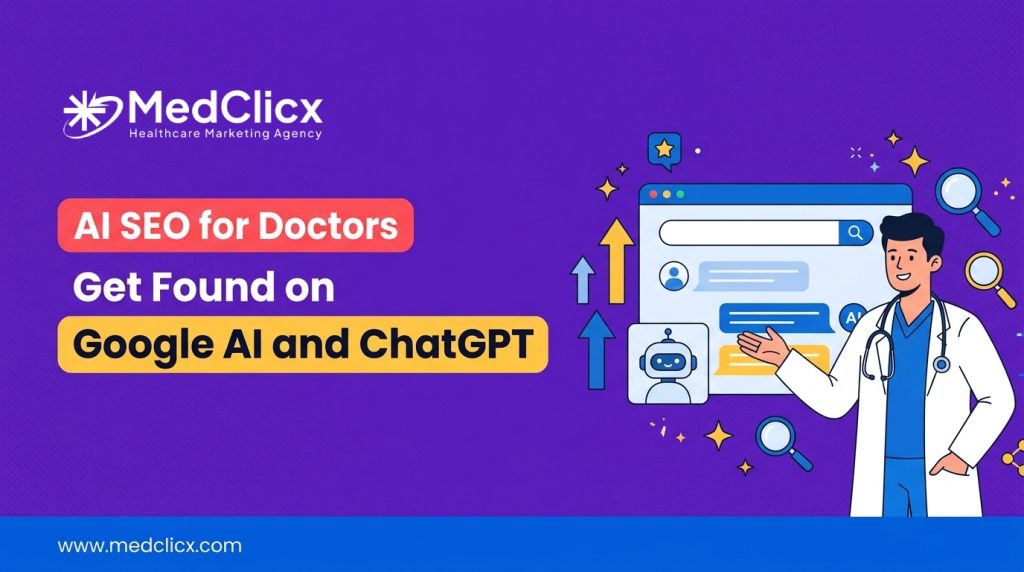
Today, AI-powered search engines, Google AI Overviews, and generative search assistants are reshaping how visibility works for clinics, hospitals, and private practices.
If your clinic is struggling with why your medical practice is not showing in AI search results, the issue is often not your services but your lack of healthcare AI SEO and modern optimization strategies.
In this guide, we’ll break down how AI search optimization for healthcare works, why local SEO for doctors is still critical, and what your medical practice must do to improve AI search visibility in 2026.
What Is AI-Powered Local SEO for Medical Practices?
AI-powered local SEO is the evolution of traditional Local SEO for doctors, enhanced with machine learning systems that understand patient intent, context, and authority signals.
Instead of just matching keywords, AI systems analyze:
- Clinical expertise and credibility
- Patient intent behind search queries
- Local relevance and proximity
- Online reputation and reviews
- Content depth and medical accuracy
This is the foundation of modern Medical SEO strategies, where ranking is no longer about stuffing keywords but about becoming a trusted entity in AI systems.
How AI Is Changing Healthcare Search in 2026
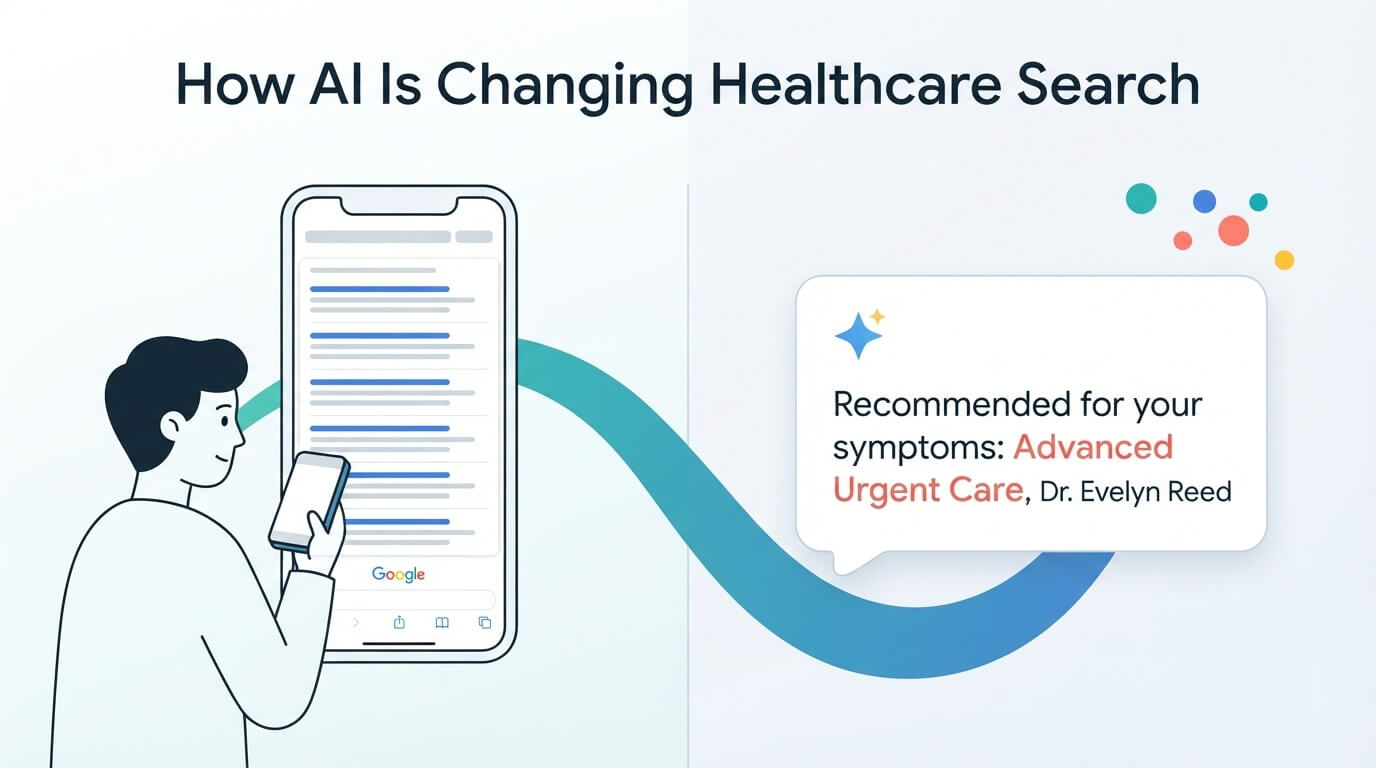
AI has completely transformed how patients discover healthcare providers. With tools like ChatGPT and Google AI Overviews for healthcare, patients now get summarized answers instead of browsing multiple websites.
This shift means:
- Patients may never visit traditional search results
- AI decides which clinics to recommend
- Only high-authority medical content is surfaced
If your practice is not optimized for AI systems, you may lose visibility even if you rank well traditionally.
This is where AI search optimization for healthcare becomes essential; it ensures your practice is included in AI-generated answers.
Why Local SEO Still Matters in an AI-Driven Search Landscape
Despite major advancements in AI-powered search and tools, Local SEO for doctors remains one of the most important foundations for visibility in healthcare marketing.
Even in 2026, AI systems do not operate in isolation; they still rely heavily on verified local and trust-based signals to decide which healthcare providers to recommend to users.
When AI evaluates medical practices, it prioritizes real-world relevance and proximity. This is because healthcare is inherently local, patients are usually searching for providers near their location, not general information. As a result, strong local optimization continues to play a direct role in AI search visibility.
Key local signals that influence both traditional rankings and AI-driven recommendations include:
- Google Business Profile optimization – A complete and active profile helps AI understand your practice details, services, location, and credibility.
- Local citations and listings – Consistent mentions of your practice across directories (health platforms, local listings, and medical directories) reinforce legitimacy and trust.
- Geographic relevance – Clear location signals on your website and across the web help AI match your practice with nearby patient searches.
- Patient ratings and feedback – Reviews and sentiment analysis strongly influence how AI systems evaluate trustworthiness and patient satisfaction.
When a medical practice is not appearing in AI-generated results or Google AI Overviews healthcare summaries, the issue is often not the lack of expertise or services but weak or inconsistent local SEO foundations.
How AI Evaluates Medical Practice Websites
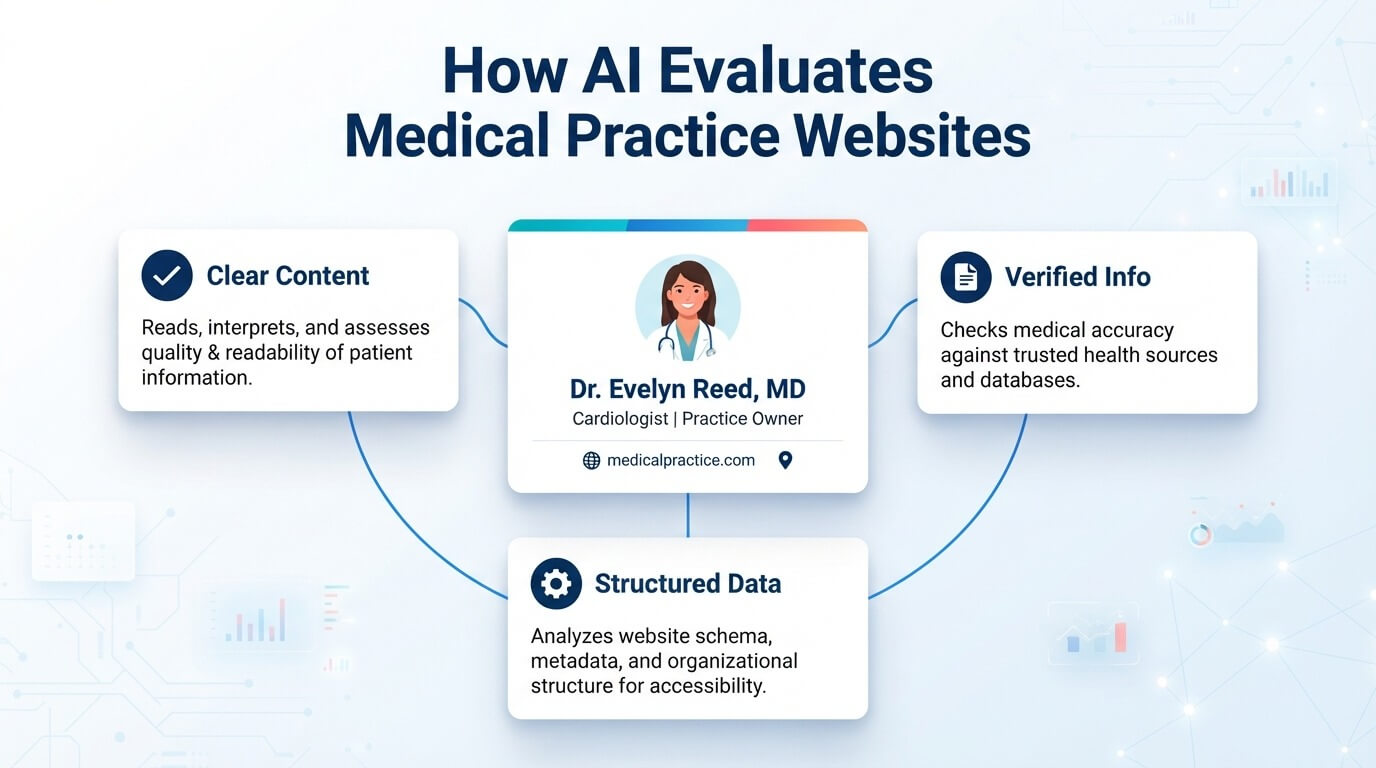
AI systems evaluate websites differently from traditional search engines. Instead of focusing purely on ranking signals, they prioritize trust and clarity.
Key evaluation factors include:
- E-E-A-T (Experience, Expertise, Authority, Trust)
- Accuracy of medical information
- Structured data and schema markup
- Engagement and user behavior signals
- Brand authority across the web
Strong AI search visibility depends on how well a practice communicates credibility and relevance across its digital presence.
The Essential Pages Every Medical Practice Needs
To perform well in healthcare AI SEO, medical websites need clear, structured, and easy-to-interpret content that AI systems can confidently understand and categorize.
In many cases, the way a website is built is just as important as the content itself, which is why professional medical website design services play a major role in how well a practice performs in both traditional search and AI-driven results.
A well-structured medical website’s essential pages include
- Service pages for each treatment area
- Location-specific pages
- Doctor and staff profile pages
- Educational condition and treatment guides
- Frequently asked questions pages
When these pages are properly designed and organized, they help AI systems understand the full scope of a practice and significantly improve the chances of being featured in AI-generated recommendations.
From Keywords to Patient Intent: The New Approach to Healthcare SEO
SEO in healthcare has shifted significantly from traditional keyword targeting to a deeper focus on patient intent. Search engines and AI systems now prioritize understanding what a patient actually needs, rather than just matching exact phrases.
Instead of broad queries like “dermatologist near me,” users are now searching in more specific, problem-focused ways such as:
“Safe ophthalmologist for LASIK and sensitive eye conditions”
“Best treatment for chronic knee pain near me”
These searches reflect real concerns, symptoms, and decision-making intent rather than generic location-based queries.
This shift means modern Medical SEO strategies must go beyond keywords and focus on creating content that directly answers patient questions, concerns, and treatment needs in a clear and trustworthy way.
Common Mistakes About AI and Local SEO in Medical Practices
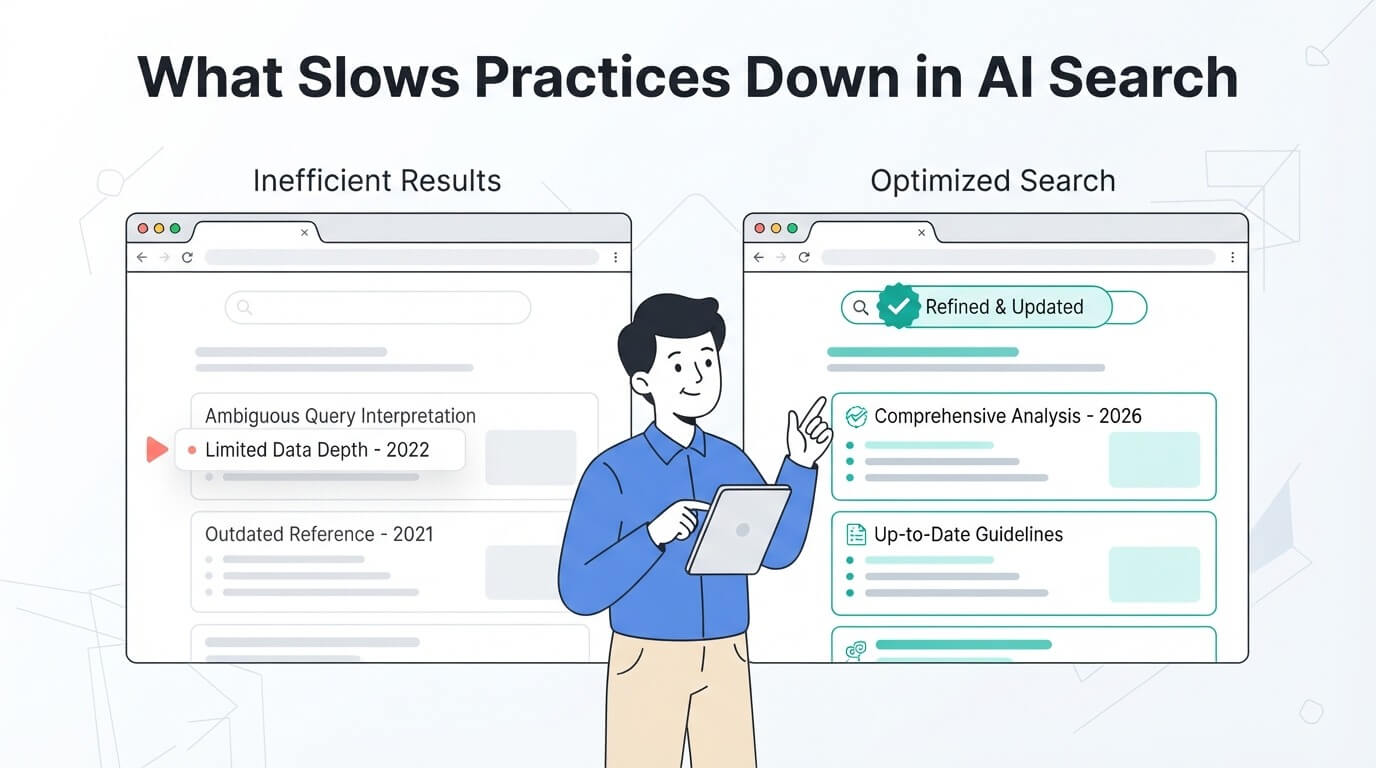
Many medical practices struggle with AI-driven search because of a few avoidable mistakes that directly affect their AI search visibility and Local SEO performance:
Mistake 1: Not optimizing for AI search at all
A common issue is relying only on traditional SEO and ignoring healthcare AI SEO, which is now essential for appearing in Google AI Overviews healthcare results.
Mistake 2: Weak or incomplete Google Business Profile
Many doctors fail to fully optimize their profiles, missing key details, updates, and categories that AI systems use for local SEO for doctors.
Mistake 3: Poor or inconsistent local presence
Inaccurate listings, missing citations, or inconsistent clinic information across directories reduce trust signals needed for AI recommendations.
Mistake 4: Creating content without patient intent in mind
Many medical websites still focus on generic keywords instead of real patient concerns, which weakens their ability to rank in AI-driven results.
Mistake 5: Ignoring website structure and medical SEO strategy
Without properly structured pages and clear medical SEO strategies, AI systems struggle to understand services, specialties, and expertise, leading to lower visibility.
What Medical Practices Should Focus on in 2026
To remain competitive in an increasingly AI-driven search environment, medical practices need to adopt a more structured and strategic approach to visibility. Traditional SEO alone is no longer enough; success now depends on how well a practice aligns with AI SEO principles and patient-focused search behavior.
Strengthening Local SEO for doctors
Medical practices need to build strong local signals through optimized Google Business Profiles, accurate citations, and consistent clinic information across directories. This helps improve trust and visibility in both traditional search and AI-driven results.
Publishing high-quality, patient-focused content
Content should directly address real patient concerns and symptoms rather than just targeting generic keywords. The focus should be on clarity, usefulness, and answering specific health-related questions.
Optimizing Google Business Profiles
A fully optimized profile with updated services, photos, reviews, and regular activity helps strengthen credibility and supports better visibility in Google AI Overviews healthcare results.
Improving website structure for AI understanding
Clear navigation, well-organized service pages, schema markup, and properly structured medical content make it easier for AI systems to interpret and recommend a practice.
Building consistent authority signals across the web
Reviews, backlinks, directory listings, and brand mentions across trusted platforms help reinforce credibility and improve overall AI search visibility.
Aligning with Google AI Overviews healthcare requirements
Content should be structured, factual, and easy for AI systems to summarize so it can be included in AI-generated responses and summaries.
A well-rounded strategy that combines SEO, content development, and technical optimization is now essential for maintaining strong AI search visibility and ensuring long-term growth in digital patient acquisition.
Conclusion
AI is not replacing SEO, it is reshaping it.
Medical practices that adapt to AI SEO and modern AI search optimization for healthcare will maintain visibility across both traditional search engines and AI-driven platforms. Those that fail to adapt often struggle with reduced visibility, even if their websites previously performed well.
The key is building trust, structure, and clarity into every part of a medical practice’s online presence.
FAQs
Why is my medical practice not showing in AI search results?
What is Healthcare AI SEO?
Does Local SEO for doctors still matter?
How do Google AI Overviews affect healthcare websites?
How can medical practices improve AI visibility?
Let’s increase appointment bookings
At MedClicx, we help medical practices connect with more patients.

Senior Digital Marketing Strategist &
Healthcare SEO Consultant
James Walker is a Senior Digital Marketing Strategist and Healthcare SEO Consultant at MedClicx. He specializes in helping healthcare organizations and service-based businesses grow their online presence through SEO, content marketing, local SEO, AI search optimization, (GEO), technical SEO, website optimization, and digital marketing strategies.
Over the years, James has worked on improving organic visibility, lead generation, and brand authority by combining search engine optimization, website performance, content strategy, conversion optimization, and AI-ready content. His expertise also includes Google Business Profile optimization, schema markup, user experience (UX), analytics, and modern digital marketing best practices.
At MedClicx, James writes educational articles covering SEO, content marketing, digital marketing, AI search optimization, social media marketing, web design, advertising strategies, podcasts, and online business growth. His goal is to simplify complex marketing concepts and help businesses make data-driven decisions that generate sustainable long-term results.
- James Walker
- James Walker
- James Walker
- James Walker