Key Takeaways
- PPC puts your practice at the top of Google.
- About 36% of ad spend goes to clicks that never convert.
- Physicians pay $4.76 per click and $40.04 per lead.
- Google blocks remarketing for health advertisers.
- Google Ads has no business associate agreement.
- Fix the leaks before you raise the budget.
Most doctors run PPC the same way: set a budget, pick a few keywords, and watch the clicks come in. PPC for doctors works when every dollar is tied to a real patient.
What Is PPC for Doctors?
PPC stands for pay-per-click. Your ad appears at the top of Google search results, and you pay only when someone clicks it.
A patient searches “dermatologist near me” or “knee surgeon Chicago”. Your ad shows above the organic results.
That search shows an ad, a map listing, and organic results side by side. Keep the map listing accurate with Google Business Profile optimization.
Medical PPC management covers the whole system behind that click. It means keyword research, ad copy, landing pages, budgets, bids, and tracking.
The Hidden Reason Your Budget Is Being Wasted
Your budget is not wasted by one big mistake. It leaks through a dozen small ones.
The account buys broad match keywords. A dermatologist bids on “skin care” and pays for clicks from people shopping for face cream.
The account has no negative keywords. Nobody blocks “free”, “jobs”, “salary”, or “pictures”.
The ads run in the whole country. A clinic in Austin pays for clicks from Dallas, Houston, and San Antonio.
The ads send everyone to the homepage. A patient who searched “Botox near me” lands on a page about the whole practice. The ads run all night. The office closes at 5 PM.
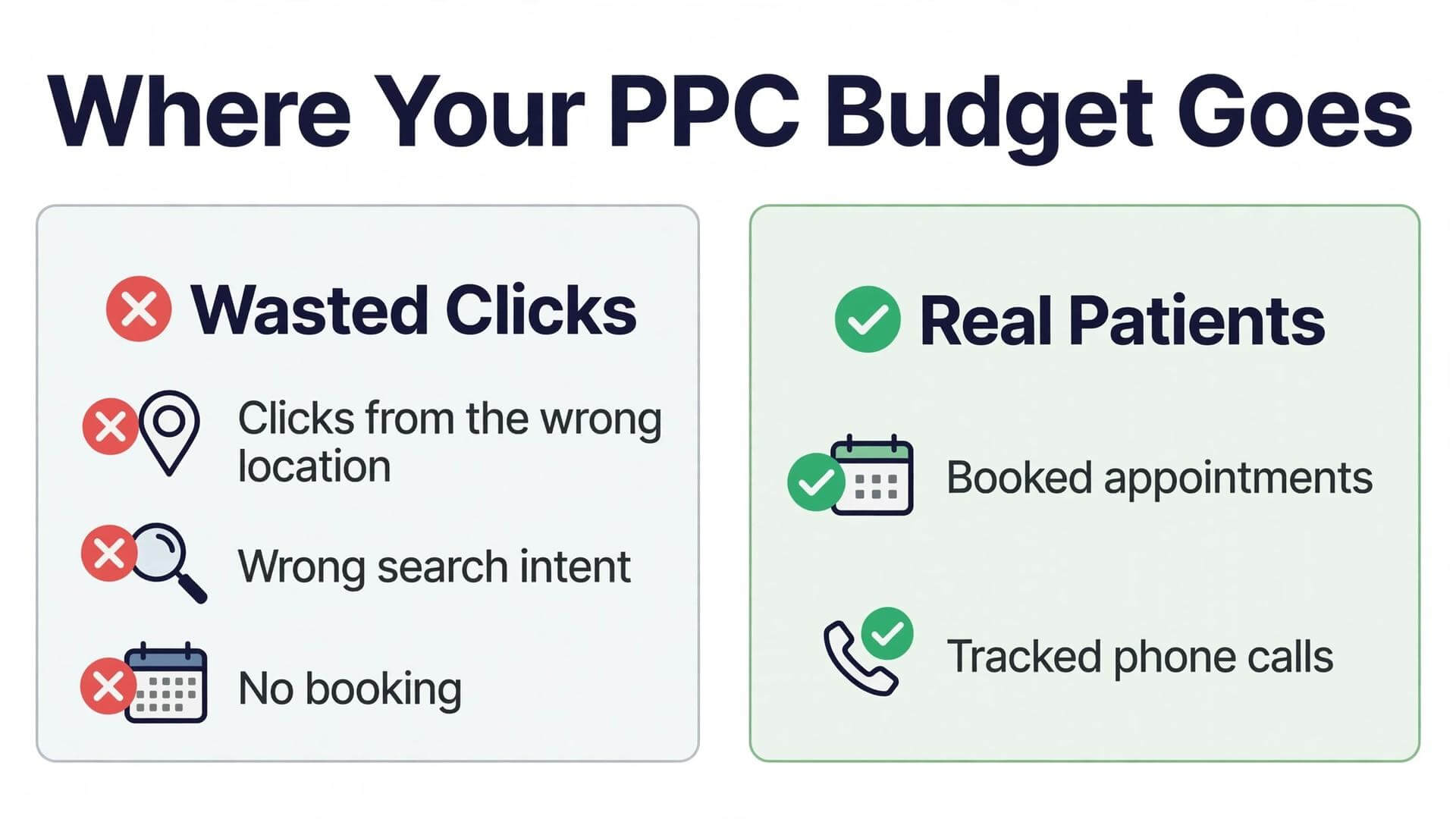
Up to 25% of advertising clicks are fraudulent, per InfluxMD 2025.
The average practice takes 47 hours to respond to a lead. A patient who waits two days has already booked somewhere else.
Weak reviews waste clicks the same way. Build review generation and replies into a routine with online reputation management for doctors, so paid clicks land on a practice patients trust.
How to Calculate Healthcare PPC Savings
There is no standard formula with that title.
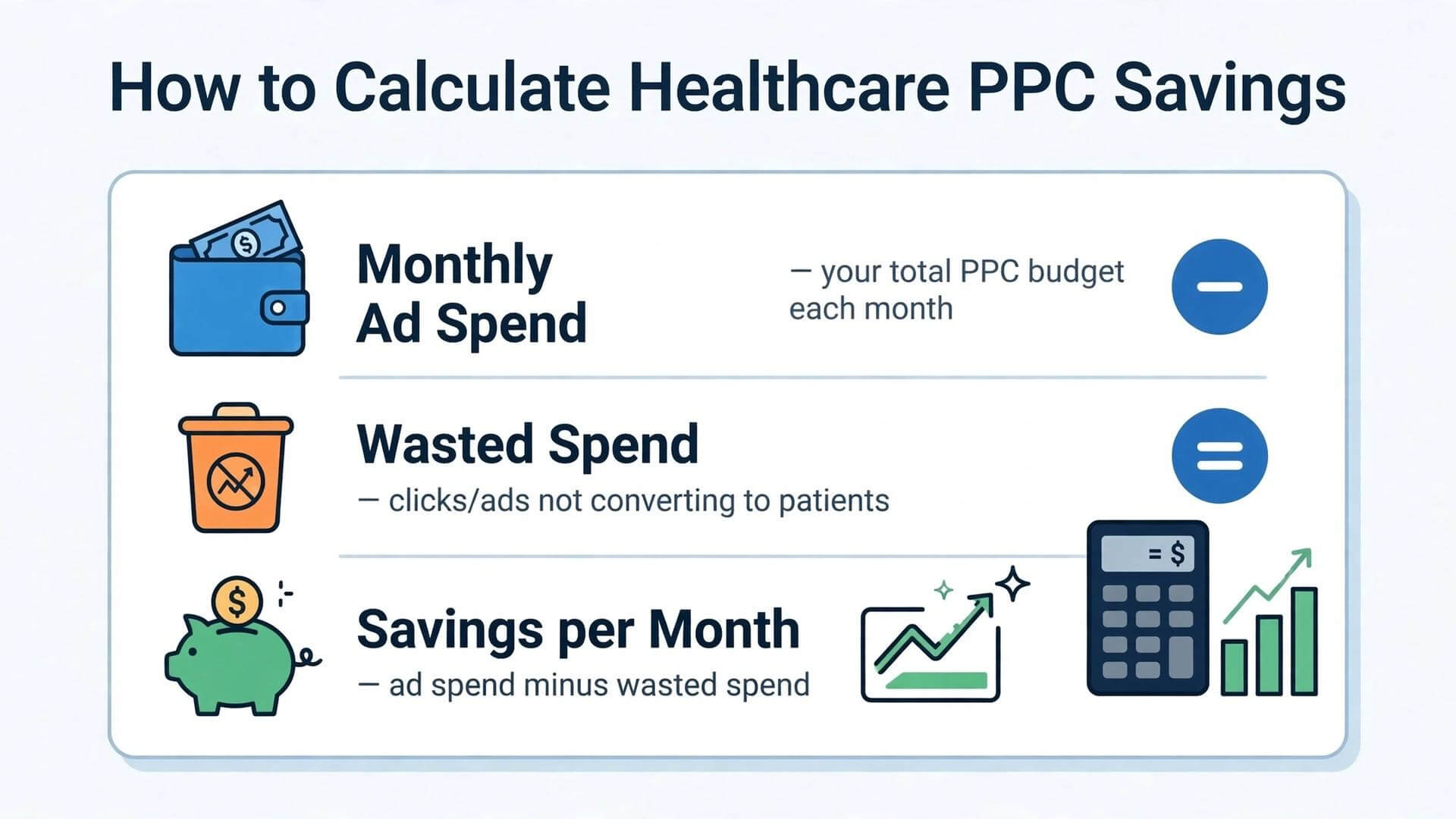
Patient acquisition cost, or PAC, is total marketing and sales costs divided by new patients acquired. Start with your monthly ad spend and your PAC.
Add up every dollar spent on terms that brought no calls and no form fills in the last 90 days. That is your wasted spend.
Savings equals current PAC minus PAC after fixes, multiplied by new patients acquired.
Here is a worked example.
| Before fixes | After fixes | |
| Monthly ad spend | $5,000 | $5,000 |
| Wasted spend | $1,800 (36%) | $500 (10%) |
| New patients per month | 25 | 38 |
| Patient acquisition cost | $200 | $132 |
| Cost for the same 25 patients | $5,000 | $3,300 |
| Monthly savings at the same patient volume | – | $1,700 |
The same 25 patients now cost $3,300. The practice saves $1,700 a month at the same volume, and gains 13 extra patients.
Set a target PAC before you judge the campaign. A healthy PAC is 10% to 20% of first-year patient value, per ThinkBasis and Medesk benchmarks.
What Does PPC for Doctors Cost?
Costs depend on speciality, city, and competition. The benchmarks below are US averages from WordStream and LocaliQ 2026.
They cover Google Ads and Microsoft Ads.
| Category | Avg CPC | Avg conversion rate | Avg cost per lead |
| Physicians and surgeons | $4.76 | 12.43% | $40.04 |
| Dentists and dental services | $8.00 | 10.67% | $72.97 |
| Health and fitness | $6.17 | 6.94% | $67.36 |
| All industries | $5.42 | 8.18% | $66.69 |
Cost per lead varies far more by specialty than by channel.
| Specialty | Avg cost per lead |
| Dermatology | $18.54 |
| Hospitals and clinics | $72.97 |
| Addiction recovery | $120.30 |
| Mental health | $141.17 |
The mental health figure comes from one compilation, so treat it as an estimate.
How to Set Up PPC for Doctors That Brings Patients
Step 1: Build Campaigns Around Services and Locations
Build one campaign per service and location. “Knee replacement Austin” and “shoulder surgery Austin” are separate campaigns.
Multi-location healthcare marketing keeps the same reviews and local setup running across every site.
Step 2: Pick High-Intent Keywords Only
Bid on searches from people ready to book. “Dermatologist near me”, “book cardiologist appointment”, and “knee surgeon Austin” convert.
Do not bid on informational terms. “What causes knee pain” and “symptoms of eczema” bring readers, not patients.
Use phrase and exact match for money keywords. Use broad match for discovery only, with a tight negative list and a capped test budget.
Step 3: Write Ads That Match the Search
The headline should repeat the search. A patient who searched ‘pediatrician Austin’ should see ‘Pediatrician in Austin’, not ‘Welcome to Our Practice’.
Add the facts patients check first: same-week appointments, insurance accepted, the doctor’s name, a phone number.
Step 4: Send Clicks to a Dedicated Landing Page
Every ad group needs its own landing page. The knee replacement ad goes to the knee replacement page, never to the homepage.
The landing page has one job: book an appointment or call. One headline, one form, one phone number.
A page that takes four seconds to load loses patients before they read a word.
Speed, layout, and trust signals decide whether a click becomes a booking. Medical website design tips set out what a landing page needs.
Step 5: Track Every Call and Form Fill
Install call tracking with a separate number per campaign. Record which keyword drove each call.
Count form fills and calls over 60 seconds as conversions. Set both up before you spend a dollar.
Review the search terms report every week. Add the wasted terms as negative keywords.
Step 6: Set Geo-Targeting and Ad Schedules
Target the radius your patients actually travel. A 10- to 15-mile radius works for most practices.
Run ads when the office can answer the phone, including one hour before opening.
Ads reach the radius you set. Local SEO for healthcare practices puts the same practice in the map and organic results inside that radius, so the ad is not working alone.
Step 7: Protect the Account From Click Fraud
Watch for the same IP clicking daily, or clicks at 3 AM from outside your state. Google refunds some invalid clicks automatically, but not all.
Use click fraud protection software if the problem persists.
Google Ads Rules Doctors Must Follow
Healthcare Policy
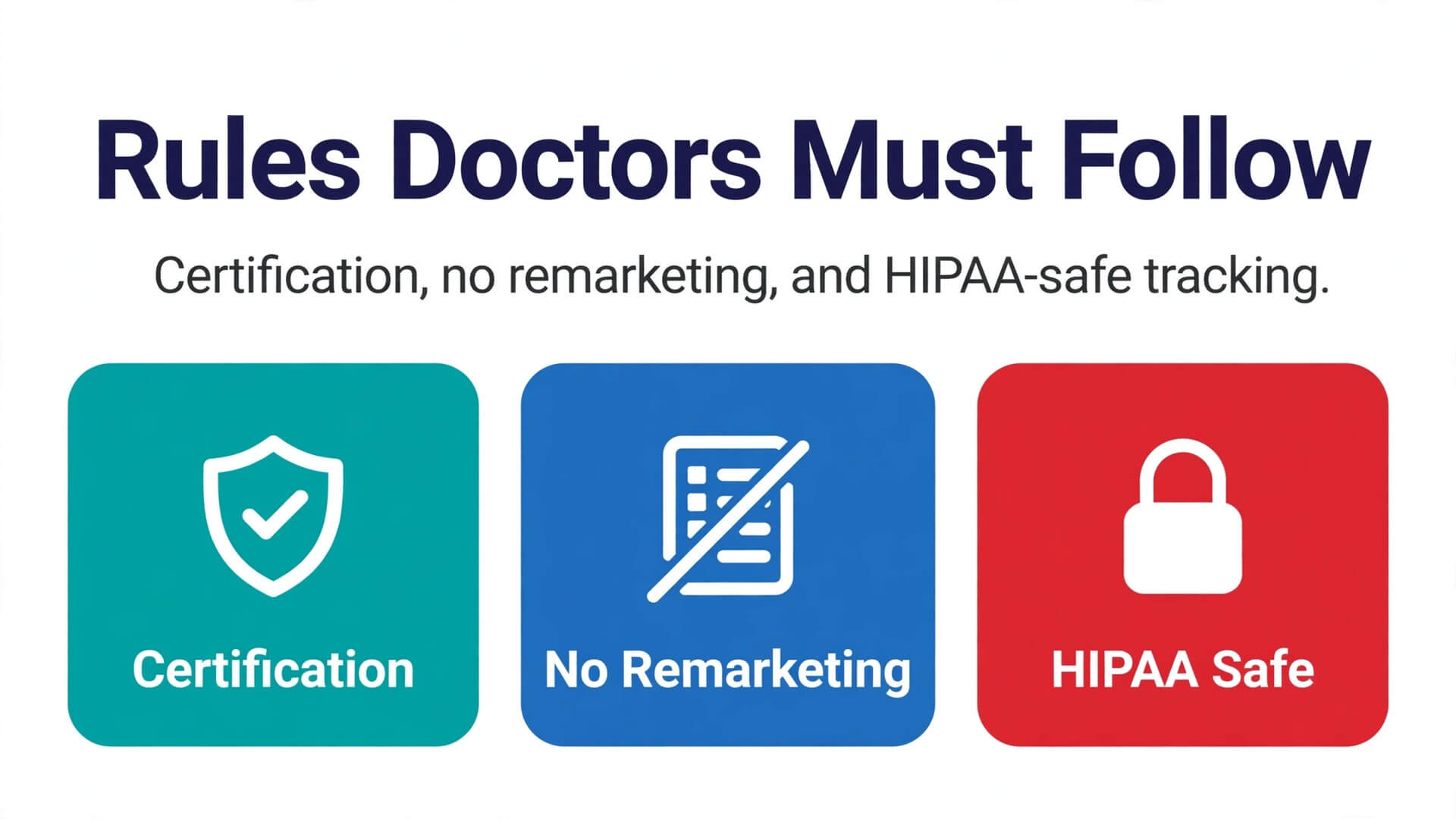
A normal practice advertising its own services needs no special certification.
Certification applies to prescription drug services, online pharmacies, addiction treatment, abortion related ads, and US health insurance ads.
Some things are banned outright. Prescription drugs without a prescription, opioid painkillers, and unapproved substances.
Speculative and experimental medical treatment. Selling prescription drugs without a prescription is an egregious violation. Google suspends the account on detection, without warning.
Ordinary practice ads are allowed. The restrictions cover drugs, addiction services, and a few other categories.
Check the Google Ads healthcare and medicines policy first.
Remarketing Is Blocked for Health Advertisers
Google treats health as a sensitive interest category, covering conditions, treatments, and invasive procedures.
Customer Match, remarketing lists, audience expansion, and lookalike segments are all blocked for health advertisers. Google blocks them because they may contain sensitive user signals.
Keywords and predefined Google audiences still work. Demand Gen may be restricted because it uses advertiser-curated audiences by default.
HIPAA and Tracking
Google offers no business associate agreement for Google Ads. Treat the platform as non-compliant.
The HHS tracking bulletin, issued in December 2022 and updated in March 2024, says information collected on a practice website generally counts as protected health information, including IP addresses, appointment dates, and treatment page visits.
Keep Meta Pixel and Google Analytics off booking, portal, and form pages, unless the vendor is under a business associate agreement.
Keep names, email addresses, phone numbers, diagnoses, and appointment reasons out of URLs, event names, and parameters.
The enforcement record is real. The FTC fined GoodRx $1.5 million in 2023, and BetterHelp paid $7.8 million the same year.
What Changed in Google Ads in 2026
AI Max for Search arrived in 2026, extending broad match with keywordless matching. Campaigns with automatically created assets or campaign-level broad match were auto-upgraded from September 2026.
Google claims AI Max typically brings about 14% more conversions at a similar cost per acquisition. That is Google’s own claim.
AI Search Ads: ChatGPT, AI Overviews, and Copilot
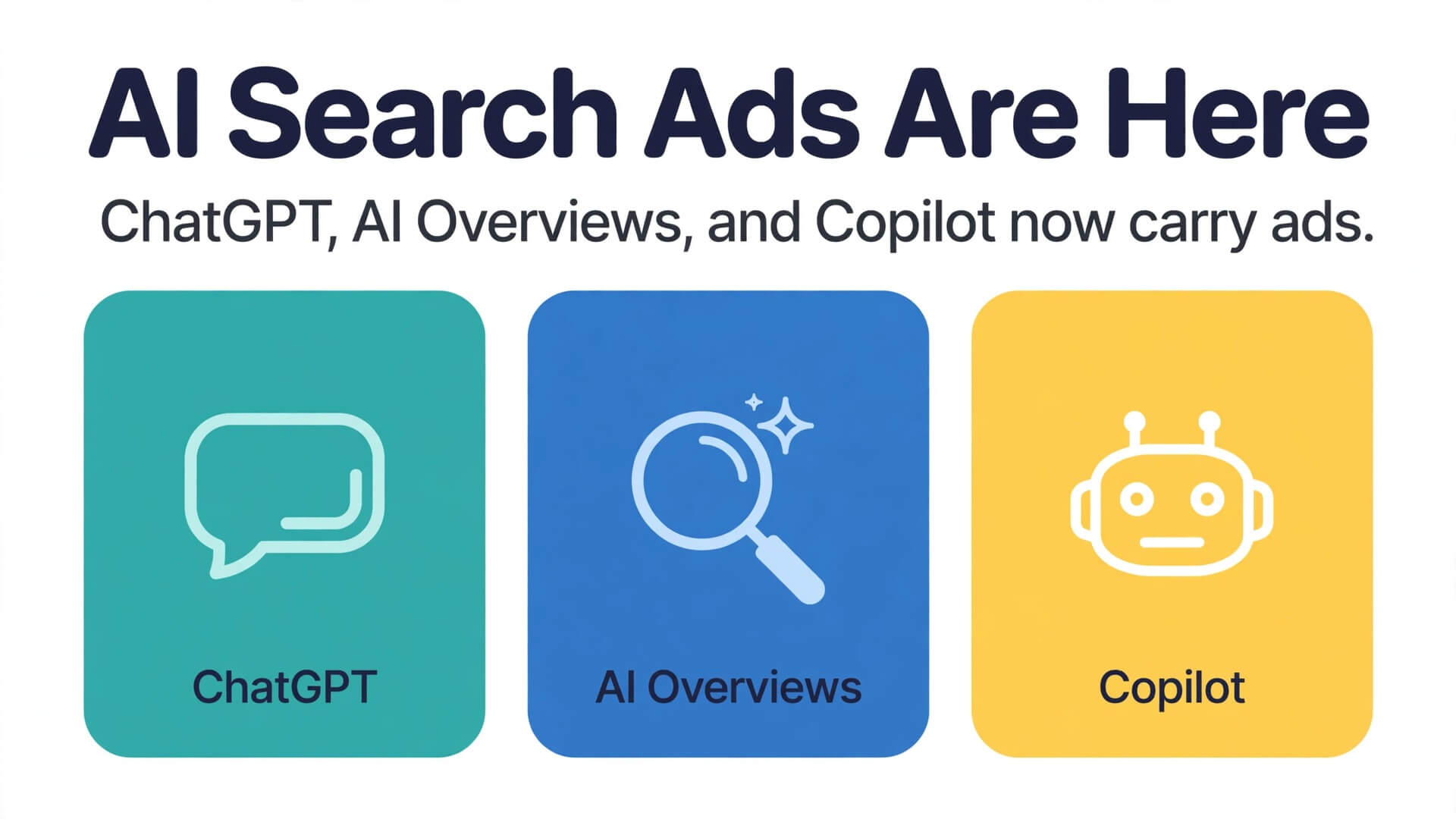
PPC no longer lives only on Google. Patients now ask ChatGPT, Copilot, and Google AI Overviews for a doctor, and paid ads follow them there.
ChatGPT Ads
OpenAI started testing ads in ChatGPT in the United States in February 2026. By October 2026, they reached 89 countries, with more than 100,000 advertisers.
A ChatGPT ad is one labeled unit below the answer, with the advertiser name, a headline, a short description, and a link.
Ads do not change the answer. Advertisers cannot shape, rank, or alter what ChatGPT says. A paid ad buys the box below the answer, not a place inside it.
Only adults on the Free and Go plans see ads. No ads run next to personal health, mental health, or politics chats.
That rule matters most for doctors. A patient asking about symptoms will not see your ad in that chat, but your ad can appear in general conversations, such as finding a clinic or comparing services.
ChatGPT ads are not bought on keywords. OpenAI matches the ad to the conversation. You pay per click or per 1,000 views, in an auction, with starting click bids of $3 to $5 and a US minimum of $25 a day per campaign.
Early results are weak. A working paper from October 2026 looked at 102 advertiser sites. A paid ChatGPT visit earned $0.89 in revenue, against $2.45 for a paid search visit. Conversion was 0.37 percent, against 1.17 percent for paid search.
The authors put the break-even click price at about $0.26, far below the $3 to $5 starting bids. This is early evidence from online shops, not medical practices.
It is not peer-reviewed yet. Test with a small capped budget and track booked appointments, not clicks.
Ads cannot buy a place inside a ChatGPT answer. AI SEO for doctors earns that mention instead, with clear facts the model can cite.
OpenAI Business Hub (Claim Your Profile First)
OpenAI launched Businesses in ChatGPT in beta in November 2026, with a Business Hub to claim a profile, correct details, and add a product feed.
The Hub also shows aggregate mentions, website clicks, and discovery topics over 28 days. Claiming a profile does not change visibility or guarantee placement or sales.
Local stores and restaurants can claim only an existing US listing for now. Claim the profile first. It is free, and it fixes the facts ChatGPT uses about your practice.
Google AI Overviews, Copilot, and the Rest
Microsoft Copilot also carries ads, bought through Microsoft Advertising. Microsoft states it does not use Copilot Health data for advertising or targeting.
Perplexity and Claude sell no ads. Perplexity tested ads in 2024 and stopped in early 2026, and Anthropic committed in February 2026 to keeping Claude ad-free. On both, visibility is earned only through citations.
Whether you appear in those answers depends on how AI engines judge your website. AI and local SEO for doctors shows what they look for.
Paid search now spans Google, ChatGPT, and Copilot. Organic AI visibility spans all of them. A practice that ignores AI search loses patients to one that does not.
PPC vs SEO for Doctors
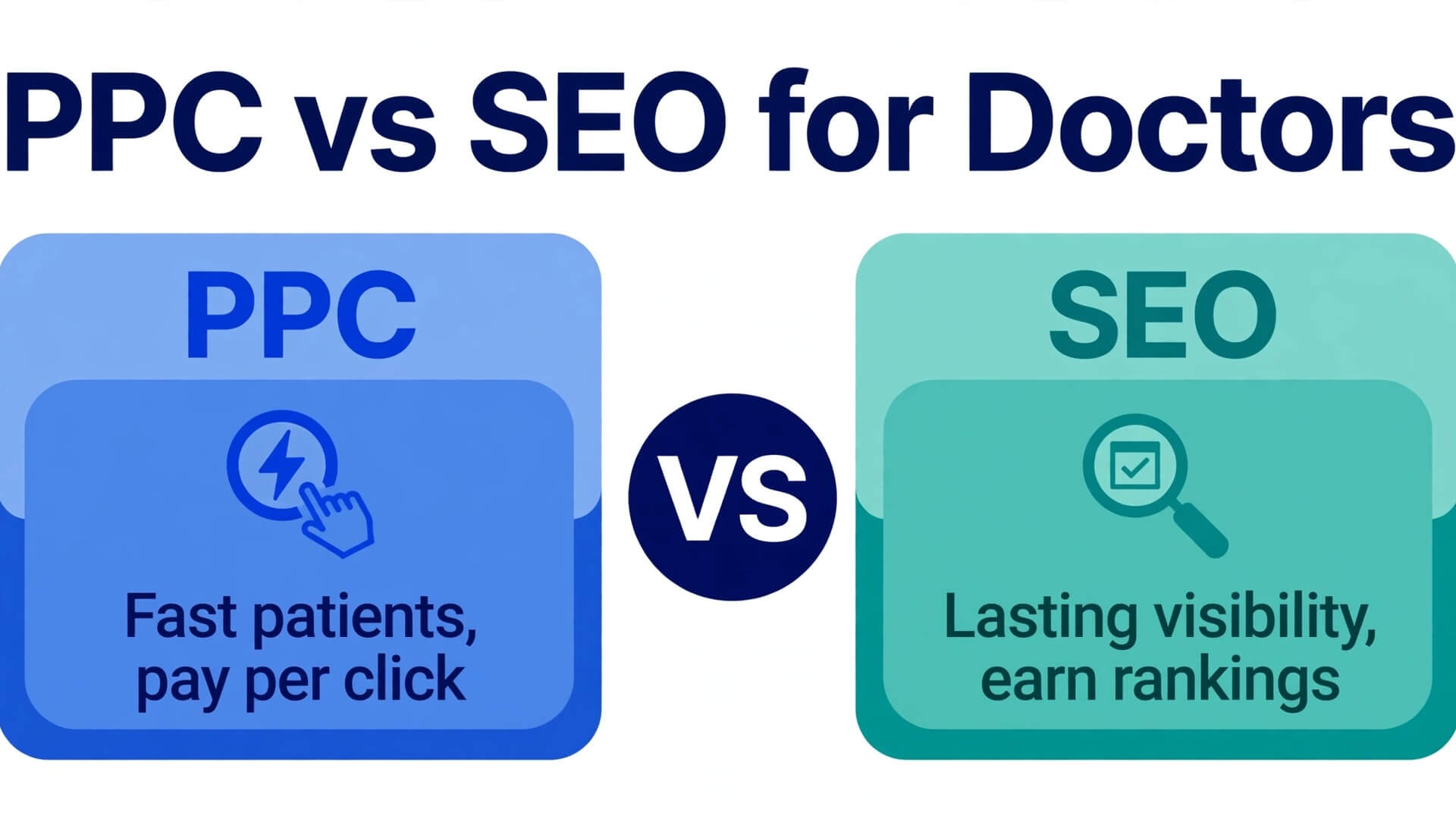
| PPC | SEO | |
| Speed | Results in days | Results in months |
| Cost model | Pay per click | Pay for work, then traffic is free |
| Best for | New practices, urgent bookings, specific procedures | Long-term visibility, trust, local rankings |
PPC and SEO work best together. PPC fills the schedule this month.
SEO builds the profile, reviews, and location pages that make both channels work.
Reviews support PPC too. Strong reviews and fast replies turn paid clicks into bookings.
A correct Business Profile keeps hours, services, and booking links accurate.
How to Choose a Healthcare PPC Agency
Ask for healthcare experience first. The agency should show results for practices like yours, and track calls, form fills, and patient acquisition cost.
Ask about their negative keyword process. A good agency reviews the search terms report every week.
Ask about HIPAA. The agency should know remarketing is blocked, Google Ads has no BAA, and pixels do not belong on booking pages.
Red flags: guaranteed results, guaranteed first position, no reporting access, no call tracking, and a fee tied to ad spend with no cap.
A fee that grows when spend grows rewards the agency for spending more, not for spending well.
Once the account is clean, AI agents and automation can handle the repetitive work.
MedClicx Final Take
PPC for doctors works. Physicians and surgeons pay $40.04 per lead on average.
The hidden reason is not mysterious. Broad match without negative keywords, no geo-targeting, homepage landing pages, ads running all night, and no call tracking.
Fix the leaks before you raise the budget. Calculate your patient acquisition cost. Then spend the same money on the clicks that book.
AI search is where the next clicks will come from. Claim your ChatGPT profile now, and test the new ad surfaces before your competitors do.
Start with a free audit. It compares your rating and review count with three local competitors.
FAQs
Does PPC advertising work for my type of practice?
It works for most practices with local demand and a clear service to sell. Dermatology, dentistry, orthopedics, plastic surgery, and urgent care see the strongest results.
How much does Google Ads cost for doctors?
Physicians and surgeons pay $4.76 per click and $40.04 per lead on average. Most practices budget $2,200 to $9,000 per month.
Is Google Ads HIPAA compliant?
Not by default. Google offers no business associate agreement for Google Ads. Keep pixels off appointment and form pages, and never upload patient lists.
Can a clinic use remarketing on Google Ads?
Not with its own lists. Google blocks Customer Match, remarketing lists, audience expansion, and lookalikes for health advertisers.
How long does it take to see results from Google PPC for doctors?
Plan for 30 to 90 days. The first month collects data, the second applies the fixes, and the third should show consistent, profitable results.
What is a good cost per lead for a doctor?
Physicians and surgeons average $40.04 per lead. Dermatology averages $18.54. Mental health averages $141.17. These are US benchmarks, not guarantees.
This article is marketing education, not legal or medical advice. Check the current Google Ads policy before you launch a campaign.
Can doctors advertise on ChatGPT?
Yes, with limits. ChatGPT ads are labeled units below answers, shown only to adults on Free and Go plans. No ads run next to personal health chats.

James Walker is a Senior Digital Marketing Strategist and Healthcare SEO Consultant at MedClicx. He specializes in helping healthcare organizations and service-based businesses grow their online presence through SEO, content marketing, local SEO, AI search optimization, (GEO), technical SEO, website optimization, and digital marketing strategies.
Over the years, James has worked on improving organic visibility, lead generation, and brand authority by combining search engine optimization, website performance, content strategy, conversion optimization, and AI-ready content. His expertise also includes Google Business Profile optimization, schema markup, user experience (UX), analytics, and modern digital marketing best practices.
At MedClicx, James writes educational articles covering SEO, content marketing, digital marketing, AI search optimization, social media marketing, web design, advertising strategies, podcasts, and online business growth. His goal is to simplify complex marketing concepts and help businesses make data-driven decisions that generate sustainable long-term results.
- James Walker

- James Walker
- James Walker
- James Walker