Dermatology Marketing: How to Get More Patients in 2026
-
 James Walker
Table of Contents:
- Why Dermatology Marketing Matters in 2026
- 12 Proven Dermatology Marketing Strategies to Attract More Patients
- How to Measure the Success of Your Dermatology Marketing Strategy
- Final Thoughts
- FAQs
Most dermatology practices don’t struggle because they lack patients in their area, they struggle because they’re not being found when patients are actively searching.
Today, the patient journey almost always starts online, and the practices that win are the ones that appear first, look most trustworthy, and make booking effortless.
This is where dermatology marketing has shifted from being optional to absolutely essential.
Modern dermatology digital marketing is no longer just about getting traffic, it’s about capturing high-intent searches, building instant trust, and converting that interest into booked appointments through a structured digital system.
In this blog we’ll discover the top 12 dermatology marketing strategies in 2026 that help attract and retain more patients.
Why Dermatology Marketing Matters in 2026
In 2026, patient behavior has fundamentally changed. A successful dermatology marketing strategy must align with how people now search, evaluate, and choose dermatology providers online.
Patients no longer just “Google a dermatologist.” They interact with multiple digital touchpoints, such as, search engines, AI tools, review platforms, and social media, before making a decision.
Here is how most patients search for dermatologists online.
Local Search and Google Business Profiles
Local search is still the foundation of dermatology SEO. Most patients search for services like “dermatologist near me” or “acne treatment in my city”, and Google prioritizes local intent heavily.
Your Google Business Profile (GBP) is often the first impression of your practice. It influences:
- Map pack rankings
- Call volume
- Direction requests
- Appointment bookings
Strong local SEO for dermatologists ensures your practice appears in the top 3 local map results, which receive the majority of clicks.
AI Search and AI Overviews
A major shift in dermatology marketing is the rise of AI-powered search tools like Google AI Overviews, ChatGPT, and other generative engines.
Instead of just showing links, AI now summarizes answers and recommends providers based on authority, relevance, and structured data.
This is why AI search optimization for healthcare has become a competitive advantage. Practices that fail to adapt risk becoming invisible in AI-driven search results.
Online Reviews and Social Proof
Online reputation is one of the strongest ranking and conversion factors in modern dermatology marketing strategies.
Patients heavily rely on:
- Google reviews
- Star ratings
- Patient testimonials
- Before-and-after results
A strong dermatology reputation management system directly impacts both rankings and patient trust.
Mobile and Voice Search Behavior
More than 60–70% of dermatology-related searches now happen on mobile devices, making mobile optimization a core part of dermatology marketing performance.
At the same time, voice search is growing rapidly. Patients are now asking questions like:
- “Who is the best dermatologist near me?”
- “Where can I get eczema treatment nearby?”
This means local dermatology marketing must also be optimized for conversational search queries.
12 Proven Dermatology Marketing Strategies to Attract More Patients
These top 12 dermatology marketing strategies are designed to improve visibility, increase patient trust, and convert search traffic into booked appointments.
1. Optimize Your Google Business Profile
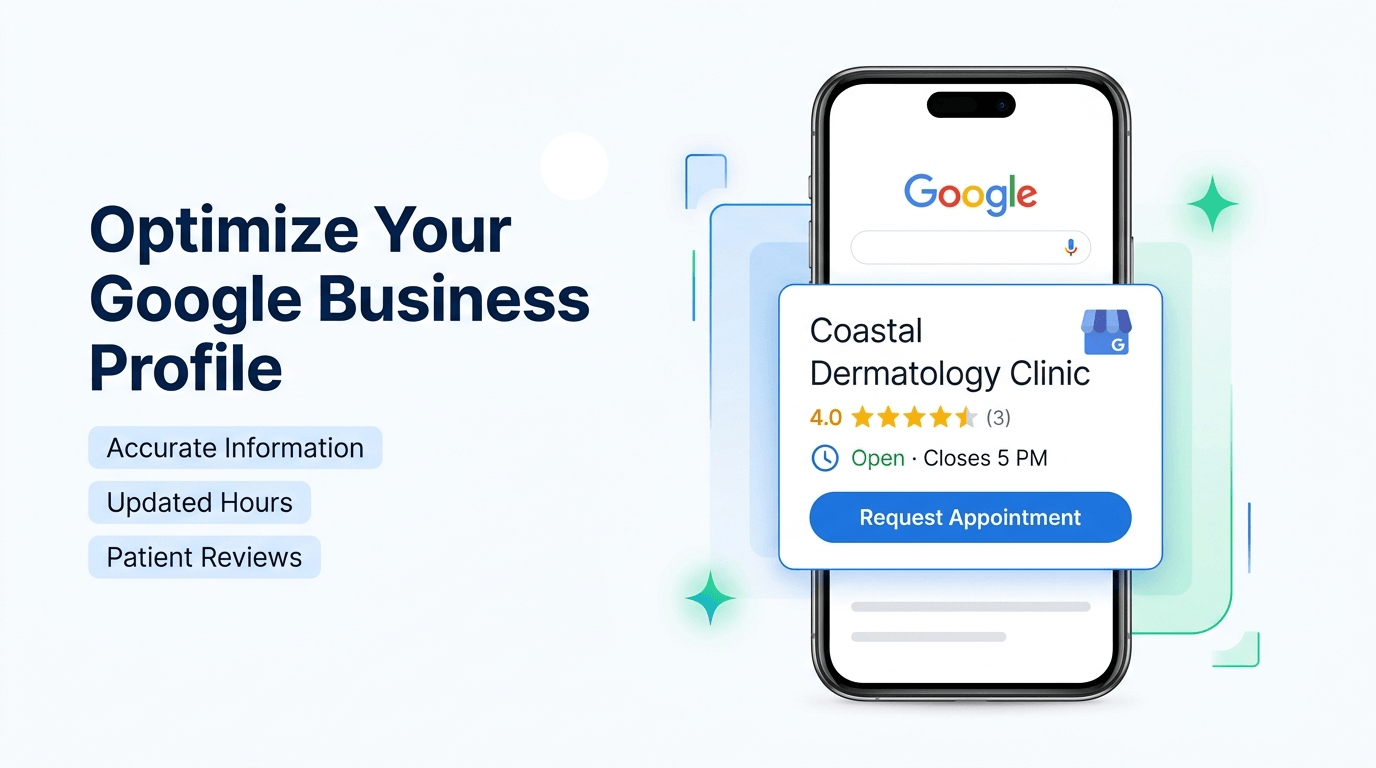
Your Google Business Profile is the most influential asset in local SEO for dermatologists, often determining whether a patient calls you or a competitor.
To fully optimize it:
- Add each high-value treatment as a dedicated service (not just “dermatology”)
- Write keyword-rich descriptions for services and clinic overview
- Upload real clinic photos, treatment rooms, and provider images consistently
- Use Google Posts weekly to highlight services, offers, or educational updates
- Ensure your primary category is highly specific (e.g., dermatologist, not general clinic)
A well-optimized profile increases visibility in the Google Map Pack, which drives the majority of high-intent patient clicks.
2. Invest in Local SEO for Your Dermatology Practice
Strong dermatology SEO ensures your practice appears when patients search for both general and treatment-specific queries.
Key improvements include:
- Creating unique location pages with localized content
- Targeting condition-based searches like “acne specialist in [city]”
- Strengthening internal linking between services, providers, and locations
- Building citations in healthcare directories to reinforce authority signals
- Implementing structured schema for services, physicians, and locations
This strengthens the website SEO by helping search engines clearly understand what you offer, where you operate, and who you serve.
3. Create Treatment-Specific Service Pages
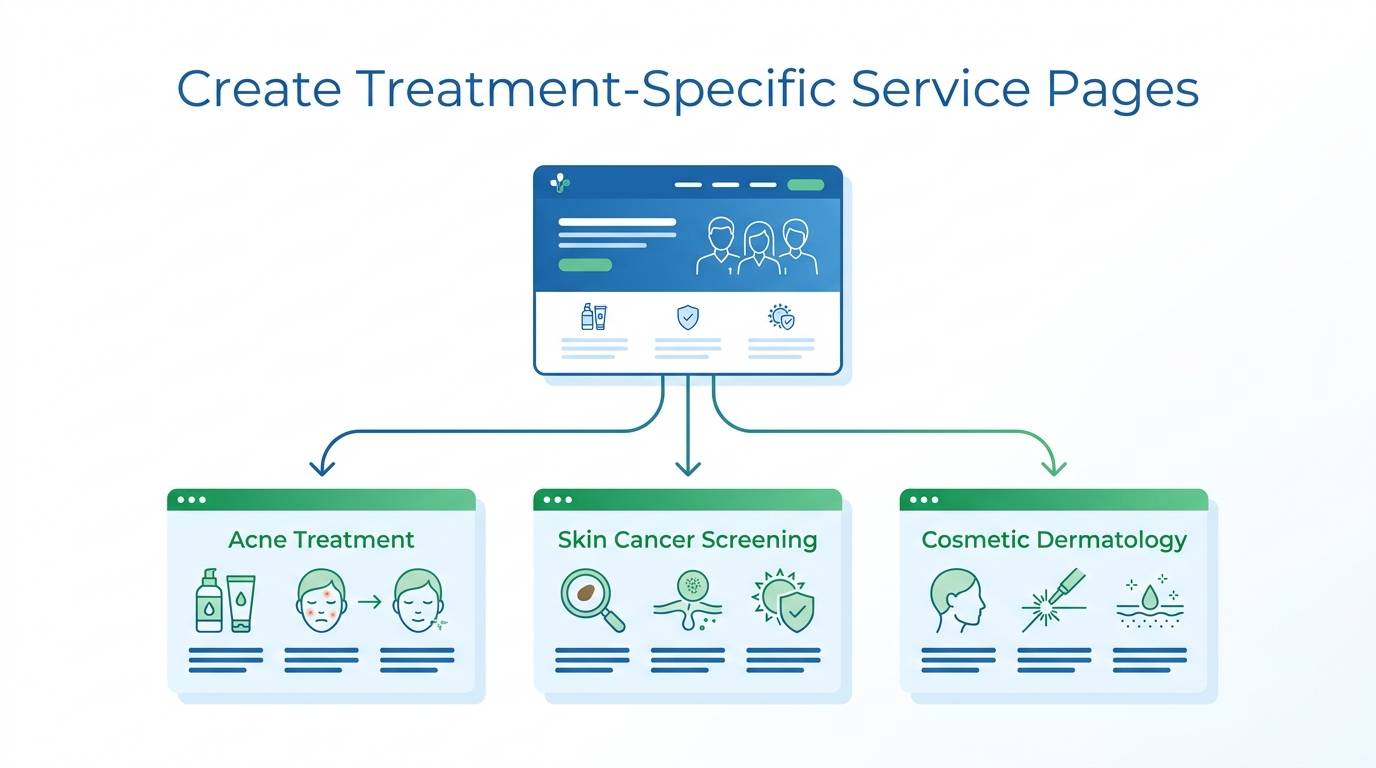
Most practices lose rankings because they rely on one generic services page instead of building intent-based landing pages.
To improve performance:
- Build separate pages for each major condition and treatment
- Match each page with a high-intent keyword (e.g., “eczema treatment,” “laser acne scar removal”)
- Include FAQs specific to each condition to improve relevance and conversions
- Add patient-focused content that explains outcomes, not just procedures
This approach improves both dermatology marketing performance and conversion rates because patients land on pages that directly match their problem.
4. Publish High-Quality Dermatology Content
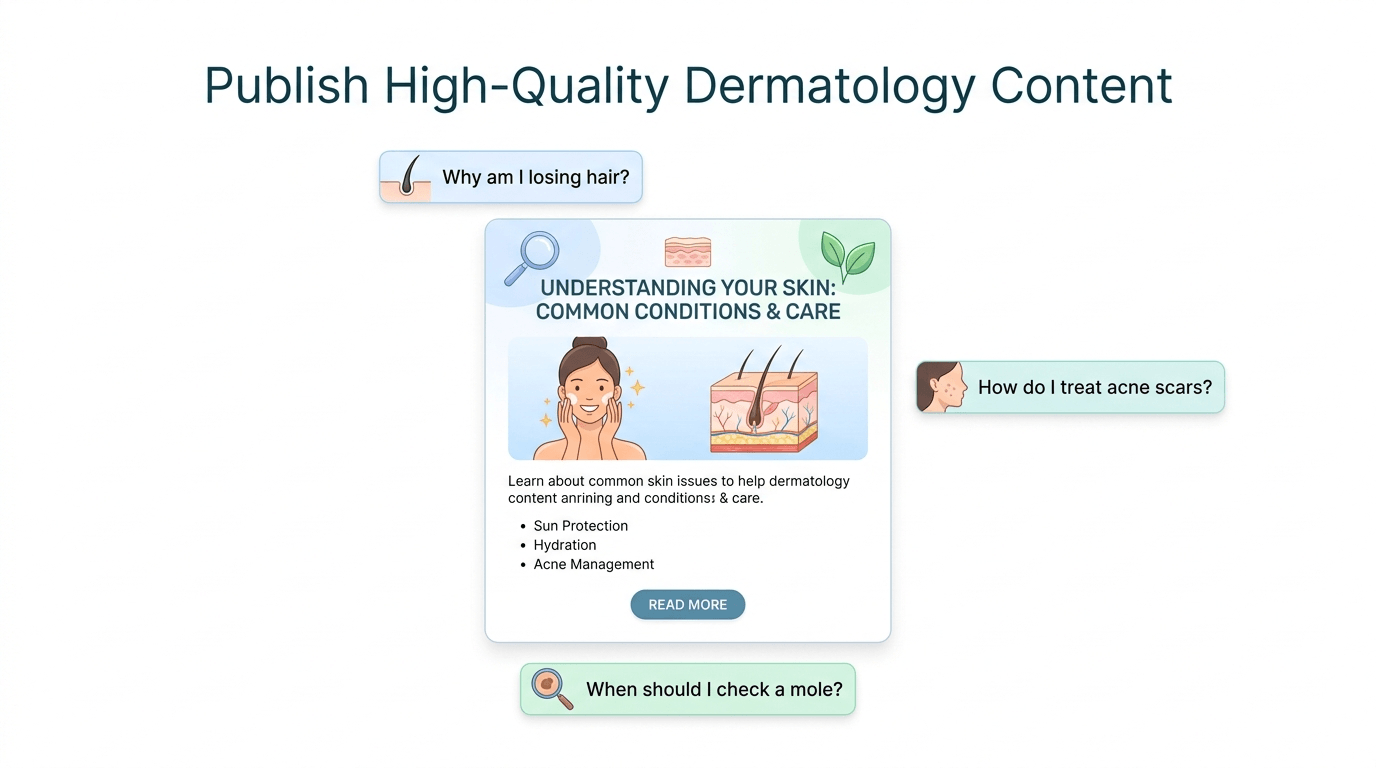
Content marketing is the foundation of long-term dermatology digital marketing success because it builds authority across multiple search queries.
High-performing content includes:
- Condition-based educational articles (eczema, psoriasis, acne causes)
- Treatment comparisons (e.g., laser vs chemical peel)
- “What to expect” guides that reduce patient uncertainty
- Seasonal skincare content that aligns with real patient concerns
This content not only improves SEO, but also supports AI search visibility by helping systems understand your expertise across multiple dermatology topics.
5. Prepare Your Practice for AI Search
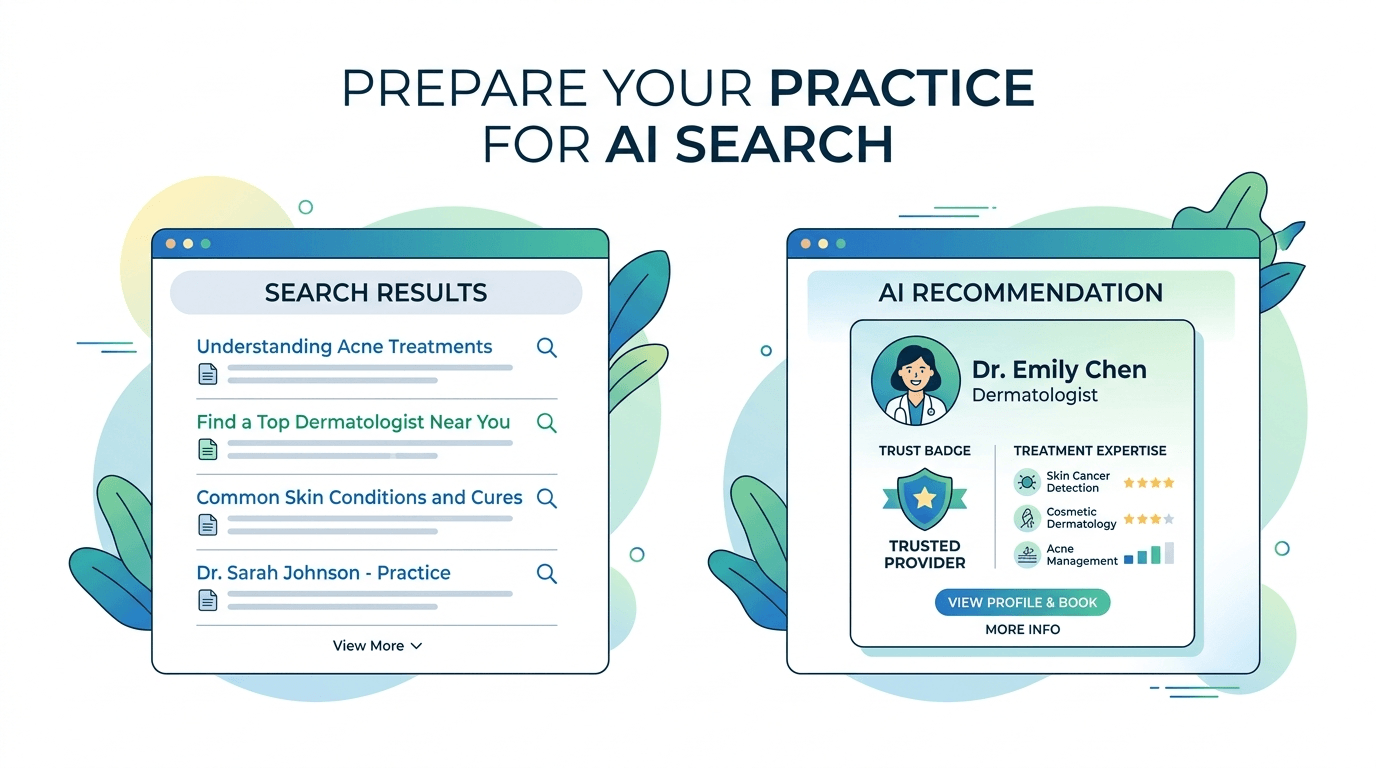
AI search is rapidly reshaping dermatology marketing, with tools like Google AI Overviews and ChatGPT now influencing how patients choose providers.
To stay competitive:
- Structure pages with clear, direct answers to patient questions
- Use FAQ sections that match real search queries
- Strengthen entity signals (consistent practice name, doctors, locations, services)
- Ensure every service page is context-rich and medically specific
This increases the likelihood of your practice being cited in AI-generated results rather than just traditional search listings.
6. Improve Your Website Conversion Rate
Even strong dermatology SEO traffic will not produce results if your website fails to convert visitors into patients.
To improve conversion:
- Reduce friction in appointment booking (fewer steps, faster access)
- Place clear CTAs above the fold on every page
- Add trust elements like real reviews, certifications, and patient outcomes
- Create dedicated landing pages for each treatment instead of one general page
A well-optimized dermatology website design ensures that every visitor has a clear path from interest to appointment.
7. Generate More Patient Reviews
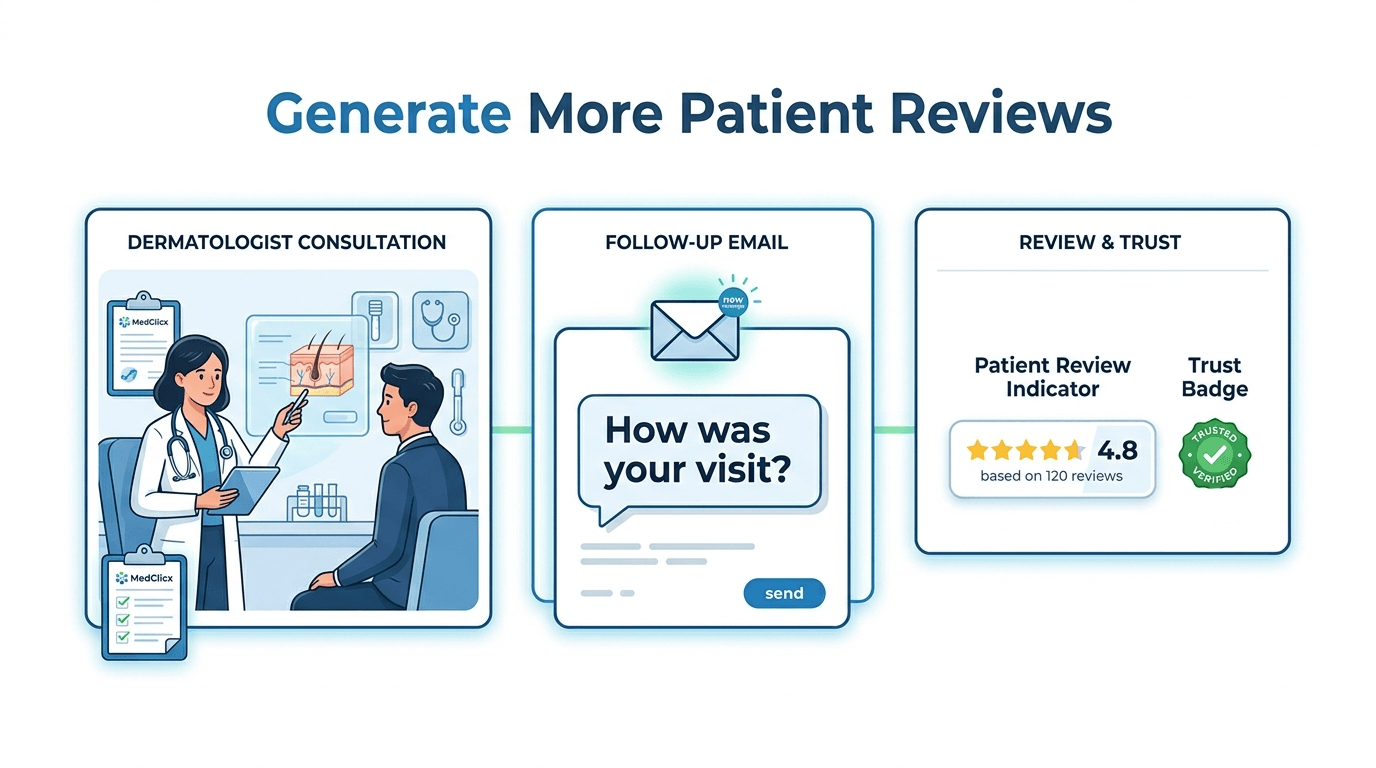
Reviews are one of the strongest trust and ranking signals in reputation management, directly influencing both visibility and patient decisions.
To improve review performance:
- Request reviews immediately after successful treatments while satisfaction is highest
- Automate follow-ups through SMS or email after appointments
- Encourage patients to mention the specific treatment they received (helps with SEO relevance)
- Respond to all reviews professionally to reinforce credibility
A consistent review generation system strengthens local SEO for dermatologists and significantly improves conversion rates in Google search results.
8. Run High-Intent Google Ads Campaigns
Google Ads remains one of the fastest ways to scale dermatology marketing because it captures patients at the exact moment they are searching for treatment.
To improve performance:
- Focus on high-intent keywords like “dermatologist near me” or “acne treatment [city]”
- Use dedicated landing pages instead of sending traffic to the homepage
- Implement call tracking to identify which campaigns drive actual appointments
- Run remarketing ads to re-engage visitors who didn’t convert initially
Well-structured dermatology PPC campaigns can consistently deliver qualified patient leads when tightly aligned with search intent.
9. Build Trust Through Social Media Marketing
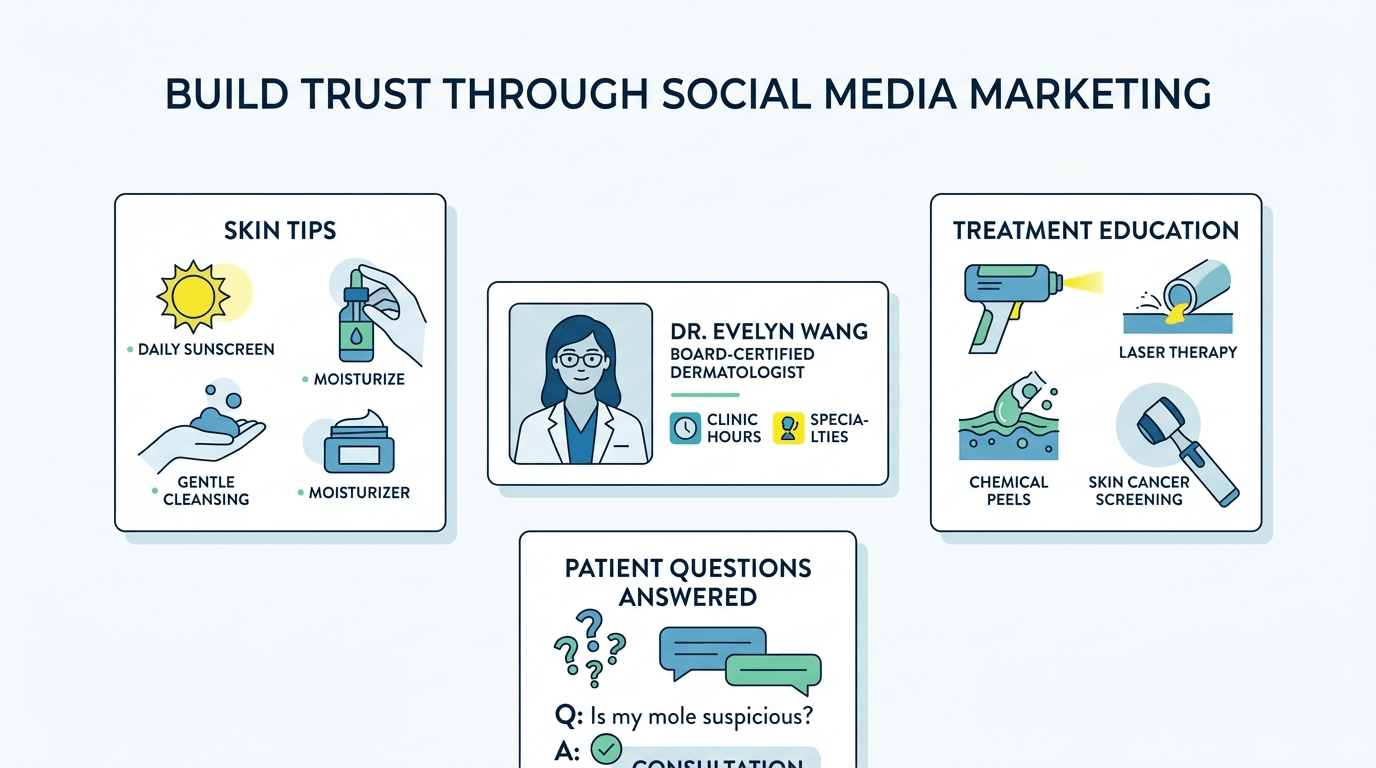
Dermatology social media plays a supporting but important role in dermatology digital marketing, mainly for trust-building and patient education.
To maximize impact:
- Share short educational posts explaining common skin conditions
- Post before-and-after results (with consent) to build credibility
- Highlight physician expertise and clinic culture to humanize the practice
- Use platforms like Instagram and TikTok for visual treatments like cosmetic dermatology
While social media may not always drive immediate bookings, it strengthens brand trust and improves overall conversion rates from other channels.
10. Use Video Marketing to Educate and Convert Patients
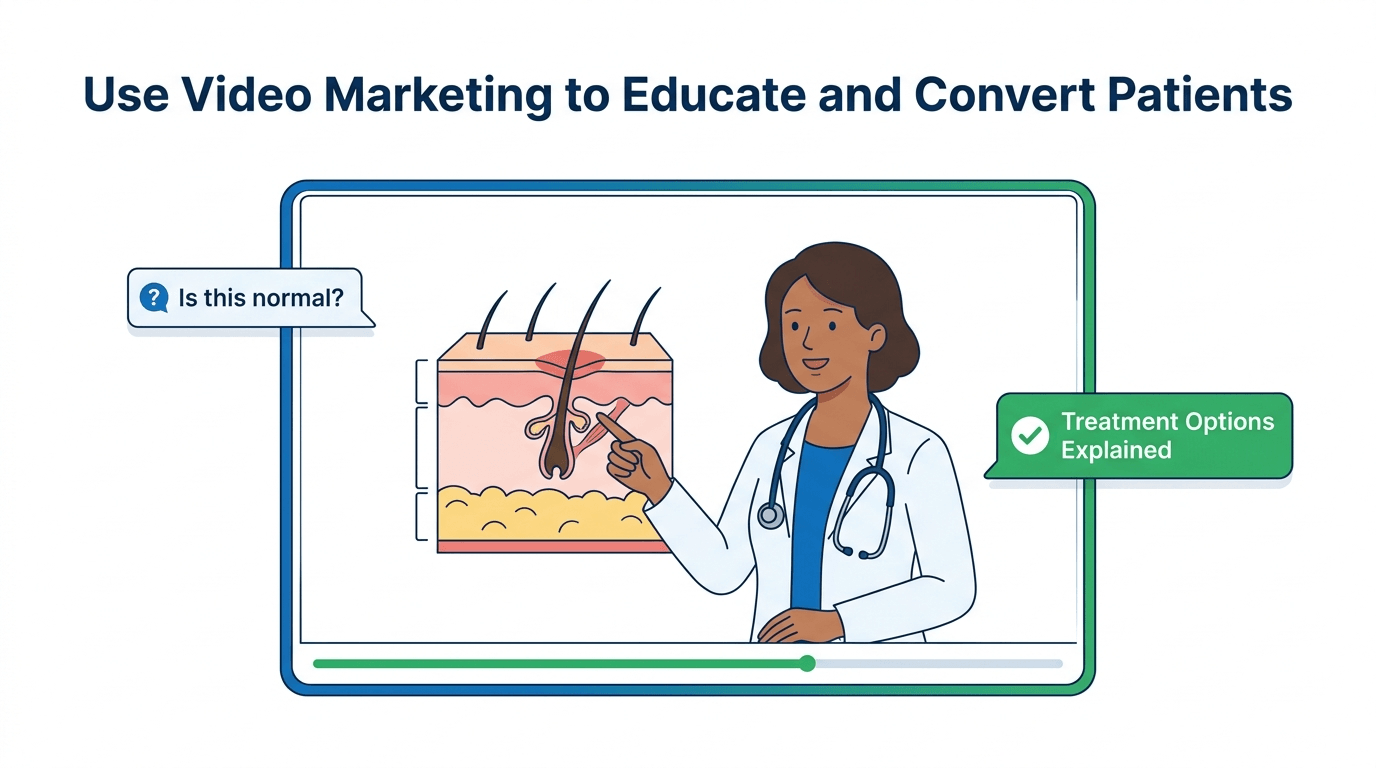
Video is one of the most effective tools in modern dermatology marketing strategies because it builds trust faster than text or images.
High-performing video content includes:
- Doctor-led explanations of common skin conditions
- Treatment walkthroughs that reduce patient anxiety
- Before-and-after case studies with patient stories
- FAQ-style videos answering common concerns
Videos can be used across your website, social media, and paid ads to increase engagement and improve conversion rates throughout your dermatology digital marketing funnel.
11. Leverage Email and SMS Marketing
Email and SMS are essential for patient retention and long-term dermatology marketing success, especially for repeat treatments like cosmetic procedures.
To use them effectively:
- Send post-visit care instructions and follow-up reminders
- Segment patients based on treatments or conditions
- Promote seasonal offers or maintenance treatments
- Re-engage inactive patients with reminders or check-ins
This creates a predictable retention system that increases lifetime patient value beyond initial acquisition.
12. Track Marketing Performance and ROI
Without tracking, even strong dermatology SEO and advertising campaigns cannot be properly optimized.
Key metrics to monitor:
- Cost per lead and cost per booked appointment
- Conversion rates from website traffic to appointments
- Call tracking data from Google Ads and organic search
- Local ranking improvements for target keywords
- Review growth and sentiment trends
Tracking these metrics allows practices to refine their dermatology marketing strategy and focus budget on channels that actually generate patients.
How to Measure the Success of Your Dermatology Marketing Strategy
Here are a few metrics that can help you analyse the success of your marketing strategy.
| Metric | What It Measures | Why It Matters in Dermatology Marketing |
| Website Traffic | Number of visitors from organic, local, and referral sources | Shows overall performance of dermatology SEO and content strategy, but must be qualified traffic |
| Local Search Rankings | Position in Google Maps and local results for target keywords | Directly impacts visibility in local SEO for dermatologists and patient discovery |
| Appointment Requests | Form submissions, calls, and bookings from website and Google Business Profile | Measures real patient intent and effectiveness of dermatology website design and funnels |
| Cost Per Lead | Cost to generate one inquiry from paid ads | Helps evaluate efficiency of dermatology PPC and advertising campaigns |
| Patient Acquisition Cost | Total marketing spend divided by new patients acquired | Core profitability metric for scaling dermatology advertising sustainably |
| Review Growth | Number, quality, and frequency of new Google reviews | Strengthens dermatology reputation management, trust, and local rankings |
Final Thoughts
A successful dermatology marketing system is not built on one tactic, it is built on integration.
Practices that consistently grow in 2026 combine:
- Strong dermatology SEO
- High-converting website design
- Paid advertising for immediate leads
- Reputation management for trust
- Content and AI search optimization for long-term visibility
When all of these elements work together, your practice doesn’t just attract traffic, it consistently converts that traffic into long-term patients and revenue growth.
FAQs
What is dermatology marketing and how does it work?
What is the best marketing strategy for dermatologists in 2026?
Local SEO
Google Business Profile optimization
Paid advertising
Strong patient reviews
High-converting website.
Practices that use multiple channels together consistently outperform those relying on just one method.
Is SEO important for dermatology practices?
How long does dermatology marketing take to show results?
How important are online reviews for a dermatology practice?
Let’s increase appointment bookings
At MedClicx, we help medical practices connect with more patients.


Senior Digital Marketing Strategist &
Healthcare SEO Consultant
James Walker is a Senior Digital Marketing Strategist and Healthcare SEO Consultant at MedClicx. He specializes in helping healthcare organizations and service-based businesses grow their online presence through SEO, content marketing, local SEO, AI search optimization, (GEO), technical SEO, website optimization, and digital marketing strategies.
Over the years, James has worked on improving organic visibility, lead generation, and brand authority by combining search engine optimization, website performance, content strategy, conversion optimization, and AI-ready content. His expertise also includes Google Business Profile optimization, schema markup, user experience (UX), analytics, and modern digital marketing best practices.
At MedClicx, James writes educational articles covering SEO, content marketing, digital marketing, AI search optimization, social media marketing, web design, advertising strategies, podcasts, and online business growth. His goal is to simplify complex marketing concepts and help businesses make data-driven decisions that generate sustainable long-term results.
- James Walker

- James Walker

- James Walker
- James Walker